Newb question

St Pauli

CGN Regular
Rating - 100%
15   0   0
Location
Durham region
Hi all new to reloading
so far three batches of 30-30, the same for 6.5x55.

so in total maybe 500 rounds tops

Just got some 270 dies and trying them. I've noticed they seem to be way harder to resize.
I'm using Lee dies for all three calibers, setting the re-size die a 1/4 to 1/3 turn in after it touches the ram as per
instructions . Using Lee case lube sparingly as per directions. The 6.5 and 30-30 are easy peasy but the 270 are hard to do and I've
about a 15% fail rate, out of 50 or so cases I've tossed out about 12. Nothing is different from what I do with the other calibers.

Bad die? Or is it me or is 270 just harder to do?
The die is brand new. I'm not crushing them but I'm getting a small dent on the shoulder.

If it is a dirty die how do I clean it? spray with brake clean then compressed air?

270 reloading on hold for now....
 
Check the 270 die set instructions and make sure that they are the same as the other die sets. I seem to recall that some of the dies are installed differently -- I don't remember which ones, but I am pretty sure that at least one of my Lee sets says to turn the sizing die down until it touches the mouth of a case in the raised ram, and then a 1/4 turn from there. I will look this up and let you know. I always check the instructions when setting the sizing die as I am sure that at least one of them is different from the "1/4 to 1/3 turn in after it touches" rule.

Make sure that you have the case holder in the ram when you set the die. You turn the die until it touches the case holder and not the bare ram.

EDIT: Seems that I am out to lunch! I looked at all of my Lee rifle die sets and they all have the "1/4 to 1/3 turn in after it touches" instruction. Only my 30 Carbine die set has a different instruction. I was sure that at least one of the rifle sets was different. In any case, make sure your shell holder is in the ram and that the die is touching the raised shell holder and not just the bare ram.

The small dent on the shoulder may be due to too much lube. The lube should just be an invisible film of lube. "The bigger the gob the better the job" does not apply here.

About every sixth case or so I put a tiny amount of lube inside the case mouth. Again, just a tiny amount. You want to lube the decapping die ever few cases.

You can still load a dented round. The dent will iron out when fired. Use your best judgement, though, as to how bad the dent is. If it's a dent with soft rounded corners, I'd use it. If it's a pinched crease with sharp corners, I would not use it and would probably toss the case.

Can you post photos of your dented cases? Use tinypic.com to host your photos.

To clean the die, I remove the decapping pin -- the Lee instructions describe how to do this -- and I rinse everything in acetone. Brake cleaner would work too. I run a clean paper towel through the thing to get any gunk out of the die body. Wipe down the decapping pin as well. If there is a pressure relief hole in the die body, make sure you clean it and that it is open. Use a toothpick or wire to make sure there is nothing clogging that hole. You do not want gunk (accumulated lube) in there -- that can lead to case denting.

Hope this helps.
 
Last edited:
MFD
Im using lube sparingly. Die is seated with the wheel holder in place as per instructions, 1/4 to 1/3 turn.
When I size the case I over cam as I've done with 6.5x55 and 30-30.
I can't post photos as cases are with my friend. He shoots 270 and wants to reload. I just cleaned and tried to size cases so when he comes over
to reload them some of the work is done already. Some of the brass had very small dings prior to sizing so that is the reason he has the brass. Might be a fault of the rifle
and or the die. He is having his rifle looked at and the brass is with the rifle to show the shop.

But non the less the brass feels way different to re-size than 6.5x55 or 30-30 so Im thinking it is an issue with both.
I tried two different lubes, RCBS (didn't like) and now I just use Lee resizing lubricant.

I will inspect the die under good light.
 
A dent means too much lube on the shoulder. Not a big deal. Load the ammo as per normal.

If the brass takes more effort, it means it is fired in a larger than average chamber rifle. Not a big deal. Just apply more arm leverage and carry on. The down stroke will be smoother if there is a little lube in the neck. If you use my lube in a jug technique, this puts a little lube on the case and a tiny dab on the mouth, which will keep the expander button lubed.

If you are sizing a few cases, the case lube technique does not matter very much. If you have a bucket or two of brass to size, there is a fast efficient way to lube the cases. I lube 100 or so cases (rifle) at a time. Takes about 30 seconds.

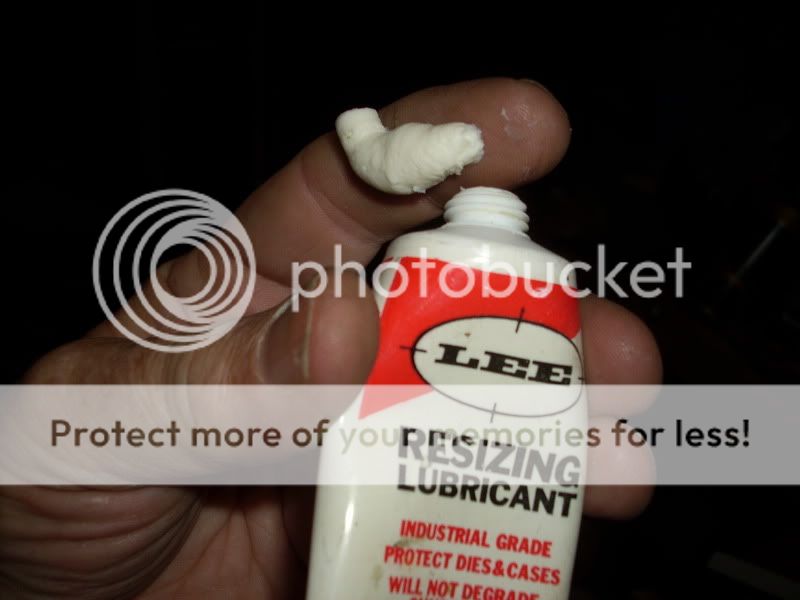
I also use Lee case lube. It is a water soluble cream that is easy to clean off.

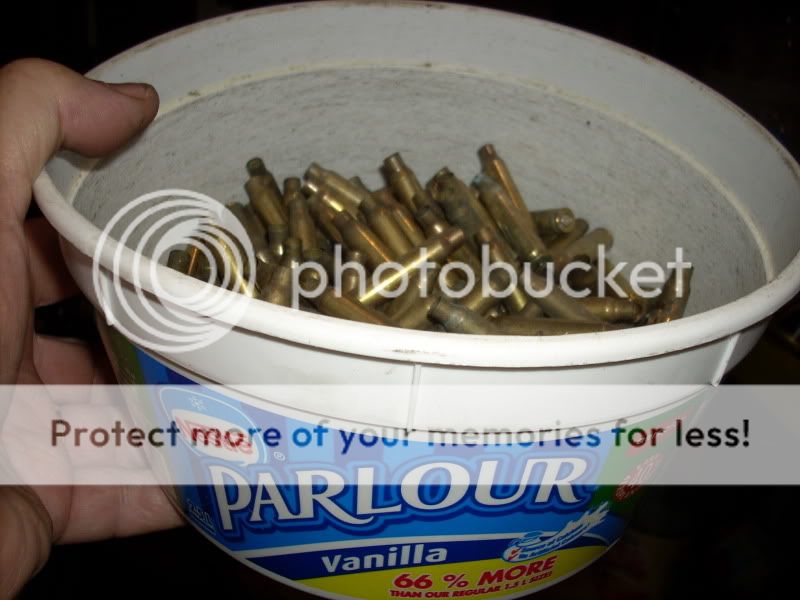
Dump brass in a plastic pail that has a lid.

lubebrass1.jpg


Then take a 1" worm of lube and smear it around the top inside wall of the pail.

lubebrass.jpg


Put lid on and swirl and shake for 15 seconds. This will lube all the cases and deposit a tiny dab on the case mouth, to lube the expander button.
 
After lubing the case you are to wipe the shoulder and neck area of excess lube. You can use a rag or your fingers to wipe off the excess.

Full length resizing squeezes any excess lube upward into the shoulder area of the die. The shoulder area is where the lube collects inside the die and causes the dented shoulders.

If you see excess lube on the shoulder area after sizing you can stick a Q-Tip inside the die and wipe the shoulder area of the die.

A home made spray lube of lanolin and alcohol works well and when the alcohol evaporates it only leaves a thin film of lanolin on the case.

Hard sizing can sometimes be fixed by polishing the die with a snug fitting shotgun cleaning mop and a drill. Apply J&B Bore paste, automotive rubbing compound etc. to the mop and polish the die.

Chambers and dies can vary in size and if you have a fat chamber and a skinny die the sizing force will increase.

Example I have a Lee .223 full length die that sizes the case diameter smaller than my small base die does. Meaning this Lee die requires more force to size the case.
 
Back
Top Bottom