Newfoundland Reg (WW1) .303

dangertree has it 100% as far as the Newfoundlanders are concerned. That is exactly what happened.

Far as the other guys are concerned, Newfoundland may not have been a Canadian Province at that time, but it WAS a self-governing Dominion under the British Crown...... NOT a mere colony. Newfoundland gained self-government in 1837. In 1914, the government of the DOMINION of Newfoundland adopted the Mark III Ross Rifle as the official rifle of the Newfoundland Contingent. As stated, the rifles arrived after the Blue Puttees had sailed, were forwarded to them in Britain..... and promptly disappeared into British ordnance stores....... just the same as happened to the (Canadian) Burgess-Dunne flying machine.

Newfoundland troops going into combat were issued initially with the SMLE Mark III rifle, later with the Mark III* as it came into production.

BTW, when Newfoundland joined Canada, it was as a result of a TREATY between TWO EQUAL self-governing Dominions. Every single article of that treaty has since been violated...... by Canada.
 
lots of colonial troops were issued older weapons
I'd say they had what they had in Newfoundland at the start of the war.
they were colonials after all.
Colonials? pffffft. :mad: Who do you think you're talking about? Rhodesia?

Newfoundland (and New Zealand) were granted Dominion status on Sept.26, 1907. :) Last year would have been our centenary. D'oh! :( Oh well, Congrats to New Zealand.

And they wonder why we're not in the Maritimes? :rolleyes:

;):D
 
Last edited:
newfoundland reverted back to colonial status in the 1930's until 1949 didn't it? wasn't it churchill who did the deal with the US for a naval base at argentia?
 
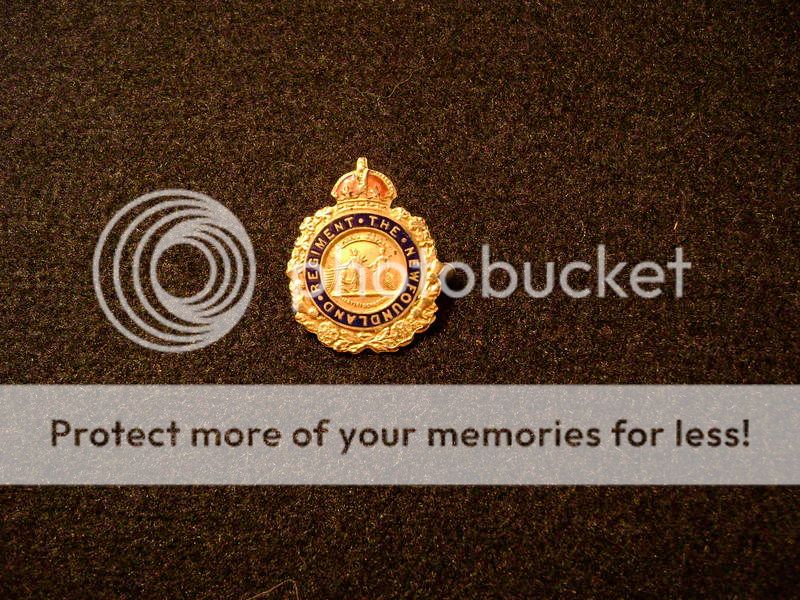
Seems to have been a shortage of cap badges as well.

They did get them though. The title of "Royal" Newfoundland regiment was bestowed on them after their many exploits during the war, particularly Beaumont-Hamel. Previous to that they were simply the Newfoundland Regiment. A friend who was aware of my interest in the war and the Newfoundland regiment found this cap badge for me in a Duckworth Street (St. John's) antique shop many years ago.

DSC00041.jpg
 
but it WAS a self-governing Dominion under the British Crown...... NOT a mere colony. Newfoundland gained self-government in 1837.

I do believe the status of Dominion wasn't even squared away until the Imperial conference of 1907 (It was subsequent to this conference in that same year that Newfounland was titled a Dominion). Dominion in the context of the British Empire, was a title to denote self-governing colonies from colonies wholey administered by the UK. Canada being the first when the British North American Colonies confederated together into a Dominion in 1967. We were still a colony.

This remained so until the Statute of Westminster of 1931 which established the Dominions as being independant states equal in all respects to the Uk.
 
newfoundland reverted back to colonial status in the 1930's until 1949 didn't it? wasn't it churchill who did the deal with the US for a naval base at argentia?

Yes,, It reverted back to pure colonial status (ie. the loss of it's legislature and it's self-governing status) in 1934 due to financial issues resulting from the Great Depression. It's excessive debt arrising from its active role in WW I made things untenable for the small colony.

It did not regain its legislature until the "Colony" joined Canada in 1949.
 
Last edited:
BTW, when Newfoundland joined Canada, it was as a result of a TREATY between TWO EQUAL self-governing Dominions. Every single article of that treaty has since been violated...... by Canada.

Not quite,, no articles have been violated in the "Terms of Union".

Not a treaty either, it was an amendment to the BNA Act and a new act called the Newfoundland Act, which was openly debated and passed as law in the British Parliament in 1949.
 
Newfoundland reverted to colonial status in the 1930s and was run by the Commission of Government. That died on March 31, 1949 and, for one minute, Newfoundland reverted to full Dominion status before joining Canada on April Fool's Day, 1949.

The Articles actually were a treaty, if you happen to read a copy. Pretty hard to find these days, but a few do exist.

And canada did violate the Articles. Whatever happened to "shared jurisdiction" over the fishery...... which Canada gave away to Russia? And whatever happened to rail passenger service??????? The Bullet has been in a museum since I was a pup.

Rifles used in training were mostly Long Lee-Enfields, with the flag safety on the cocking piece. They came off the old HMS Briton (formerly HMS Calypso), which was the Newfoundland Navy of the period. Calypso's wreckage lies in Job's Cove, Embree, about 500 yards from my old house, and her anchor sits in front of the Lewisporte Town Hall.
 
Newfoundland did not revert back to "colonial" status. Because of the unpopularity of the Prime Minister of the day and the growing financial burden brought on by the Great Depression, the Dominion of Newfoundland voluntarily accepted a Commission of Government comprised of Newfoundland & British commissioners to oversee the Dominion though the tough depression era.

BTW, Newfoundland paid of its war debt. IIRC, the only other country to do so was Finland. Negotiations for Newfoundland to joing Confederation was conducted between equals.

There is much evidence to indicate that a massive fraud was perpetuated by Joey Smallwood in order to force Newfoundland to join Canada. A previous referendum saw Newfoundlanders reject Confederation, then a year or so later, they vote to join??? Funny, Joey saw to it that the ballots & even the ballot boxes were burned the next day.

That bastard sold out our birthright and I hope he's burning in Hell as we speak. Stole the provincial treasury blind. Wasn't hard to become a millionaire when every contractor who won a government bid had to pay the "Joey" tax. The bastard even got the government to turn over hundreds of acres of prime farmland and the official Premier's country residence to him as a gift. The family is still suckling at the provinical taxpayer's teat through free government grants, loans and subsidides for their agricultural business interests.

Can't say as I blame my grandfather for cutting down every Canadian Maple in his yard back in '49. My Dad still considers himself a Newfoundlander first. Of course, watching the so-called "national" new/weather and time and again phrases like "from all across the country, from Vancouver to Halifax..." of the national weather starts at Halifax and ends at Vancouver. Happens on a regular basis, despite my and other complaints to the contrary, even today. Sure makes you feel all warm and fuzzy toward Canada, speaking from a Newfoundland perspective.
 
Does anyone know what model of Lee Enfield were used by the Newfoundland Regiment in WW1 and where they were manufactured?

No. 1 Mk. III?


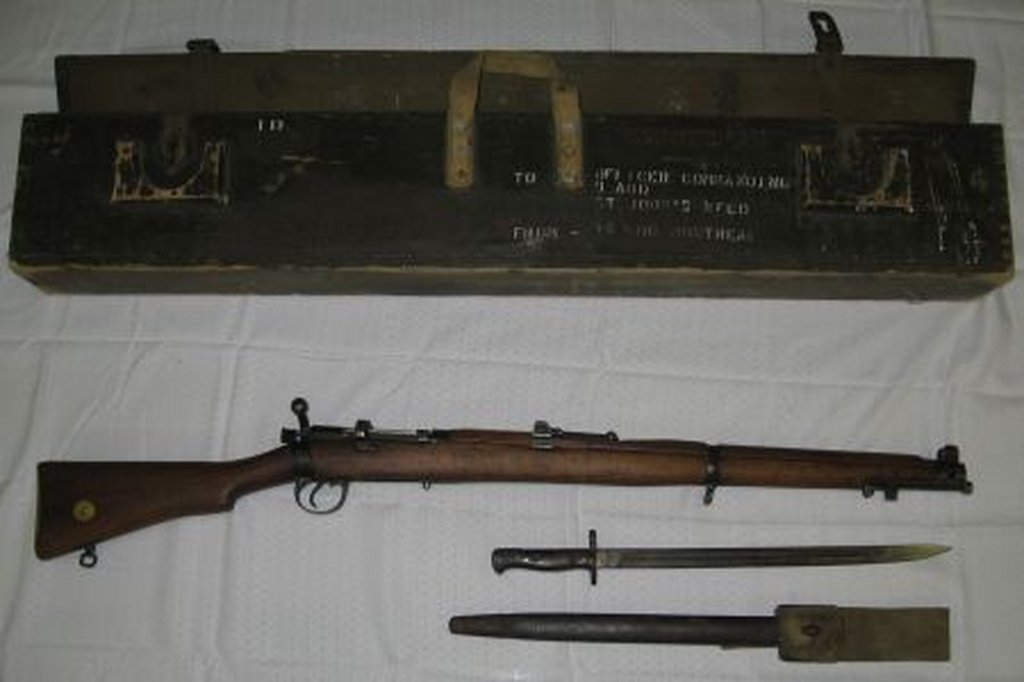
This rifle was issued to the Newfoundland Regiment in 1918. The rifle entered the Church Lad's Brigade collection when it was donated to the brigade in the wake of the fire that claimed their armoury.
(Click PIC to Enlarge)


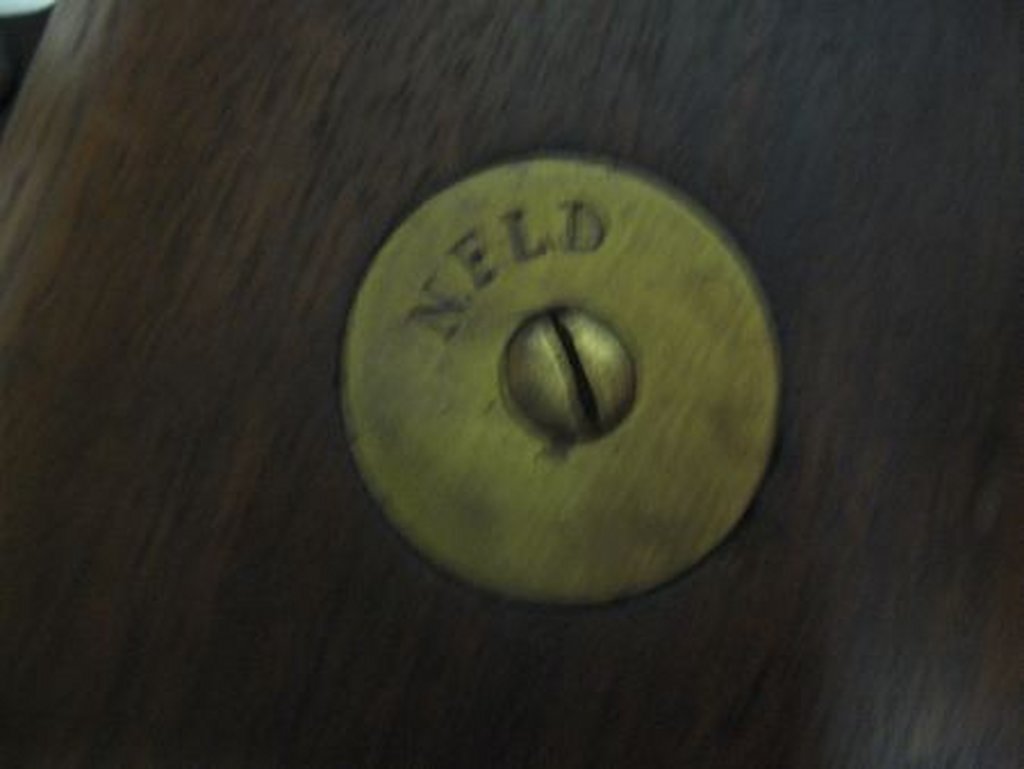
Description: This artefact is a case containing a 1918 British No. 1 MKIII Short Magazine Lee Enfield Rifle and 1917 Wilkinson Enfield bayonet. The Case is of a wooden construction that has been painted green, with metal hinges and khaki cloth handles. The front of the case contains white stencilled lettering that informs of the shipping information. It reads "TO- OFFICER COMMANDING 9 AOD ST. JOHN'S NFLD. FROM -25 COD MONTREAL." The reverse bears the same inscription. The top of the case also bears the same inscription but contains the marking I.V. A-125695. The Left end of the case shows a serial number of IL 9636, while the right end states "CASE NO 3 OF 4 T 25 CV 118. The Rifle is comprised of a blued metal barrel, action, bolt, magazine, trigger and trigger guard, and bayonet mount. The majority of the rifle is encased in a dark wood that runs the length of the weapon from muzzle to stalk. The bolt, that forms the rifles firing action, is worked by a lever that faces to the right. The lever must be rotated up before the bolt can slide back. Under the muzzle of the rifle is a flat disk over which the bayonet ring is placed. The stock is capped by a brass end that has a small circular opening covered by a brass door. Under the door is a void in which the rifle's cleaning equipment is stored. A brass disk bearing the marking "N.F.L.D.' has been screwed to the right side of the stalk. The Rifle contains the British Government markings of an arrow and a crown at numerous points on the weapon. The weapon also contains the maker's information on the trigger guard below the bolt which reads "G.R. B.S.A. co. 1918 SHT. L.E. III*." The Bayonet is single edged with a broad back edge that narrows to a thin cutting edge. The tip of the blade is curved from the cutting edge to the back edge. The blade also contains an oval depression that runs the length of the blade on both sides. Under the depression appears a crown and "G.R. 1907 II 17 Wilkinson." The blade runs through the cross guard, where two wooden hand grips have been attached by way of two screws. The end of the bayonet is formed by a cast metal piece that contains a spring loaded locking mechanism that helps keep the bayonet attached to the rifle. The scabbard has been formed from a single piece of leather that has been folded and stitched down the back, to which a metal end cap and collar have been attached.

Commentary: When war was declared by the British in 1914 and Newfoundland had offered forth its war time commitment, the island quickly set about recruiting, equipping, and training men for service in the Newfoundland Regiment. The Church Lad's Brigade armoury on Harvey Road in St. John's was established as the headquarters of the Newfoundland Regiment, and the men who made up the ranks of the regiment in 1914 all reported to the armoury to enlist. The equipment committee of the Newfoundland Patriotic Association placed an order with the Canadian Government for a number of military items, which included 500 Canadian Ross Rifles, to equip the men for overseas service. The rifles had not reached the island by 3 October 1914 when the first contingent of the Newfoundland Regiment set sail for further training in England. Upon their arrival in England the Regiment was equipped with the British No.1 MKIII .303 Small Magazine Lee Enfield, which was the standard British Army rifle. From that point to the close of the war, the Newfoundland Regiment was issued with the Enfield. The British Enfield was produced by a number of firms throughout its service in the Army between 1907 and 1944. The Birmingham Small Arms Company or B.S.A. Co. was established in 1861 at Small Heath just outside Birmingham. During the time they produced the No. 1 MK III the company manufactured nearly two million. Many regiments and organizations used the No. 1 MKIII and it was common practice to stamp regimental identification marks on the brass stock disk. The N.F.L.D. of this rifle's stock disk identifies it as a rifle of the Newfoundland Regiment prior to the official name change of the regiment in 1918. After the addition of Royal to the Newfoundland Regiment in 1918 the stock disks on Enfield's produced for the regiment read 1RNR.

OBJECT Documents 13 de 20 http://daryl.chin.gc.ca:8001/SEARCH...+AND+MUSEUM'&M=13&K=AEMZNOACCESSION06&R=Y&U=1


Regards,
Badger
 
The Articles actually were a treaty, if you happen to read a copy. Pretty hard to find these days, but a few do exist.

And canada did violate the Articles. Whatever happened to "shared jurisdiction" over the fishery...... which Canada gave away to Russia? And whatever happened to rail passenger service??????? The Bullet has been in a museum since I was a pup.

I think you are just perpetuating myths that continue to be thrown about by half-cut Newfoundlanders in the barrooms on the rock. :). Not a treaty,, It is the Newfoundland Act: An Act of the British Parliament. There is a copy on line that spell it all out.
Here is the link:
http://www.solon.org/Constitutions/Canada/English/nfa.html

The actual Terms of Union being an MOU between Canada and Newfoundland which is a Schedule to the Newfoundland Act, and nothing more.

There is no mention of "shared jurisdiction" with respect to fisheries. Same with the railway myth,, Newfoundland signed them over lock, stock and barrel to the government of canada with no strings attached.
 
Last edited:
Newfoundland did not revert back to "colonial" status. Because of the unpopularity of the Prime Minister of the day and the growing financial burden brought on by the Great Depression, the Dominion of Newfoundland voluntarily accepted a Commission of Government comprised of Newfoundland & British commissioners to oversee the Dominion though the tough depression era.

BTW, Newfoundland paid of its war debt. IIRC, the only other country to do so was Finland. Negotiations for Newfoundland to joing Confederation was conducted between equals.

There is much evidence to indicate that a massive fraud was perpetuated by Joey Smallwood in order to force Newfoundland to join Canada. A previous referendum saw Newfoundlanders reject Confederation, then a year or so later, they vote to join??? Funny, Joey saw to it that the ballots & even the ballot boxes were burned the next day.

That bastard sold out our birthright and I hope he's burning in Hell as we speak. Stole the provincial treasury blind. Wasn't hard to become a millionaire when every contractor who won a government bid had to pay the "Joey" tax. The bastard even got the government to turn over hundreds of acres of prime farmland and the official Premier's country residence to him as a gift. The family is still suckling at the provinical taxpayer's teat through free government grants, loans and subsidides for their agricultural business interests.

Can't say as I blame my grandfather for cutting down every Canadian Maple in his yard back in '49. My Dad still considers himself a Newfoundlander first. Of course, watching the so-called "national" new/weather and time and again phrases like "from all across the country, from Vancouver to Halifax..." of the national weather starts at Halifax and ends at Vancouver. Happens on a regular basis, despite my and other complaints to the contrary, even today. Sure makes you feel all warm and fuzzy toward Canada, speaking from a Newfoundland perspective.


Just to add to that, the pro-confederation people were so strongly in favor of confederation that some people voted several times, as the number of votes cast in some communities was actually larger then the population of that community, and a large number voted dispite the usually severe handicap of being DEAD. As well, a lot of people in those days were illiterate, and Smallwood made sure that he had people at every poling station to "help" these people cast their vote. I guess we know how these votes went, whether the people were for confederation or not.

The end result was that the confederation crowd won by 51%; responsible government 49%. As mentioned, Smallwood immediately had the ballots burned so there could be no recount, dispite claims of voting irregularities, and moved quickly to join Canada.

One of the main arguments for confederation was whether or not the country was wealthy enough to stand on it's own, dispite the fact that the country was in the black financially. In order to keep the population thinking that we couldn't make it financially, and had to depend on confederation with Canada, the British and Canadian governments kept secret the fact that a huge iron ore deposit had been found in Labrador until after the referendum; afraid that it would deter some people from voting for confederation.

I've always been surprised that the federal government has always told Quebecers that they could only seperate from Canada only if the vote showed an overwelming majority in favor of seperation; a win by the seperatists by only 51% or more would not be deemed adequate. As it was obviously adequate enough to get Newfoundland into confederation, so it should be adequate enough to let Quebec out. You can't make cheese of one and chalk of the other.

On a happier note, when Smallwood died, on the evening he was buried, I went out ans P*SSED on the old c*cksucker's grave. I sincerely hope the B*stard is rotting in hell.
 
Last edited:
If everything was the result of an Act of the British parliament, why did they even bother to draw up the Articles of Union, much less negotiate the articles in the first place? Sure, there is a Newfoundland Act, but it was the RESULT of the negotiation of the Articles and the understanding between the two countries. Check out the dates of the relevant documents and always read the introductions, which are, in a sense, the overriding conditions under which the documents must be interpreted, should interpretation become necessary. Thus, using out own BNA Act as an example, one of the overriding conditions is the desire for "peace, order and good government", which boils down to the legal fact that an Act which does NOT contribute to these becomes unconstitutional. Similarly, the introduction to the BNA Act specifies that Canada will have a constitution (the Act is not a constitution) "similar in principle to that of Great Britain"...... which gives us Common Law, the 1698/9 Bill of Rights, Magna Charta and so forth....... and gives us the opportunity to challenge and/or ignore legislation which trashes these vital principles.
The biggest problem is that Canadians do no know or understand the basics of law, and so are snowed by lawyers and crooked politicians. The basis of our legal system is a local, tribal law which was simple enough that every man understood it; we have allowed this to become corrupted and surpassed by statute law which violates the basic principles of decency and of the Common Law itself. Read Blackstone: the statute law may only ENLARGE the rights of men under the Common Law: it may not restrict them.
You think things get interesting here? When you start considering firearms law and tax law, it gets even better, hence my books.
 
should be 1688/9 Bill of Rights.

Most Canadians do not even know of the existence of the "Canadian Bill of Rights, 1960".

Get it, read it, understand it. It confirms property rights and is your watchdog over the powers of parliament, which is why Parliament simply ignores it. It is still in force, but you have to want to use it in order to get any use from it. It is FAR better than the very-flawed "Charter of Rights and Freedoms", which is the best that that statist &^%$* Trudeau would allow us, most graciously, to have.

The tools exist; you have to use them to get the job done.
 
Back
Top Bottom