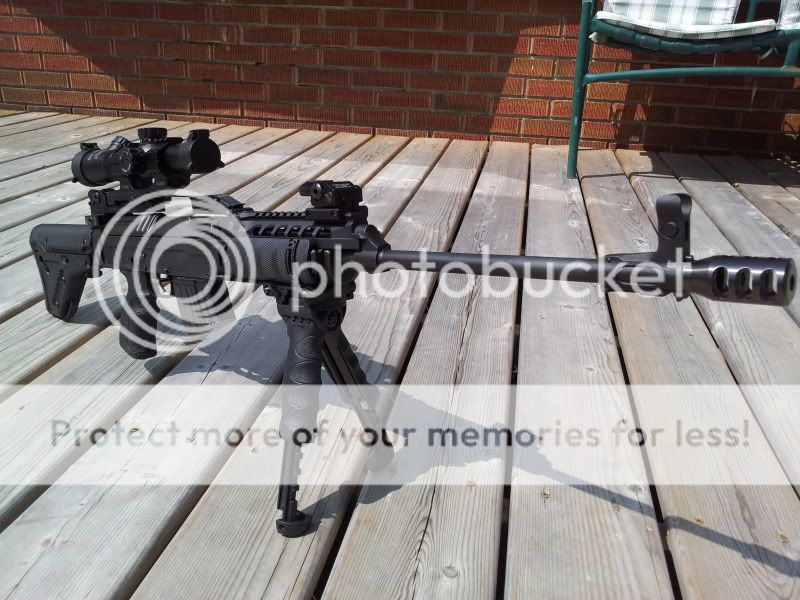
Here is an interesting read that I found when researching this a bit:
"Metal Treatments: Ferritic Nitrocarburizing/Melonite/Tenifer
In the last few posts, we looked into metal treatments like plating, parkerizing and bluing. In this post, we will study a newer form of metal treatment that has rapidly gained popularity in the firearms industry since the 80s. This metal treatment process is called Ferritic Nitrocarburizing, but there are several variants of this. The most popular variants are known by their trademarked names of Tenifer and Melonite and the main difference between these two are the chemicals used during the process. Both these trademarks, along with Tufftride, are owned by the same company, Degussa of Germany. The Degussa website explains that Tenifer and Tufftride are actually the same process and the only reason for the different names is because they couldn't get the trademark Tenifer registered in all countries and therefore use Tufftride in the countries where they couldn't get the name Tenifer registered.
To understand this method, we must first understand a few basic properties of iron and steel. Some materials, such as iron and steel, can exist with different crystalline structures. These different crystalline structures cause the same material to have different physical properties (e.g. different hardness, elasticity etc.). These different crystal structures are called "phases". Examples of such phases are: ferritic phase, austenitic phase, martensitic phase, ledeburite phase, pearlite phase etc. Both iron and steel can be switched from one phase to another by heating to different temperatures and adding other elements and cooling at different rates to change the crystalline structure of the product. The diagram below illustrates the temperatures and carbon content % that cause steel to change from one phase to another.
The basic concept behind the Ferritic Nitrocarburizing method is to introduce nitrogen and carbon to the steel when its crystal structure is still in the Ferritic phase. The temperature when this is done ranges from between 525-650 degrees centigrade. The first Ferritic Nitrocarburizing treatment process was invented by UK chemical giant, Imperial Chemical Laboratories (ICL), who came up with a process of dropping the workpiece in a sulfur salt bath at 550 degrees centigrade. This process was called Sulfinuz treatment because of the sulfur salt content. It was mainly used for cutting tools and high speed spindle parts, but it had problems with cleaning the solution off.
Degussa of Germany came up with a more environment friendly salt-bath process, which they called Tenifer in most of Europe and Tufftride in England and Asia. They later improved on this by inventing an ion nitriding process in the early 1980s. The ion nitriding process was faster and more precise to control. As far as the firearms industry is concerned though, the processes used for metal treatment use the salt-bath. Tenifer and Melonite use the same process, but slightly different chemicals and temperatures. Melonite treatment is known to be the simpler of the processes. The process starts by creating a salt bath of alkali cyanate in a steel vessel. The steel vessel has a pipe that creates bubbles and aerates the salt bath. The workpiece is introduced into the bath and the cyanate reacts with the workpiece to form an alkali carbonate. The bath is then treated with a regenerator chemical to convert the carbonate back to a cyanate. This causes two layers to form on the surface: the compound layer and the diffusion layer. The compound layer has iron, nitrogen and oxygen and is resistant to abrasion and wear. The diffusion layer has nitrides and carbides and provides extra hardness. The end result is a corrosion resistant finish that is extremely hard and corrosion resistant.
The Tenifer process was traditionally used in the German automotive industry for years, by manufacturers such as BMW and Mercedes. Glock GmBH, which was then an unknown Austrian manufacturer, was the first to use it in the firearms industry in the 1980s. All Glock pistols come with Tenifer treatment and it became well known to the firearms industry because of their success. It is now used by other manufacturers as well, such as Steyr, Walther, Heckler & Koch etc. It is renowned for its hardness and toughness. Tenifer has a dull-gray color and has a hardness of 69 HRC on the Rockwell scale, which is very hard, considering that diamond has a hardness of 70 HRC. Tenifer is also extremely corrosion resistant and is at least 85% more corrosion resistant that hard chrome plating and almost completely salt-water resistant as well. It also has excellent anti-friction properties. Glock generally applies a tenifer coat of 0.5 mm thickness to the slides and barrels of their pistols. The slides are further subject to parkerizing treatment on top of that. So, even if the parkerized finish were to wear off, the slide is still protected by the Tenifer layer.
Tenifer's properties have reached semi-legendary status. There are lots of videos and articles available on the Internet showing how hard and tough it is. People have subject their Glocks to ocean immersion for months and sharpened their knives with glocks, all without any effect on the finish!
While tenifer treatment is a very excellent process of metal treatment, it has one legal disadvantage -- it cannot be done in the United States, due to environmental laws regulating the use of certain cyanide salt chemicals and the amount of byproduct cyanide generated by the process allegedly exceed EPA limits. The original process as done in Europe uses 60% Sodium Cyanide and Cyanate and 40% Potassium Cyanide and Cyanate.
Hence, American companies such as Smith and Wesson or Springfield Arsenal use the Melonite treatment process instead, which is also a ferric nitrocarburizing process, but uses different salts and a slightly modified process to produce the same results. Melonite can be used on such steel grades as 416 stainless and 4140. However, it has the disadvantage of actually removing some of the properties of 416 stainless steel. The melonite process also produces a black finish instead of the gray color of Tenifer.
Ferritic Nitrocarburizing treatments produce some of the most corrosion resistant and hardest metal treatments in existence. After Glock pioneered their use in the industry, traditional firearms manufacturers are slowly beginning to adopt this technology to their products.[/I]"















































 I'm glad that my 858 was done with