













































You are using an out of date browser. It may not display this or other websites correctly.
You should upgrade or use an alternative browser.
You should upgrade or use an alternative browser.
Old Charles Osborne shotguns?
- Thread starter kagia
- Start date
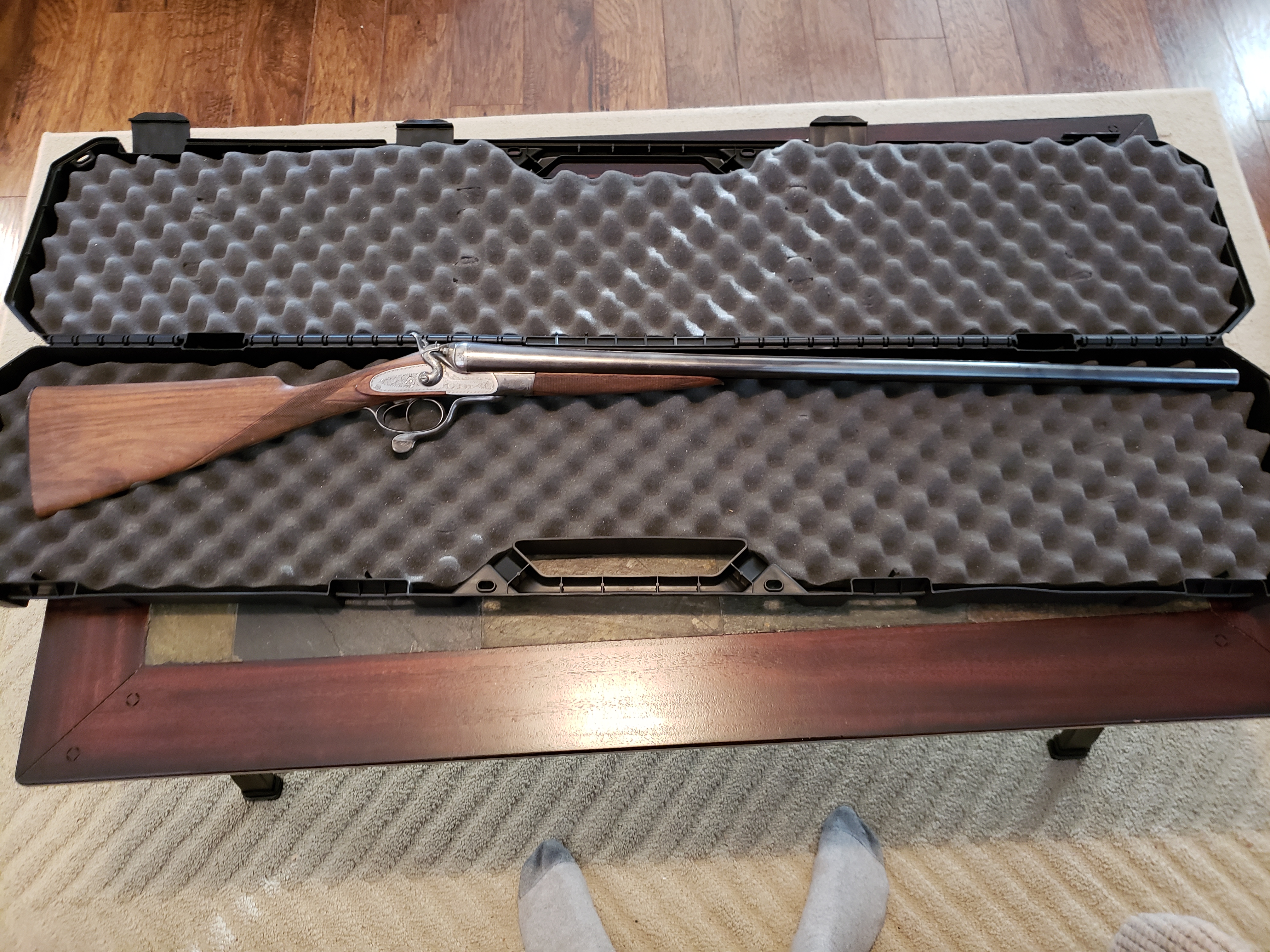
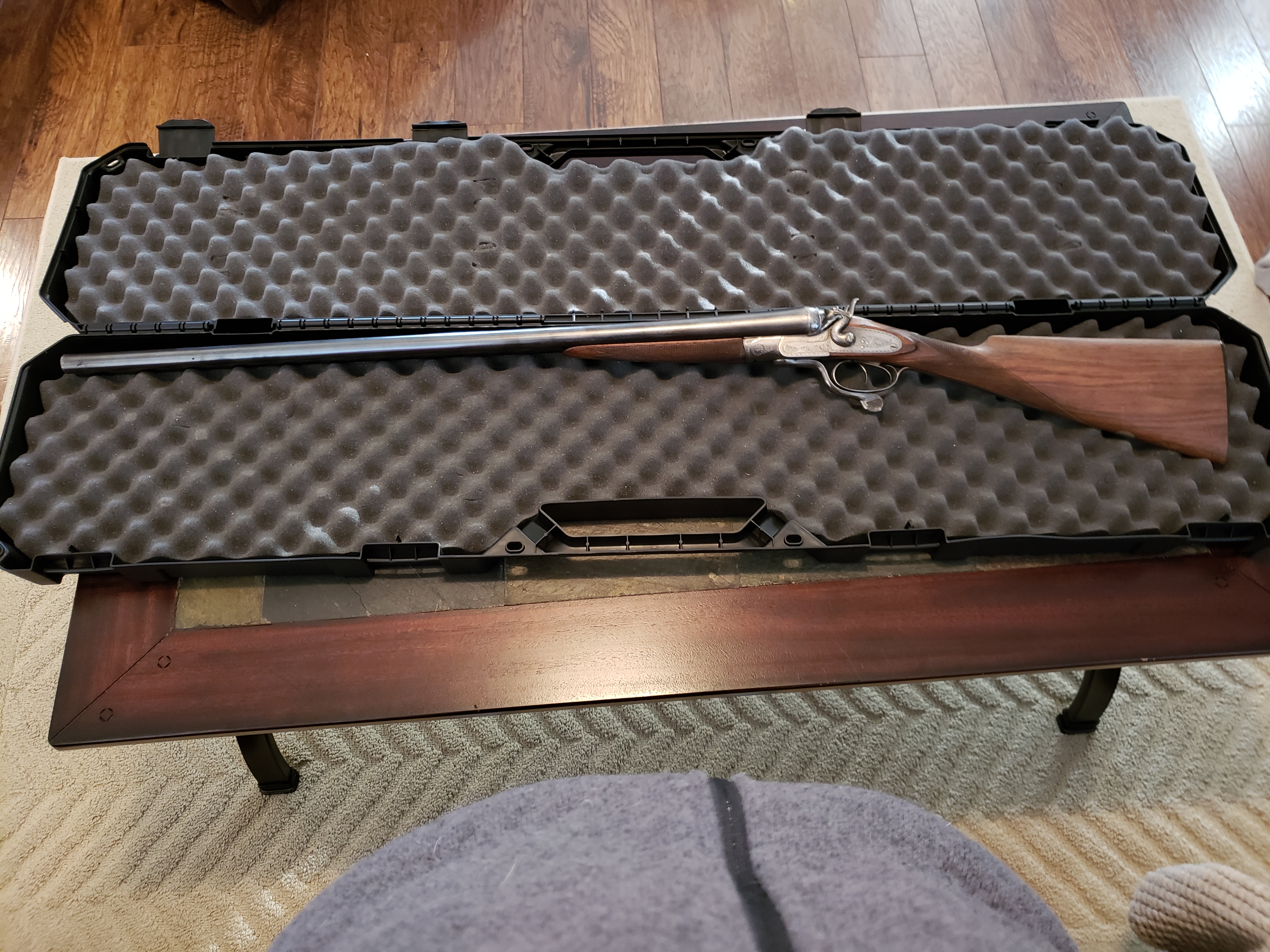

Perhaps a little more information might be in order. Barrel length and condition, proof marks and is it in proof? Current bore diameter, chamber lengths, chokes, LOP....all the usual stuff. Looks like it may be a Jones Underlever. Good pics of the proofs and any aspect of the gun that doesn't seem quite right as well as some close ups on the engraving to judge quality.
Charles Osborn was a well known Birmingham maker. And produced fine enough guns but the value of his name is similar to the vast majority of English makers. Nothing special.
Charles Osborn was a well known Birmingham maker. And produced fine enough guns but the value of his name is similar to the vast majority of English makers. Nothing special.
gunsaholic
CGN Ultra frequent flyer
- Location
- Winnipeg, Manitoba
Well, I had a Charles Osborne box lock. It was nitro proofed and had nice bores and locked up tight. The wood needed refinishing but the gun was ready to use as it was. I had a hell of a time getting $500.00 for it.
Perhaps a little more information might be in order. Barrel length and condition, proof marks and is it in proof? Current bore diameter, chamber lengths, chokes, LOP....all the usual stuff. Looks like it may be a Jones Underlever. Good pics of the proofs and any aspect of the gun that doesn't seem quite right as well as some close ups on the engraving to judge quality.
Charles Osborn was a well known Birmingham maker. And produced fine enough guns but the value of his name is similar to the vast majority of English makers. Nothing special.
I'll grab more pics and try to get more info tonight.
I haven't measured the bore diameters, but it is a 12g full chokes on both barrels, British nitro proofed, 2 3/4" chambers and good for smokeless powder. If I had to guess, I'd say 30" barrel, but I will check later.
Lockup is rock solid, bores are great, hasn't been refinished or reblued. It is missing one firing pin and has a cracked butt plate.
Also, pardon my ignorance, but what does "in proof" mean?

That gun has certainly been refinished, possible even restocked. Barrels are highly likely to be Damascus, but the figure has been covered up by the blue job. Rough guess would be 1890's manufacture. The chambers are probably 2 1/2", if they haven't been lengthened at some point. Jones underlever action, and it looks like the action may have been polished, but it's hard to say for sure without close up pics.
That gun has certainly been refinished, possible even restocked. Barrels are highly likely to be Damascus, but the figure has been covered up by the blue job. Rough guess would be 1890's manufacture. The chambers are probably 2 1/2", if they haven't been lengthened at some point. Jones underlever action, and it looks like the action may have been polished, but it's hard to say for sure without close up pics.
It is definitely not Damascus, and I really do not think it's been refinished, but I'm no expert. I was told that the markings date the gun between 1908 and 1925.
Receiver hasn't been polished, but the case hardening does look to have mostly worn off.
"In proof" means that within tolerances, the critical meaurements of the barrels....bore diameter and chamber length are as they were when the gun was proofed. Having the chambers lenghtend will put it out of proof and reduce value. Having the bores honed enough to be more than .010 bigger than the proof diameter will put it out of proof and reduce value.
Would be surprising to me if it hasn't been restocked, if they aren't Damascus and if it wasn't built before 1900. Not a whole of of Jones underlevers after that, never mind hammer guns.
Would be surprising to me if it hasn't been restocked, if they aren't Damascus and if it wasn't built before 1900. Not a whole of of Jones underlevers after that, never mind hammer guns.
gunsaholic
CGN Ultra frequent flyer
- Location
- Winnipeg, Manitoba
Yes, my first impression when looking at the pics was that it has at least been refinished as the finish is not correct for the age of the gun. As a rule, if the case coloring has worn off the metal parts from age and use, there is no way the wood is going to look new. I would guess at it being closer to 1880ish time period and I'd also be surprised if it was not Damascus barrels possibly covered up by a re-blue. Or the barrels maybe replaced. It would be nice to see clear, close up pics, particularly of the barrel flats.
Charles Osborne was in business 1838 - 1955 and they were prolific makers of mainly low to medium grade guns. As well as guns under their own name they also produced many thousands for other 'makers' large and small. Their records have been lost however some dated guns give partial age indications, #65041 was made in 1912, if your serial number is lower your gun is older..
As noted the Jones underlever action was pretty much obsolete by 1900 although occasionally produced in the lowest grades for a few more decades. Hammer guns from the early 1870's normally had the cross pin type forend attachment, this gun would be newer than that. Without seeing the proof marks my best guess would be 1890-1910.
This would be a lower (standard) grade gun for the time and I agree, most certainly refurbished fairly recently, probably in North America. If made prior to about 1896 it would most likely be damascus (laminated) barrels but evidence of this would no longer show as the barrels are now blued. They could be nitro proofed, especially if made after 1900 but original 1 1/4 oz proofs ( 2 3/4") are unlikely. The action would have originally had strong case colours, now it appears to be all bright. Case colours wear slowly and unevenly, lingering in corners and more protected areas. This gun appears to have the colours all polished off. The stock is perfectly smooth with crisp checkering except for a few chipped diamonds with no noticeable dents or marks which would normally show on a 100+ year old gun. The stock colour is incorrect for an English gun of this period. The stock looks a little plump, could be a restock.
With a few good clear pictures of the proof marks on the barrel flats and barrel tubes and the name and address inscription on the top rib I can date it within 10 years, maybe closer.
As noted the Jones underlever action was pretty much obsolete by 1900 although occasionally produced in the lowest grades for a few more decades. Hammer guns from the early 1870's normally had the cross pin type forend attachment, this gun would be newer than that. Without seeing the proof marks my best guess would be 1890-1910.
This would be a lower (standard) grade gun for the time and I agree, most certainly refurbished fairly recently, probably in North America. If made prior to about 1896 it would most likely be damascus (laminated) barrels but evidence of this would no longer show as the barrels are now blued. They could be nitro proofed, especially if made after 1900 but original 1 1/4 oz proofs ( 2 3/4") are unlikely. The action would have originally had strong case colours, now it appears to be all bright. Case colours wear slowly and unevenly, lingering in corners and more protected areas. This gun appears to have the colours all polished off. The stock is perfectly smooth with crisp checkering except for a few chipped diamonds with no noticeable dents or marks which would normally show on a 100+ year old gun. The stock colour is incorrect for an English gun of this period. The stock looks a little plump, could be a restock.
With a few good clear pictures of the proof marks on the barrel flats and barrel tubes and the name and address inscription on the top rib I can date it within 10 years, maybe closer.


.
My first impression from the picture was that the gun had been refinished.
The chamber length would be in question. The British made from 2 in to 2 1/2 inch guns for the period you say the gun was made. .... The 2 3/4 inch shotgun shell did not come until about the 1930s, and you still find earlier made Browning Auto Five shotguns, for example, with 2 9/16 inch chambers.
My first impression from the picture was that the gun had been refinished.
The chamber length would be in question. The British made from 2 in to 2 1/2 inch guns for the period you say the gun was made. .... The 2 3/4 inch shotgun shell did not come until about the 1930s, and you still find earlier made Browning Auto Five shotguns, for example, with 2 9/16 inch chambers.
photos of the proof marks on the action flats and barrels will help us tell you more.
I also believe the gun to be restocked, and metal refinished. The restocking looks competent but in plain vanilla wood. The action looks well fitted and finished, so better than your basic Birmingham gun.
Close examination of the engraving will tell how much the action was polished in removing case colours. The gun appears to be engraved more than an entry level Birmingham hammer gun, but the photos are not clear enough to say more..
The Jones underlever was obsolete by the turn of the 20th Century, so I doubt this gun was made as late as you were told. 2 3/4 and 3 inch 12 bore guns were made in the 1880s but were usually heavy wildfowling or Pigeon guns.
I do not think that value is high but I do think this would be a really nice gun to hunt with.
Detailed examination of bore diameters and chambering is in order before shooting this gun.
As to value, it is worth what it will bring - perhaps $900 to $1000 on a good day, from someone who wants to shoot it. The restocking was likely a labour of love, costing more than the value of the gun.
I also believe the gun to be restocked, and metal refinished. The restocking looks competent but in plain vanilla wood. The action looks well fitted and finished, so better than your basic Birmingham gun.
Close examination of the engraving will tell how much the action was polished in removing case colours. The gun appears to be engraved more than an entry level Birmingham hammer gun, but the photos are not clear enough to say more..
The Jones underlever was obsolete by the turn of the 20th Century, so I doubt this gun was made as late as you were told. 2 3/4 and 3 inch 12 bore guns were made in the 1880s but were usually heavy wildfowling or Pigeon guns.
I do not think that value is high but I do think this would be a really nice gun to hunt with.
Detailed examination of bore diameters and chambering is in order before shooting this gun.
As to value, it is worth what it will bring - perhaps $900 to $1000 on a good day, from someone who wants to shoot it. The restocking was likely a labour of love, costing more than the value of the gun.
gunsaholic
CGN Ultra frequent flyer
- Location
- Winnipeg, Manitoba
I'm thinking saskbooknut is on the money in the gun assessment but I have a suspicion his valuation may be a bit high. VERY specialized (read 'small") market for a gun like this.
I kind of agree that $1000.00 is a bit optimistic for Canada. But one could always get lucky if/when selling.
OK, so on a good day, with the wind at your back.
A Jones Underlever Jeffery heavy wildfowl hammer gun was recently on Gunnutz - less well fitted, less engraving and considerably more worn, was priced just over the $600 mark as I recall. I have shot the Jeffery with BP cartridges, thanks to the kindness of the owner.
Much lesser original quality gun in fair to good only condition; the gun did not sell when offered.
While not a really high end gun, this Osborne gun would be an attractive shooter, assuming the bores, wall thickness and chambers check out well.
As posted above, there is a small pool of buyers in Canada for modest English guns, and maybe even smaller pool for restocked hammer guns.
A Jones Underlever Jeffery heavy wildfowl hammer gun was recently on Gunnutz - less well fitted, less engraving and considerably more worn, was priced just over the $600 mark as I recall. I have shot the Jeffery with BP cartridges, thanks to the kindness of the owner.
Much lesser original quality gun in fair to good only condition; the gun did not sell when offered.
While not a really high end gun, this Osborne gun would be an attractive shooter, assuming the bores, wall thickness and chambers check out well.
As posted above, there is a small pool of buyers in Canada for modest English guns, and maybe even smaller pool for restocked hammer guns.
I agree with saskbooknut, canvasback and gunsaholic, a nicely refurbished gun that if the baarels check out would make a great user for someone who wants a nice shooter hammer gun. At competent gunsmith rates this gun would be badly upside down, higher expense than the finished value. Miles above another Belgian clunker or a number of other cheap european "settlers " guns, this gun was made to provide unwavering service for decades and will continue to do so long after we're all gone. Unfortunately there is so little interest in these fine guns that the value in Canada remains very low. A gun like this, as noted, would have a very hard time fetching $1000 here unless it was originally nitro proofed for 2 3/4" chambers. Worth much more in Britain. Buffdog, as cartridge guns evolved in the 1850's - 1880's the chamber dimensions went from no standard length through the standard 2 1/2" game gun and numerous guns were made with 2 3/4" and 3" chambers for heavier shot loads as wildfowl, pigeon and trap guns. The nominal 2 1/2", 1 1/8 oz load became the norm for game guns by about 1870 but many guns from the 1870's through 1900 have non standard length chambers ( between 2 1/4" and 2 5/8" ) when measured, with no indication of this on the gun. They just weren't too interested in minor variations.
I'll grab more pics and try to get more info tonight.
I haven't measured the bore diameters, but it is a 12g full chokes on both barrels, British nitro proofed, 2 3/4" chambers and good for smokeless powder. If I had to guess, I'd say 30" barrel, but I will check later.
Lockup is rock solid, bores are great, hasn't been refinished or reblued. It is missing one firing pin and has a cracked butt plate.
Also, pardon my ignorance, but what does "in proof" mean?
I forgot to ask. Are you saying 2 3/4” chambers because you measured them or because that’s what the proofs say?






















