















































Thanks for the kind comments on my earlier post on Parker, Field & Sons. I am encouraged to keep posting in this sub-forum.
The world of black-powder guns encompasses quite a few interesting designs and inventions, whose origins are murky at best. As the current thread on the Hopkins and Allen revolver rifle shows, there is often very little published information. I have learned that researching and writing a book on guns and gunmaking is no small task, and it takes up a big chunk of one’s lifetime!
A question that interests me is from where all the features and designs on modern guns come from? At the junction between muzzle-loading and the modern cartridge is the pin-fire system, all but forgotten now. At the time, these were the finest and most cutting-edge guns in the world. So many of the mechanisms, construction features, and decorative and functional designs that we find on a double gun today appeared first on pin-fires.
At the Great Exhibition in London in 1851 an example of Casimir Lefaucheux’s pin-fire shotgun was on display. The British shooting press didn’t make any notable mention of Lefaucheux’s gun prior to the Great Exhibition, despite the pin-fire being in use in France since the 1830s. Perhaps it was believed the British sportsman would stick to the muzzle-loader, and leave the “crutch-gun” to foreigners. With the benefit of hindsight, it is easy to differentiate a curiosity from a real developmental step, but it was clearly not obvious back then.
British gunmakers could have just copied Lefaucheux’s pin-fire, much as the earlier generation of makers copied the French flintlock. The pin-fire gun was, after all, a design in working use and not just a prototype. A straightforward copy with recognizable names on the lock plates might have been reassuring enough for at least some sportsmen to try the new system. The invention was not patented in Britain, leaving the door open to anyone to copy the gun and the cartridge system. That this didn’t happen is an indication of the tremendous reluctance that existed towards this invention. Trusted names spoke ill of the French breech-loader, which seems to have deterred even the slightly curious. Who would want to try a gun boldly proclaimed by the experts to be unsafe? The muzzle-loader was also at its highest level of refinement, with quick-firing locks, strong barrels and quality craftsmanship. There would have to be a change to the design to make it palatable to the shooting community.
Giving a British character to the Continental pinfire was indeed the first step towards its acceptance. Not just a respected name, but a design make-over was needed. This is what Joseph Lang accomplished, by having a wooden fore-end instead of an iron one, substituting a discrete lever to release the barrels instead of the long Lefaucheux lever, limiting decoration to tasteful acanthus-leaf engraving and fine chequering, and, most importantly, sticking to the lines, proportions and dimensions of the British double-barrelled muzzle-loader.
The version first offered by Lang around 1853 was built by Edwin Charles Hodges, who convinced Lang to market it. Hodges subsequently became the most sought-after actioner of early breech-loaders, and his work was used by the top makers. This is not surprising, as hardly any at the time knew how to accomplish this task well. The Lang gun has the forward-underlever engaging with a single notch or bite on the barrel lump, relatively close to the hinge pin. This proved adequate but less robust than the later double-bite fastening mechanisms. The original Lefaucheux patent of 28 January 1833 clearly shows a double-bite fastener, and the addendum to the patent dated 13 March 1833 shows the typical double-bite fastening mechanism found on all Lefaucheux-type sporting guns. The Lefaucheux gun of the Great Exhibition illustrated in The London Illustrated News of July 1851 appears to have had this typical double-bite mechanism, so it is anyone’s guess as to why this engineering feature was not copied by Hodges and Lang. Perhaps they surmised that a single bite was sufficient to the task. It was nevertheless a good working design, as guns with this mechanism have survived hard use, and single-bite guns were made by many noted makers well into the 1860s, even after the British double-bite fastener (the Henry Jones double screw grip) came into widespread acceptance.
The earliest builders of British breech-loaders, from contemporary accounts, were Joseph Lang, John Blanch, and Edward Michael Reilly. Lang put his first pin-fire on the market in 1853 or so. Blanch built his first in 1856, and Reilly was already making them by that time. James Purdey's first pin-fire was built in 1858, and Boss & Co., under Stephen Grant, started producing pinfires in 1859 and sold 15 in that year. Before 1860, a small number of makers made a small number of breech-loading sporting guns for a shooting public that mostly already owned fine muzzle-loaders – it didn't help that sporting guns were built to last.
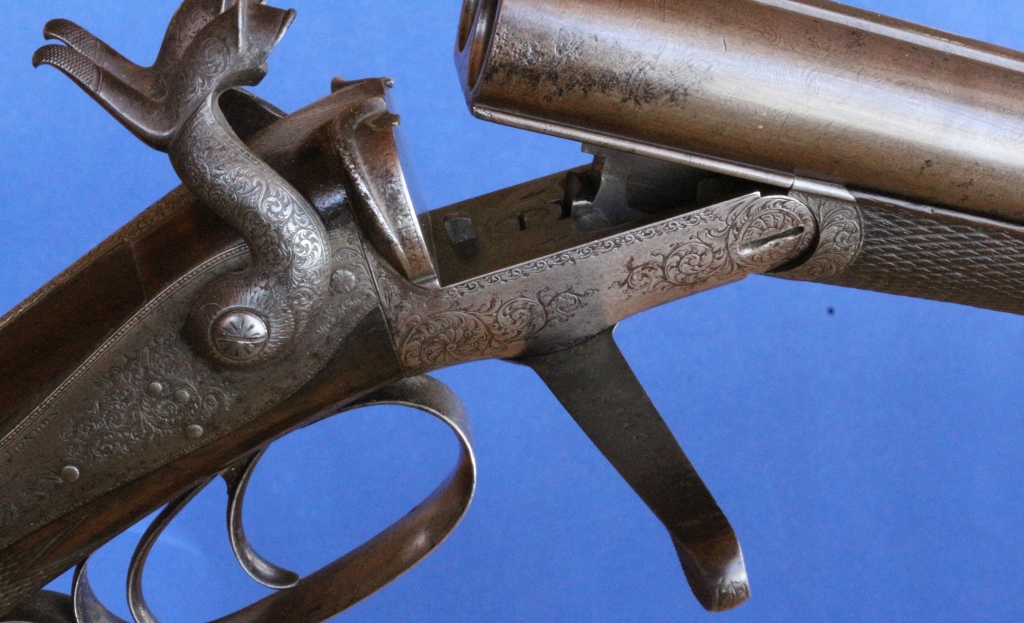
On to today’s gun. Not far from Parker, Field & Sons on High Holborn Street in London was the establishment of John Blissett, across from Gray’s Inn (where lawyers have been trained for over 600 years). John Mills wrote in The Sportsman’s Library in 1846: “...John Blissett of High Holborn... a better judge of what should be, from the nose of the barrel to the heel plate, I do not think exists.” Blissett, who started his business in 1833, was another of the first London makers to offer pin-fire breech-loaders on Lang’s pattern in the 1850s. On Lang’s design is a stud rising from the action bar when the lever is swung, to assist with opening the barrels. This feature is copied from the Parisian gunmaker Beatus Beringer, another inventor quick to perfect Lefaucheux’s system (it was Beringer who first reversed the lever and wrapped it around the trigger guard, in the configuration usually associated with the ‘Jones underlever’).
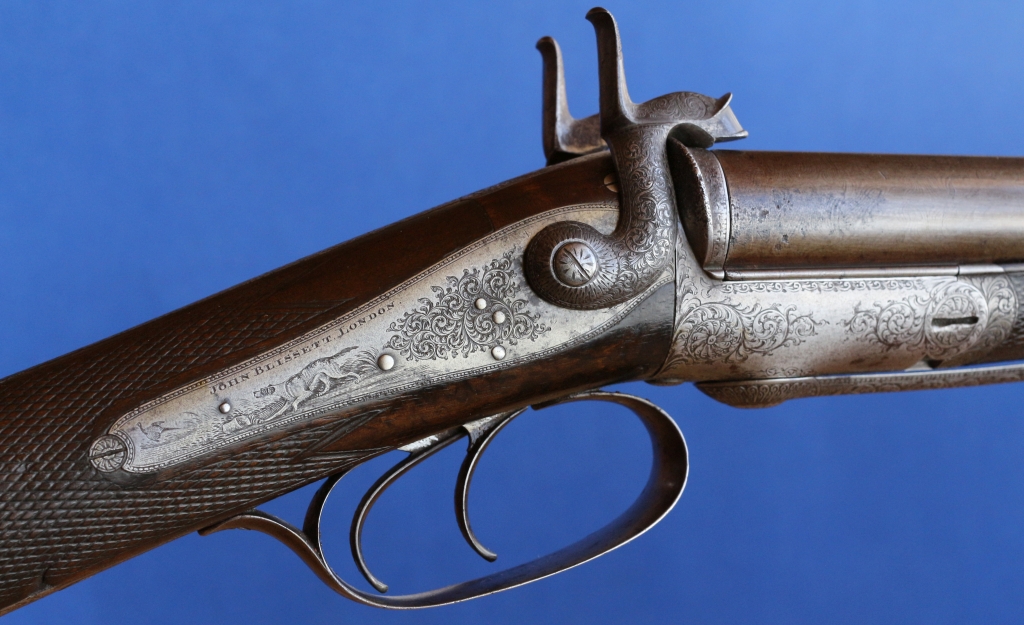
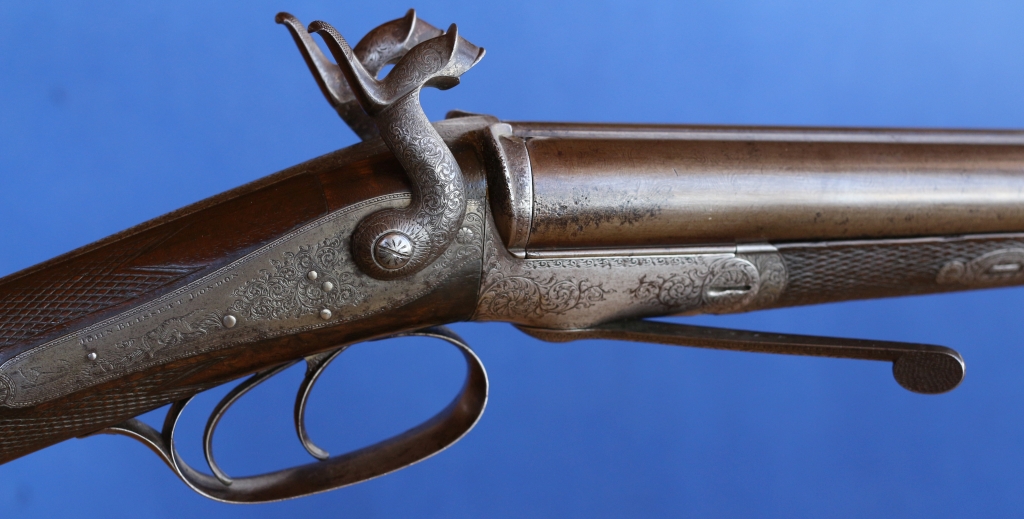
This gun is an excellent example of pre-1860 early breech-loading design. It is a 16-bore forward-underlever pin-fire game gun number 3742. It is a single-bite forward-underlever action with the assisted-opening stud, and the action is signed by E. C. Hodges. The 29 7/8” damascus barrels are signed “John Blissett, 322 High Holborn, London,” the thin fences are typical of a pre-1860 gun, and the hammers have prominent stylized cap guards, a carry-over from percussion guns. The back-action locks are signed “John Blissett London” and have foliate scroll engraving, with dog and game scenes. The stock escutcheon is gold instead of the usual silver, suggesting this was Blissett’s ‘best’ offering, now showing its many years of wear and use.
Prior to 1860, there were probably no more than 300 breech-loading shotguns of any type in all of Britain, so any early gun is a good collector’s find.

The world of black-powder guns encompasses quite a few interesting designs and inventions, whose origins are murky at best. As the current thread on the Hopkins and Allen revolver rifle shows, there is often very little published information. I have learned that researching and writing a book on guns and gunmaking is no small task, and it takes up a big chunk of one’s lifetime!
A question that interests me is from where all the features and designs on modern guns come from? At the junction between muzzle-loading and the modern cartridge is the pin-fire system, all but forgotten now. At the time, these were the finest and most cutting-edge guns in the world. So many of the mechanisms, construction features, and decorative and functional designs that we find on a double gun today appeared first on pin-fires.
At the Great Exhibition in London in 1851 an example of Casimir Lefaucheux’s pin-fire shotgun was on display. The British shooting press didn’t make any notable mention of Lefaucheux’s gun prior to the Great Exhibition, despite the pin-fire being in use in France since the 1830s. Perhaps it was believed the British sportsman would stick to the muzzle-loader, and leave the “crutch-gun” to foreigners. With the benefit of hindsight, it is easy to differentiate a curiosity from a real developmental step, but it was clearly not obvious back then.
British gunmakers could have just copied Lefaucheux’s pin-fire, much as the earlier generation of makers copied the French flintlock. The pin-fire gun was, after all, a design in working use and not just a prototype. A straightforward copy with recognizable names on the lock plates might have been reassuring enough for at least some sportsmen to try the new system. The invention was not patented in Britain, leaving the door open to anyone to copy the gun and the cartridge system. That this didn’t happen is an indication of the tremendous reluctance that existed towards this invention. Trusted names spoke ill of the French breech-loader, which seems to have deterred even the slightly curious. Who would want to try a gun boldly proclaimed by the experts to be unsafe? The muzzle-loader was also at its highest level of refinement, with quick-firing locks, strong barrels and quality craftsmanship. There would have to be a change to the design to make it palatable to the shooting community.
Giving a British character to the Continental pinfire was indeed the first step towards its acceptance. Not just a respected name, but a design make-over was needed. This is what Joseph Lang accomplished, by having a wooden fore-end instead of an iron one, substituting a discrete lever to release the barrels instead of the long Lefaucheux lever, limiting decoration to tasteful acanthus-leaf engraving and fine chequering, and, most importantly, sticking to the lines, proportions and dimensions of the British double-barrelled muzzle-loader.
The version first offered by Lang around 1853 was built by Edwin Charles Hodges, who convinced Lang to market it. Hodges subsequently became the most sought-after actioner of early breech-loaders, and his work was used by the top makers. This is not surprising, as hardly any at the time knew how to accomplish this task well. The Lang gun has the forward-underlever engaging with a single notch or bite on the barrel lump, relatively close to the hinge pin. This proved adequate but less robust than the later double-bite fastening mechanisms. The original Lefaucheux patent of 28 January 1833 clearly shows a double-bite fastener, and the addendum to the patent dated 13 March 1833 shows the typical double-bite fastening mechanism found on all Lefaucheux-type sporting guns. The Lefaucheux gun of the Great Exhibition illustrated in The London Illustrated News of July 1851 appears to have had this typical double-bite mechanism, so it is anyone’s guess as to why this engineering feature was not copied by Hodges and Lang. Perhaps they surmised that a single bite was sufficient to the task. It was nevertheless a good working design, as guns with this mechanism have survived hard use, and single-bite guns were made by many noted makers well into the 1860s, even after the British double-bite fastener (the Henry Jones double screw grip) came into widespread acceptance.
The earliest builders of British breech-loaders, from contemporary accounts, were Joseph Lang, John Blanch, and Edward Michael Reilly. Lang put his first pin-fire on the market in 1853 or so. Blanch built his first in 1856, and Reilly was already making them by that time. James Purdey's first pin-fire was built in 1858, and Boss & Co., under Stephen Grant, started producing pinfires in 1859 and sold 15 in that year. Before 1860, a small number of makers made a small number of breech-loading sporting guns for a shooting public that mostly already owned fine muzzle-loaders – it didn't help that sporting guns were built to last.
On to today’s gun. Not far from Parker, Field & Sons on High Holborn Street in London was the establishment of John Blissett, across from Gray’s Inn (where lawyers have been trained for over 600 years). John Mills wrote in The Sportsman’s Library in 1846: “...John Blissett of High Holborn... a better judge of what should be, from the nose of the barrel to the heel plate, I do not think exists.” Blissett, who started his business in 1833, was another of the first London makers to offer pin-fire breech-loaders on Lang’s pattern in the 1850s. On Lang’s design is a stud rising from the action bar when the lever is swung, to assist with opening the barrels. This feature is copied from the Parisian gunmaker Beatus Beringer, another inventor quick to perfect Lefaucheux’s system (it was Beringer who first reversed the lever and wrapped it around the trigger guard, in the configuration usually associated with the ‘Jones underlever’).
This gun is an excellent example of pre-1860 early breech-loading design. It is a 16-bore forward-underlever pin-fire game gun number 3742. It is a single-bite forward-underlever action with the assisted-opening stud, and the action is signed by E. C. Hodges. The 29 7/8” damascus barrels are signed “John Blissett, 322 High Holborn, London,” the thin fences are typical of a pre-1860 gun, and the hammers have prominent stylized cap guards, a carry-over from percussion guns. The back-action locks are signed “John Blissett London” and have foliate scroll engraving, with dog and game scenes. The stock escutcheon is gold instead of the usual silver, suggesting this was Blissett’s ‘best’ offering, now showing its many years of wear and use.
Prior to 1860, there were probably no more than 300 breech-loading shotguns of any type in all of Britain, so any early gun is a good collector’s find.
























