













































fat tony
CGN Ultra frequent flyer
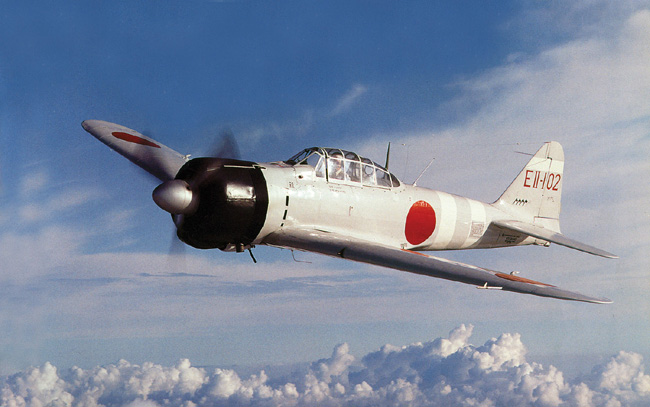
Saburō Sakai's account of the Battle
Pacific Theatre

Pug Southerland's Account of the battle:

EDIT: it would have been funny to see the look on the face of the Japanese pilot when he pulled up alongside the F4F & realized he had wasted 600 rounds of 7.7 ammo.
Strikes me as kind of a gentlemanly affair.
Pacific Theatre
On 3 August, Sakai's air group was relocated from Lae to the airfield at Rabaul.
Sakai in flightsuit.
On 7 August, word arrived that U.S. Marines had landed that morning on Guadalcanal. The initial Allied landings captured an airfield, later called Henderson Field by the Allies, that was under construction by the Japanese. The airfield soon became the focus of months of fighting in the Battle of Guadalcanal, as it enabled U.S. airpower to hinder the Japanese attempts at resupplying their troops. The Japanese made several attempts to retake Henderson Field, resulting in continuous, almost daily air battles for the Tainan Kokutai.
U.S. Marines flying F4F Wildcats from Henderson Field on Guadalcanal were using a new aerial combat tactic, the "Thach Weave", developed in 1941 by the U.S. Navy aviators John Thach and Edward O'Hare. The Japanese Zero pilots flying out of Rabaul were initially confounded by the tactic. Saburō Sakai described their reaction to the Thach Weave when they encountered Guadalcanal Wildcats using it:[5]
"For the first time Lt. Commander Tadashi Nakajima encountered what was to become a famous double-team maneuver on the part of the enemy. Two Wildcats jumped on the commander’s plane. He had no trouble in getting on the tail of an enemy fighter, but never had a chance to fire before the Grumman’s team-mate roared at him from the side. Nakajima was raging when he got back to Rabaul; he had been forced to dive and run for safety."
On 8 August, Sakai scored one of his best documented kills against an F4F Wildcat flown by James "Pug" Southerland, who by the end of the war became an ace with five victories. Sakai, who did not know Southerland's guns had jammed[citation needed], recalled the duel in his autobiography:
"In desperation, I snapped out a burst. At once the Grumman snapped away in a roll to the right, clawed around in a tight turn, and ended up in a climb straight at my own plane. Never before had I seen an enemy plane move so quickly or gracefully before, and every second his guns were moving closer to the belly of my fighter. I snap-rolled in an effort to throw him off. He would not be shaken. He was using my favorite tactics, coming up from under."
They were soon engaged in a skillfully maneuvered dogfight. After an extended battle in which both pilots gained and lost the upper hand, Sakai shot down Southerland's Wildcat, striking it below the left wing root with his 20 mm cannon. Southerland parachuted to safety.[6]
Sakai was amazed at the Wildcat's ruggedness:[7] {{cquote|" I had full confidence in my ability to destroy the Grumman and decided to finish off the enemy fighter with only my 7.7 mm machine guns. I turned the 20 mm cannon switch to the 'off' position and closed in. For some strange reason, even after I had poured about five or six hundred rounds of ammunition directly into the Grumman, the airplane did not fall, but kept on flying. I thought this very odd - it had never happened before - and closed the distance between the two airplanes until I could almost reach out and touch the Grumman. To my surprise, the Grumman's rudder and tail were torn to shreds, looking like an old torn piece of rag. With his plane in such condition, no wonder the pilot was unable to continue fighting! A Zero which had taken that many bullets would have been a ball of fire by now. "
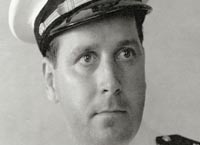
Pug Southerland's Account of the battle:
World War II dogfight at Guadalcanal
At the beginning of the Battle of Guadalcanal, August 7, 1942, United States forces shelled Guadalcanal and neighboring Tulagi in the Solomon Islands. Soon after the attack began, 27 Japanese bombers and an escort of 17 fighters took off from Rabaul, Japan's stronghold and strategic base in the South Pacific. Their mission was to bomb the ships that were supporting the American attack.
Lieutenant Southerland commanded a group of 8 American Wildcats aboard the USS Saratoga in Wildcat Battle Unit #5192. Due to planning errors and the loss of planes to a recent training exercise, these were the only fighter cover available to patrol the landing area. Southerland's flight took off to intercept the Japanese bombers before they could reach the American ships.
Southerland shot down the first Japanese aircraft of the Guadalcanal campaign, a G4M1 "Betty" bomber of the 4th Kokutai, under the command of Shizuo Yamada. After shooting down a second bomber, Southerland was engaged in a dogfight with an A6M2 "Zero" of the Tainan Kokutai. He lined up the Zero in his sights only to find his guns would not fire, probably due to damage from fire by the tailgunner from the second bomber he had downed. Although he was now defenseless, Southerland had to stay in the fight. Two more Zeros engaged him, but he successfully outmaneuvered all three of them. The dogfight was spotted by Saburo Sakai who felt the deftly handled Wildcat was winning the engagement. Sakai described the duel in his autobiography:
In desperation, I snapped out a burst. At once the Grumman snapped away in a roll to the right, clawed around in a tight turn, and ended up in a climb straight at my own plane. Never before had I seen an enemy plane move so quickly or gracefully before, and every second his guns were moving closer to the belly of my fighter. I snap-rolled in an effort to throw him off. He would not be shaken. He was using my favorite tactics, coming up from under.
Southerland and Sakai were soon engaged in one of the most legendary dogfights in aviation history. After an extended battle in which both pilots gained and lost the upper hand, Sakai finally shot down Southerland's Wildcat, striking it below the left wing root with his 20mm cannon. As Southerland bailed out of his doomed Wildcat his .45 caliber automatic pistol caught in the cockpit. He managed to free himself but lost his pistol, leaving him weaponless, wounded, and alone behind enemy lines.
Suffering from eleven wounds, shock and exhaustion, Southerland struggled through the brush, carefully evading Japanese soldiers. He finally reached the coast, where he was found by some natives, who at the risk of their own lives fed him and treated his wounds. With their assistance, he eluded the Japanese ground forces and returned to American lines. Southerland was evacuated from Guadalcanal on the first patrol boat to land at Henderson Field, on August 20.
Both pilots survived the war to write their accounts, making it one of the best documented dogfights of WWII. On February 14, 1998 the wreckage of Southerland's Wildcat was found, including Southerland's service .45 caliber automatic handgun. Investigation of the remains has confirmed both Southerland's and Sakai's accounts of the dogfight.
EDIT: it would have been funny to see the look on the face of the Japanese pilot when he pulled up alongside the F4F & realized he had wasted 600 rounds of 7.7 ammo.
Strikes me as kind of a gentlemanly affair.
Last edited:
























