












































You are using an out of date browser. It may not display this or other websites correctly.
You should upgrade or use an alternative browser.
You should upgrade or use an alternative browser.
Partial Full Length sizing
- Thread starter CSI-WALLEYE
- Start date

Screw the FL die down far enough that it sizes the neck and body, but doesn't bump the shoulder back. A headspace comparator will be useful in this regard.
A little pointless imho, since you will have to bump the shoulder eventually anyway.
A little pointless imho, since you will have to bump the shoulder eventually anyway.
I have a Forster datum tool for measuring my brass and set my dies so there 3-4 thou shorter( shoulder bump ) than my fire formed brass come out .
Without the tool , you can set your die a bit off the holder ( so you can see light ) , try it if there's trouble chambering set the die down slightly like 1/8 turn and repeat . Once it's set its good for that gun , others may need set
I play with a blank and have a puller handy
Without the tool , you can set your die a bit off the holder ( so you can see light ) , try it if there's trouble chambering set the die down slightly like 1/8 turn and repeat . Once it's set its good for that gun , others may need set
I play with a blank and have a puller handy

I'm pretty new to reloading too and I'm curious why you'd want to do this - if anything its the opposite to what I understand
For bolt action I intend to use fire formed cases with the neck bumped back (body left untouched) and for semi auto I full length resize (not partial) so the round will chamber properly
For bolt action I intend to use fire formed cases with the neck bumped back (body left untouched) and for semi auto I full length resize (not partial) so the round will chamber properly
I'm pretty new to reloading too and I'm curious why you'd want to do this - if anything its the opposite to what I understand
For bolt action I intend to use fire formed cases with the neck bumped back (body left untouched) and for semi auto I full length resize (not partial) so the round will chamber properly
I am reloading mainly for hunting and it is my understanding that if you only neck size you will have problems with getting the action to work on some rounds. Also these rounds have little tolerance for ant dirt or debris getting in the chamber. This is not acceptable in the field.
I am reloading mainly for hunting and it is my understanding that if you only neck size you will have problems with getting the action to work on some rounds. Also these rounds have little tolerance for ant dirt or debris getting in the chamber. This is not acceptable in the field.
Sounds like you need to fully resize (not partial) in that case?
Otherwise the bottom of the case or the point beyond wherever you stop the die won't be resized and the necks won't be bumped back so chambering will be tough

Partial Full Length sizing is a cheat for people too cheap to buy a neck sizing die. Meaning trying to use a full length die as a neck sizing die but it still sizes the case body to some extent.
And the vast majority of competitive shooters are full length resizing, like Kevin Thomas of "Team Lapua USA" below.
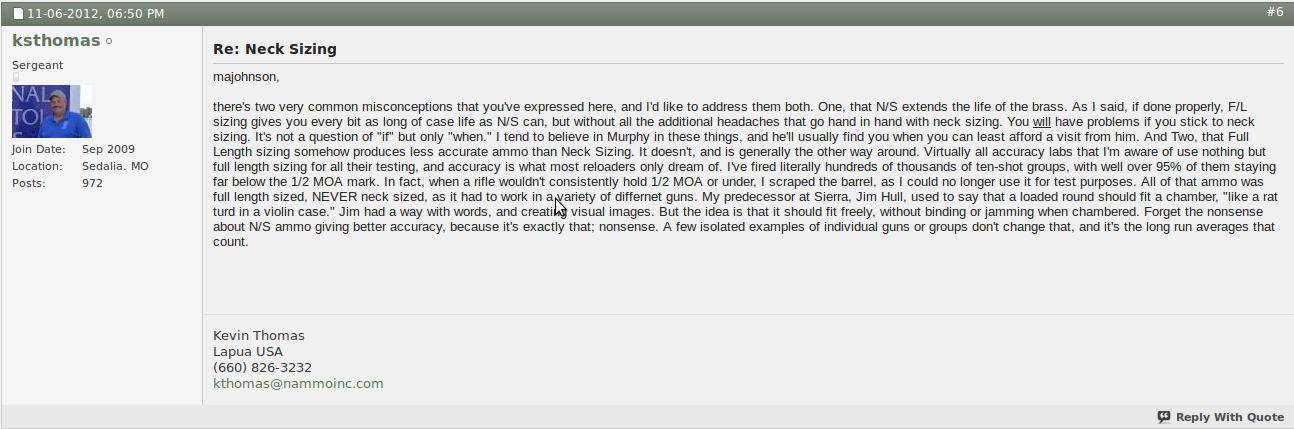
Below German Salazar is answering a question about partial full length resizing and why full length sizing is better. Simply put with a full length resized case it has wiggle room in the chamber and lets the bullet be self aligning with the bore. Or let the cartridge fit the chamber like a rat turd in a violin case.
Reloading: Partial Neck Sizing
by German A. Salazar
http://riflemansjournal.########.com/2010/06/reloading-partial-neck-sizing.html
"Now the last scenario, a full-length sized case in which the neck is also fully sized. There is clearance at the neck and in the body of the case, the closest fit anywhere is the bullet in the throat. If the neck to bullet concentricity is good (although it needn't be perfect), then the bullet will find good alignment in the throat and the case body and neck will have minimal influence. Let's not forget that the base of the case is supported by the bolt face or the extractor to a certain degree as well; this is yet another influence on alignment. As you can see, there are several points from base to bullet that can have an effect. My procedure is to minimize the influence of those that I can control, namely the case body and neck, and let the alignment be dictated by the fit of the bullet in the throat and to some extent by the bolt's support of the base. Barring a seriously out of square case head, I don't think the bolt can have a negative effect on alignment, only a slightly positive effect from minimizing "case droop" in the chamber. Given that a resized case will usually have a maximum of 0.001" diametrical clearance at the web, this isn't much of a factor anyway."
Below Erik Cortina of "Team Lapua USA".
And the vast majority of competitive shooters are full length resizing, like Kevin Thomas of "Team Lapua USA" below.
Below German Salazar is answering a question about partial full length resizing and why full length sizing is better. Simply put with a full length resized case it has wiggle room in the chamber and lets the bullet be self aligning with the bore. Or let the cartridge fit the chamber like a rat turd in a violin case.
Reloading: Partial Neck Sizing
by German A. Salazar
http://riflemansjournal.########.com/2010/06/reloading-partial-neck-sizing.html
"Now the last scenario, a full-length sized case in which the neck is also fully sized. There is clearance at the neck and in the body of the case, the closest fit anywhere is the bullet in the throat. If the neck to bullet concentricity is good (although it needn't be perfect), then the bullet will find good alignment in the throat and the case body and neck will have minimal influence. Let's not forget that the base of the case is supported by the bolt face or the extractor to a certain degree as well; this is yet another influence on alignment. As you can see, there are several points from base to bullet that can have an effect. My procedure is to minimize the influence of those that I can control, namely the case body and neck, and let the alignment be dictated by the fit of the bullet in the throat and to some extent by the bolt's support of the base. Barring a seriously out of square case head, I don't think the bolt can have a negative effect on alignment, only a slightly positive effect from minimizing "case droop" in the chamber. Given that a resized case will usually have a maximum of 0.001" diametrical clearance at the web, this isn't much of a factor anyway."
Below Erik Cortina of "Team Lapua USA".
Last edited:
Ghys_T3LSS
CGN Regular
- Location
- Sherbrooke, QC
Here’s my experience:
In both my varmint rifles (Tikka 243 and 300WSM), the chambers are so close to the full length I get from my dies, that I don’t even consider neck size...
My 300 especially, where the FL is like 0.001” shorter than the chamber...
Check your fl size and a fired cartridge and make your own decision.
My 2 cent
In both my varmint rifles (Tikka 243 and 300WSM), the chambers are so close to the full length I get from my dies, that I don’t even consider neck size...
My 300 especially, where the FL is like 0.001” shorter than the chamber...
Check your fl size and a fired cartridge and make your own decision.
My 2 cent





















