































I have been sorting out a new pistol. I have only found one pistol (I own over 100) that worked just fine out of the box, not needing at least new grips and a sight adjustment. That is one of those Tarique 9mm Berreta clones from Iraq.
This pistol is a FMK, a small sized 9mm carry pistol, that looks like a M&P that did not quite grow up.
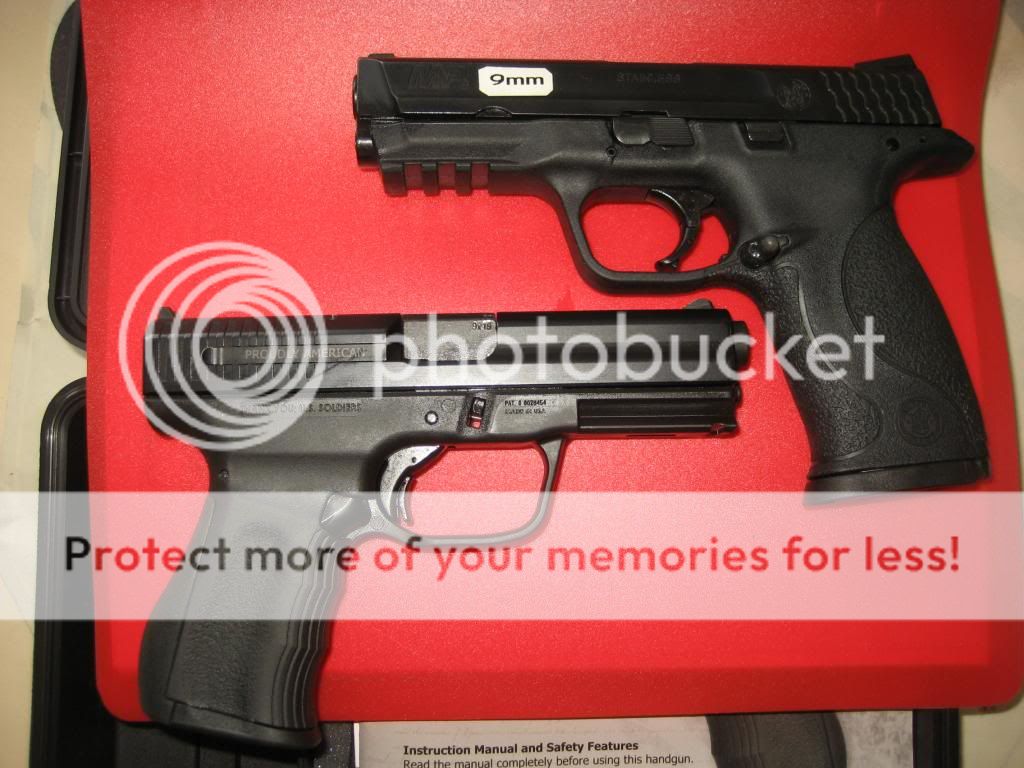
It shoots well for me. Feels comfortable in the hand, and using the sight inserts that came with the pistol, by changing both the front (for elevation) and rear (for azimuth) I got it to hit POA.
One of the things I do with guns that I might use in competition is test the firing pin energy. I want 100% ignition of all rounds. Obviously if I get 1 in 10 in the mag that won’t go BANG, I have a problem. But how to tell if it is 1 in 1000 that won’t go bang? That 1000th round might be in a competition.
What I do is load some ammo with rifle primers. If the pistol fires 100% of those, then I can assume there is reserve energy for all the pistol primers. In a recent test, about 18 of 20 9mm pistols fired all the rifle primers.
This FMK won’t shoot a mag full of most brands of pistol ammo without misfires. The strike looks to be light. It is also off-center, which I assume does not help. With CCI and Winchester pistol primers I get 1 in 10 misfires. With S&B I get 3/10 and with Tula, I get 6/10 misfires. It fires Federal primers 100%.
The short term fix is to shoot only Federal ammo or primers. I would rather it fired all ammo, and preferably, I would like it to fire rifle primers, just to be sure it will work when needed.
At the moment I have been unable to try a new or stronger striker spring. But with a semi auto pistol it is quite easy to adjust where the firing pin hits the primer. By putting a case in the chamber with a felt marker tab at 12:00 o’clock, the first step is to find out where the strike is. In this case, it is clearly low.

The “fix” then would be to move the chamber down a bit, so the strike is higher. This is done by placing a shim above the barrel, so it does not move quite so high when locking up. In this case, the thickest shim I could get in the pistol without jamming the lock-up was 7 thou. Not very much.
I tried a mag full of Tula-primed ammo (the ammo that got 60% misfires). All 10 fired. This has never happened before unless I used Federal primed ammo. I am shocked that such a small movement of the primer strike had such a profound impact. These fired cases show the strike just slightly closer to center.
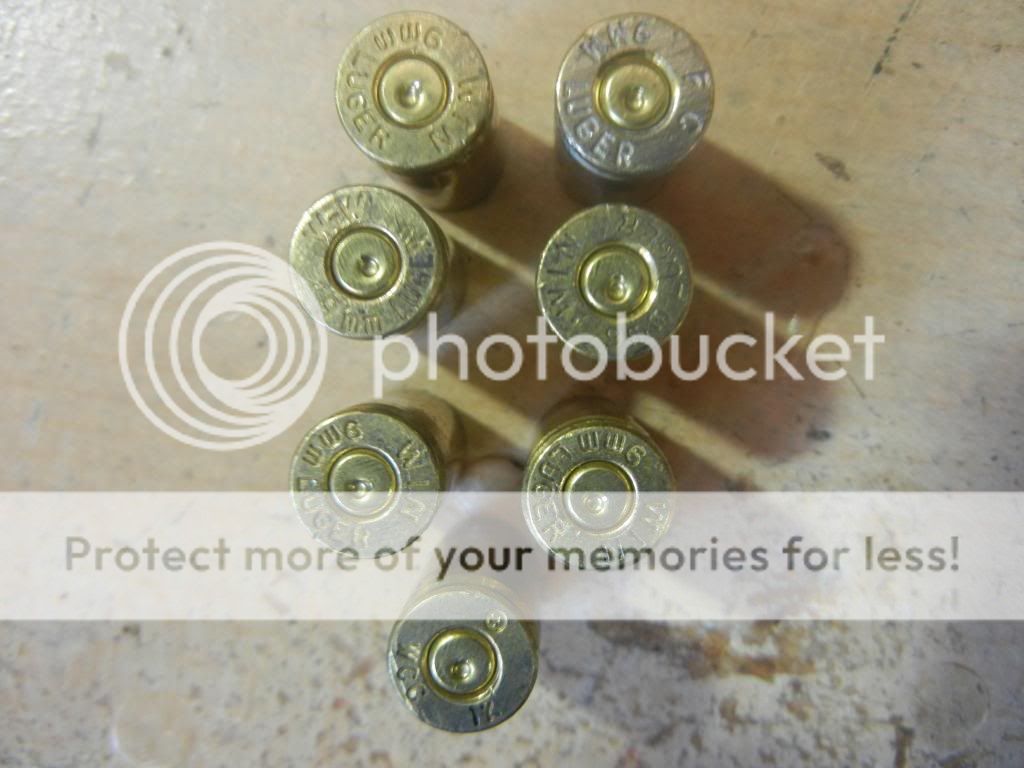
I look forward to shooting a few hundred of these to see if the “fix” is real. I am out of Tula primers, and my next 10,000 are S&B, which ignite better than Tula, so I might have a pistol that will function 100%. If it fires rifle primers I will be real surprised.
A primer has an anvil, on which to crush the priming compound when the firing pin strikes. Berdan ammo uses a big solid brass anvil formed as part of the case. A significant advantage of Berdan primers. The anvil in a Boxer primer is much smaller and flimsier. If the firing pin strike is off center, the compound is not being pushed against anything and a misfire is more likely. It appears that in this case 7 thou was enough to catch the edge of the little anvil.
I don’t want to modify the pistol to take a bigger shim to centre the chamber some more, so the next step is to try a new striker assembly or a new striker spring.
A shim is often used to tune a pistol that shoots a vertical group. It can be used to take out some of the slop so the chamber end of the barrel locks up in the same place for each shot. Until now I never paid much attention to the change to where the firing pin hit.
This pistol is a FMK, a small sized 9mm carry pistol, that looks like a M&P that did not quite grow up.
It shoots well for me. Feels comfortable in the hand, and using the sight inserts that came with the pistol, by changing both the front (for elevation) and rear (for azimuth) I got it to hit POA.
One of the things I do with guns that I might use in competition is test the firing pin energy. I want 100% ignition of all rounds. Obviously if I get 1 in 10 in the mag that won’t go BANG, I have a problem. But how to tell if it is 1 in 1000 that won’t go bang? That 1000th round might be in a competition.
What I do is load some ammo with rifle primers. If the pistol fires 100% of those, then I can assume there is reserve energy for all the pistol primers. In a recent test, about 18 of 20 9mm pistols fired all the rifle primers.
This FMK won’t shoot a mag full of most brands of pistol ammo without misfires. The strike looks to be light. It is also off-center, which I assume does not help. With CCI and Winchester pistol primers I get 1 in 10 misfires. With S&B I get 3/10 and with Tula, I get 6/10 misfires. It fires Federal primers 100%.
The short term fix is to shoot only Federal ammo or primers. I would rather it fired all ammo, and preferably, I would like it to fire rifle primers, just to be sure it will work when needed.
At the moment I have been unable to try a new or stronger striker spring. But with a semi auto pistol it is quite easy to adjust where the firing pin hits the primer. By putting a case in the chamber with a felt marker tab at 12:00 o’clock, the first step is to find out where the strike is. In this case, it is clearly low.
The “fix” then would be to move the chamber down a bit, so the strike is higher. This is done by placing a shim above the barrel, so it does not move quite so high when locking up. In this case, the thickest shim I could get in the pistol without jamming the lock-up was 7 thou. Not very much.
I tried a mag full of Tula-primed ammo (the ammo that got 60% misfires). All 10 fired. This has never happened before unless I used Federal primed ammo. I am shocked that such a small movement of the primer strike had such a profound impact. These fired cases show the strike just slightly closer to center.
I look forward to shooting a few hundred of these to see if the “fix” is real. I am out of Tula primers, and my next 10,000 are S&B, which ignite better than Tula, so I might have a pistol that will function 100%. If it fires rifle primers I will be real surprised.
A primer has an anvil, on which to crush the priming compound when the firing pin strikes. Berdan ammo uses a big solid brass anvil formed as part of the case. A significant advantage of Berdan primers. The anvil in a Boxer primer is much smaller and flimsier. If the firing pin strike is off center, the compound is not being pushed against anything and a misfire is more likely. It appears that in this case 7 thou was enough to catch the edge of the little anvil.
I don’t want to modify the pistol to take a bigger shim to centre the chamber some more, so the next step is to try a new striker assembly or a new striker spring.
A shim is often used to tune a pistol that shoots a vertical group. It can be used to take out some of the slop so the chamber end of the barrel locks up in the same place for each shot. Until now I never paid much attention to the change to where the firing pin hit.
Last edited: