were did this co me from .thy have controled round feed or somthing i donot now about .i have been in to guns with my father all my life and just lately guys are dividing 94 winchesters in two catagores .the pre 64 model 70 is all about the action the controled round feed .there is no diff on a 94 win on a 63 or 66 in the sction what gives DUTCH














































You are using an out of date browser. It may not display this or other websites correctly.
You should upgrade or use an alternative browser.
You should upgrade or use an alternative browser.
pre 64 94s
- Thread starter dutchhunter
- Start date

Applefarmer
CGN Ultra frequent flyer
- Location
- Lime Stone City
bunch of crap, depends on the factory and date. Not every factory changed in 64
\
Tis the biggest chunk of crap every spouted.
\
Tis the biggest chunk of crap every spouted.
bunch of crap, depends on the factory and date. Not every factory changed in 64
\
Tis the biggest chunk of crap every spouted.
What planet have you been living on?

bunch of crap, depends on the factory and date. Not every factory changed in 64
\
Tis the biggest chunk of crap every spouted.
...lol... you're funny!


NAA.
bunch of crap, depends on the factory and date. Not every factory changed in 64
\
Tis the biggest chunk of crap every spouted.


Brutus
CGN Ultra frequent flyer
I own a 1956 made M94 Carbine (Best quality bar-none)
A 1967 made commemorative rifle (worst quality)
And a 1983 made Trapper model, (okay, in that 'they tried' to reverse the downslope in quality, somewhat)
Most obvious after firing all three models is the shell-lifter, machined, good quality steel in the 1956 carbine, sheet steel folded crap in the 1967 rifle, and looks to be a cast piece of metal in the 1983 AE Trapper.
The 1967 rilfe's shell lifter gave up the ghost after less than 200 rounds.
There are other aesthetically pleasing aspects, such as the wonderful blueing finish on the carbine. Also the action is smoother on this one as well.
The 1983 made Trapper, has some cheap pot metal parts, that the rubbed off blueing exposes, and you can see the difference inside the working parts. But it is more reliable in feeding/firing/ejecting, than the 1967 rifle, by far.
The 1956 made carbine has flawless, wood to metal fit, and deep dark, uniform blueing on all steel parts.(No cheap alloys present)
Nothing comes close to the smooth operation, of my 1956 made Winchester Carbine.
My two cents........
PS: My friend Silverback owns a 1978 made XTR Big Bore in .375 Winchester, and so far his appears to be trouble-free in operation.
A 1967 made commemorative rifle (worst quality)
And a 1983 made Trapper model, (okay, in that 'they tried' to reverse the downslope in quality, somewhat)
Most obvious after firing all three models is the shell-lifter, machined, good quality steel in the 1956 carbine, sheet steel folded crap in the 1967 rifle, and looks to be a cast piece of metal in the 1983 AE Trapper.
The 1967 rilfe's shell lifter gave up the ghost after less than 200 rounds.
There are other aesthetically pleasing aspects, such as the wonderful blueing finish on the carbine. Also the action is smoother on this one as well.
The 1983 made Trapper, has some cheap pot metal parts, that the rubbed off blueing exposes, and you can see the difference inside the working parts. But it is more reliable in feeding/firing/ejecting, than the 1967 rifle, by far.
The 1956 made carbine has flawless, wood to metal fit, and deep dark, uniform blueing on all steel parts.(No cheap alloys present)
Nothing comes close to the smooth operation, of my 1956 made Winchester Carbine.
My two cents........
PS: My friend Silverback owns a 1978 made XTR Big Bore in .375 Winchester, and so far his appears to be trouble-free in operation.

I've got a 1927 (well made but worn out)
A 1956 (just given to me this spring) that looks like hell, is externally worn but shoots like a scoped rifle.
A 1977 that is the nicest looking, no complaints about the fit and finish (well, I had to redo the stock) but doesn't shoot worth a damn. Huge groups even at 50 yards, never mind 100.
A 1956 (just given to me this spring) that looks like hell, is externally worn but shoots like a scoped rifle.
A 1977 that is the nicest looking, no complaints about the fit and finish (well, I had to redo the stock) but doesn't shoot worth a damn. Huge groups even at 50 yards, never mind 100.
Here is a Pre -64 for you. This one was made in 1900 according to the s/n.
Thats only 5 years after the caliber was introduced to the world! 25-35 WCF.
As far as the differance between pre and post 64's goes It probably depends on what you are looking for and individual rifles. I've had them that will shoot and some that wouldn't both ways. Some with the pot metal receivers,and with the stamped metal lifter that worked great but looked like crap.
Some from the late 70's that looked great but had the rebounding hammer and misfired alot. Most of the serious collectors want the pre 64's. I like to shoot all of them.
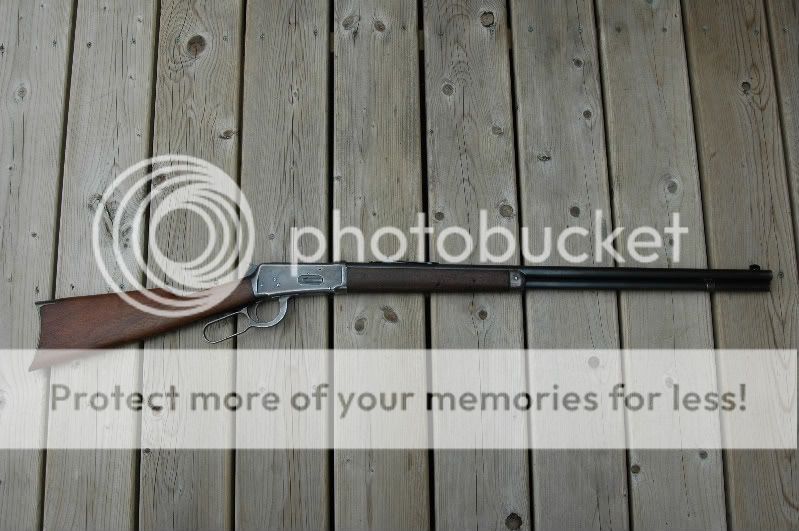
Thats only 5 years after the caliber was introduced to the world! 25-35 WCF.
As far as the differance between pre and post 64's goes It probably depends on what you are looking for and individual rifles. I've had them that will shoot and some that wouldn't both ways. Some with the pot metal receivers,and with the stamped metal lifter that worked great but looked like crap.
Some from the late 70's that looked great but had the rebounding hammer and misfired alot. Most of the serious collectors want the pre 64's. I like to shoot all of them.
Applefarmer
CGN Ultra frequent flyer
- Location
- Lime Stone City
What planet have you been living on?
Try reading up on all the factories Winchester had in the usa and Canada. Then look up when the retooling occurred.

Try reading up on all the factories Winchester had in the usa and Canada. Then look up when the retooling occurred.
Please provide a list of all these factories producing Model 94 Winchesters.
It should be a pretty short list .....................
Try reading up on all the factories Winchester had in the usa and Canada. Then look up when the retooling occurred.
In that case, how did they manage to have a direct serial number change over, then?
Are all these factories in New Haven, Conn., as is stated on the 94 barrels as where the 94s are made?
Applefarmer
CGN Ultra frequent flyer
- Location
- Lime Stone City
two plants in Texas as well as a plant here in Ontario produced model 94s along with the Connecticut plant.
The Pre 64 Winchester really refers to the Model 70 action which was changed to a push feed system in '64 though the action was stronger, smoother, less likely to bind than those pre 64, people didn't take to the new design as well.
The Pre 64 Winchester really refers to the Model 70 action which was changed to a push feed system in '64 though the action was stronger, smoother, less likely to bind than those pre 64, people didn't take to the new design as well.

I have a 1911 saddle ring carbine in .32w.s. I need to sight it in properly but it's in pretty nice shape. Feeding and handling is excellent. I've only put 60 rounds through it since I've got it, but not a single problem.

madtrapper143
CGN Ultra frequent flyer
- Location
- Steep Rock Lake NWO
Pre 64 applies to alot of the grand old winchesters. In 1964 the model 12 was ended, the model 50 and 59 were phased out. The model 70 was made with cast and stamped parts, the model 94 was re tooled with stamped parts and cast receivers. The model 1200 and model 1400 were intoduced. (plastic, aluminum etc etc) The new models worked but for quality and pride of ownership you can't beat a pre 64 anything by Winchester.
regards, Darryl
regards, Darryl
all i am saying is growing up watching dad buy thousands of guns we never heard pêople refer to a 94 as pre 64 or post 64 .it was always the model 70 s i had a model 70 in 264 western pre 64 it sold for 22oo$ and a post 64 in 264 that sold for 550$ .both were near new in copndition and yes the pre 64s were that much better in the model 70s
I was curious as to this exact thing, for about the same reasons, in that, as far as I knew the "pre '64" thing was really only applicable to the Model 70. Someone posted some pictures showing the internal parts differences of a '94. It was educational.
A search should find it again.
Cheers
Trev
A search should find it again.
Cheers
Trev
two plants in Texas as well as a plant here in Ontario produced model 94s along with the Connecticut plant.
The Pre 64 Winchester really refers to the Model 70 action which was changed to a push feed system in '64 though the action was stronger, smoother, less likely to bind than those pre 64, people didn't take to the new design as well.
I can't quite fathom that 94s were made in other factories. If they were, it would show up in the serial numbers, because something would have to be different. Check out the serial numbers and you will see the 94s run from 1 to 7 or 9 million, or whatever it was they ended up at. The break is there between pre and pro 64.
Please tell me how I can tell if my 94 is made at some place, other than New Haven.
There were copies of 94s made with the name of a big store on them, such as Sears-Roebuck. I know there were others, but can't think of any more names now. I will guess these were the ones made at different factories, under contract.
The Model 70s changed one hell of a lot more than the type of bolt at 1964. The ones made after they started up had virtually no resmblance to the former ones. The excellent metal to wood fitting all changed. Teh original had a bedded action and barrel. Talk about a free floating barrel! They usually say to see if you can put a five dollar bill around the barrel and work it all the way back to see if the barrel is floating. With the 70s made in 1965 you could take a wad of twenty bills and simply push them all the way down the barrel.
A minor complaint of the new models was that the great space around the barrel filled with twigs and needles, wile in the bush hunting with them.
Classic craftsmanship was out and modern, fast machine manufaturing was in.
I've read that the Canadian Centennial Commemoratives were made in Coburg.Though the barrels are marked Made in USA. Maybe assembeled in Canada??
And the Serial numbers you see on them might just bear this out.
Any I've seen are only 5 digit. I think the special runs have there own Numbering system. Maybe someone can shed some light??
And the Serial numbers you see on them might just bear this out.
Any I've seen are only 5 digit. I think the special runs have there own Numbering system. Maybe someone can shed some light??






















