Pressure Signs in Single Shots and Lever Actions

conor_90

CGN Ultra frequent flyer
Rating - 100%
91   0   0
Location
NW BC
Without relying on the esoteric art of primer reading how do you tell when you are approaching high pressures in single shots and lever actions?

Is case head separation on thrice loaded 454 casull brass a sign that the loads are too hot for the gun to handle? I have yet to have this happen to me but saw a few guys online claim this is common in their rossi 92's. Does pistol brass generally not last as long as rifle?

I do not fire hot loads in my 454 casull 1892, but my 500 S&W handi-rifle is another story. If the single shot action can handle the pressures what are the risks associated with hotrodding?

Thanks guys.
 
Marlin 1895: more case stretch and sticky extraction as loads approach load manual maximum level.

Handi Rifle: more case stretch, spring ejector won't eject the case past maximum level.

Ruger No.1: not quite sure??
 
Last edited:
Simple Trick for Monitoring Pressure of Your Rifle Reloads
http://www.hodgdonreloading.com/reloading-education/tips-and-tricks/simple-trick-monitoring-pressure-your-rifle-reloads

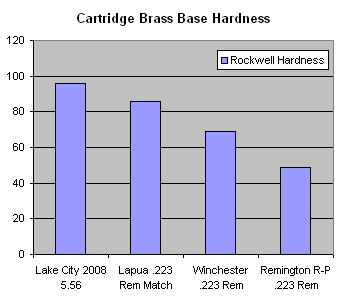
The above is like reading primers, measuring base expansion only tells you how strong the brass is. Meaning softer brass will show more expansion than harder brass. But it does tell you if you are pushing the case beyond its elastic limits.

How Hard is Your Brass? 5.56 and .223 Rem Base Hardness Tests
http://bulletin.accurateshooter.com/2014/05/how-hard-is-your-brass-5-56-and-223-rem-base-hardness-tests/

brasstest03.png


Bottom line, if your brass is falling apart after a few reloadings you are over stressing the brass. It may be caused by the type action, chamber finish, the quality of the brass or your reloading techniques.

NOTE, reloading dies vary in size and can overwork the brass and a rough chamber can cause the brass to stretch more when fired.
 
Last edited:
It is helpful to chrono your loads. If you are exceeding published velocities, you likely are exceeding normal pressures. Like most ways of reading pressures, not really precise, but helpful none the less.
 
There isn't always a good way to monitor pressure. With some of the weaker actions it is possible to exceed maximum pressure before you see any signs on the brass or primers. When you do see signs, then you could already be well past maximum. For those rifles you use a chronograph, watch for sticky extraction, and stray less from published data. Quickload used with a chronograph can give you some insight on pressure but isn't foolproof.
 
Marlin 1895: more case stretch and sticky extraction as loads approach load manual maximum level.

Handi Rifle: more case stretch, spring ejector won't eject the case past maximum level.

Ruger No.1: not quite sure??
Of the three above the Ruger #1 is the strongest to my knowledge.
For instance consult a Lyman manual for 45-70 loads. 3 levels, 1 is for trap door Springfields, 2 is for leverguns and 3 (heavy) is for Ruger #1.
 
Incipient case separation (that ring around the base) is absolutely a bad sign and so are the usual primer behaviour like flattening, cratering or leakage around the primer.

The thing is, interpreting the signs is always a bit of black magic because unless you have some kind of pressure transducer set up on your chamber, you will never know for sure how close you're getting to the practical limits in peak chamber pressures. Change the primer and you might get different signs for the same case/bullet/charge. Change the case brand for another brand, same thing.

Bigedp's link to measuring the case expansion is useful indeed, just make sure your calipers are actually accurate to that 0.0001" if you use them... mine SHOWS that fourth decimal, but as a 0.0005" increment only (the fourth decimal figure is either a 0 or a 5) so it doesn't gave the required level of accuracy. My micrometer does, however.
 
Incipient case separation (that ring around the base) is absolutely a bad sign and so are the usual primer behaviour like flattening, cratering or leakage around the primer.

The thing is, interpreting the signs is always a bit of black magic because unless you have some kind of pressure transducer set up on your chamber, you will never know for sure how close you're getting to the practical limits in peak chamber pressures. Change the primer and you might get different signs for the same case/bullet/charge. Change the case brand for another brand, same thing.

Bigedp's link to measuring the case expansion is useful indeed, just make sure your calipers are actually accurate to that 0.0001" if you use them... mine SHOWS that fourth decimal, but as a 0.0005" increment only (the fourth decimal figure is either a 0 or a 5) so it doesn't gave the required level of accuracy. My micrometer does, however.

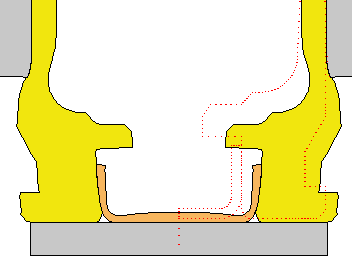
If your vernier calipers are only good to +- .0005 then just eyeball it, if it looks like the image below then back 10 or 15 grains of powder. :evil:

IBJQA9p.gif
 
Back
Top Bottom