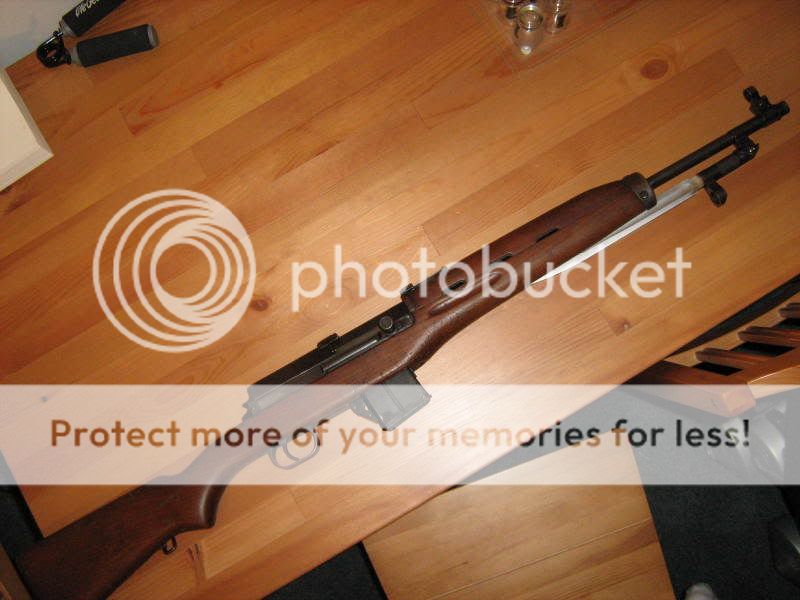
Rashid Rifle Facts
I forgot to put the mag in the gun when I took the pictures. A couple of blemishes like the patch on the stock and the screw holes on the bottom of the forestock might drop the price a bit. I guess if I put it up for sale I will consider the blemishes. It's like the import markings on firearms going into the US. It's a tool used by the buyer to get the price down. I have had a number of offers for the gun and I haven't considered selling it. I disagree with the 100% Egyption built no Swede involvement. The equipment for the Hakim was provided by the Swedes and the Rasheed is a further development of Egyptian Hakim rifle
As an aside - the Rashid is 100% built by the Egyptians - no Swede involvement...and no mag dropped the value 25%....also the Bubba-marks on the stock (moved rear sling mount - original recess is patched, also holes behind the bayo recess) drop the value even more. Rashid parts are VERY hard to find, as the production run was only 1959/1960 and 6000 built.
Caliber: 7,62x39 mm
Action: Gas operated, tilting bolt
Overall length: 1035 mm / 40,7"
Barrel length: 520 mm / 20,5"
Weight: 4,2 kg / 9,25 lbs
Magazine capacity: 10 rounds
Rasheed rifle (or, more properly, a carbine; also sometimes spelled as Rashid) is a further development of Egyptian Hakim rifle, scaled down to accept significantly less powerful 7,62x39 Soviet ammunition, and slightly modified with introduction of the separate cocking handle and integral folding bayonet. Only about 8 000 of Rasheed carbines were apparently produced in Egypt during sixties. It seems that most of these guns were later sold for export as surplus.
Rasheed carbine is gas operated, semi-automatic only, magazine fed rifle. It uses direct-impingement gas system developed in Sweden by Erik Eklund. Locking is achieved by tipping the rear of the bolt down and into the recess in receiver. Cocking of the bolt is provided by separate bolt handle which is installed on the right side of receiver and does not move when gun is fired. Manual safety is located at the rear of receiver, above the stock. Feed is from detachable box magazine that holds 10 rounds, although the rifle is fitted with bolt hold-open device and can be reloaded using stripper clips with magazine in place. Sights are of open type, with range-adjustable u-notch rear (optimistically marked up to 1000 meters) and protected front. A non-detachable, folding-down bayonet is patterned after Soviet SKS carbine.
The Rasheed (or Rashid) is a semi-automatic carbine, derived from the Hakim Rifle and used by the Egyptian military. Only about 8,000 Rasheeds were produced, making it a very rare rifle. As of 2004 a carbine was valued at approximately USD 400 to 600, depending on condition.
The Rasheed was designed by the Swedish engineer Erik Eklund, who based it on his previous Hakim Rifle (8 x 57 mm Mauser cartridge), which was itself a slightly modified version of the Swedish AG-42 Ljungman rifle (6.5 x 55 mm Swedish cartridge).
The carbine resembles the Soviet SKS carbine, particularly in the permanently-attached pivoting blade bayonet which appears identical to its Russian counterpart. The 12 in. (305 mm) blade bayonet pivots from a mount under the barrel, back into a recessed groove in the forend stock.
The carbine features a rear ladder sight, with a "battle" position for short-range fire as well as increments of 100 to 1000 metres, although the latter distance greatly exceeds the 300-metre effective range of the weapon. The semi-automatic mechanism is gas-operated through the direct impingement system.
Retrieved from "http://en.wikipedia.org/wiki/Rasheed_Carbine"