Pro/con of crimping plinking .223

sask3500

Member
Rating - 100%
15   0   0
Location
Under a rock
I just started reloading .223 with a 3 hole turret press and lee dies. I neck size sako brass shot in my gun, throw powder with an auto disk and seat a bullet.

I noticed a small decrease in group size with a 1/2 turn and second push up into the collet neck die before priming. That’s why I’m considering running them through the crimp die too, see if there is a bump in accuracy.

I’m wondering about using the factory crimp die in the set but I’m wanting to hear the pros and cons of it first. I’m disinterested if it will drastically shorten the life of my brass.
 
Sorry. Bolt action. Little cz527.

Edit: now that I’m thinking of it I’ll likely crimp some and see in the spirit of experimentation. I just want to know if it’ll harm brass long term.
 
Last edited:
in theory any extra working of brass will reduce brass life but I think it'll be negligible as it's not being worked very much. Your primer pockets are more likely to go before you ever start getting split necks in most brass. I have only got multiple split necks in Lapua brass after 10+ firings and annealing stopped the issue after it had started (3 cases of 50) and I do not anneal every firing.

I'd say if you get an improvement and you care about that then do it but it is an extra step that is not necessary especially just for plinking.
 
In general, crimping a round for a bolt gun does more harm than good.

BUT, if you are using a light bullet and a ball powder, Like BLC2, H335 or 748, a crimp is a very good idea. It will help ignition.
 
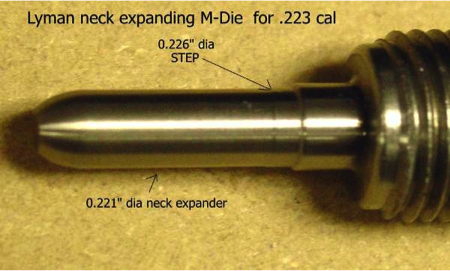
Below is a Lyman type "M" expander, please note the expander is .003 smaller than bullet diameter. Meaning increased bullet grip over the expander in most dies. You can bump the case mouth onto the .226 section that aids straight inline seating and decreasing bullet runout. After brass spring back the case mouth will be approximately .001 larger than bullet diameter. This allows you to seat the bullets straight in the case mouth with just your fingers.

Bottom line, with the increased .003 bullet grip no crimp is necessary. Many AR15 reloaders with progressive presses use the Lyman type "M" expander.

ohIUcpd.png
 
The M die is what is recommended for cast bullet. No advantage at all for jacketed.
Use standard Lee die and no need to crimp bolt gun load. Heck, I was not even crimping my AR15 , AR10 and M1A Supermatch ammo, ever.
 
The M die is what is recommended for cast bullet. No advantage at all for jacketed.
Use standard Lee die and no need to crimp bolt gun load. Heck, I was not even crimping my AR15 , AR10 and M1A Supermatch ammo, ever.

RIFLE NECK EXPANDING M DIES

https://www.lymanproducts.com/rifle-neck-expanding-m-dies

A Lyman Original
Improves accuracy of cast and jacketed bullet reloads. Doesn't stretch cases as does standard expander button. Extends case life. A "Must-Have" die for the cast bullet or flat-base bullet user.

The first step expands the inside of the case neck to just under bullet diameter for precise case neck tension in the finished reload.

The second step expands the case mouth to bullet diameter or slightly over. This allows the jacketed or cast bullet to be started perfectly centered in the case mouth and properly aligned with the axis of the case neck.

Note: By adjusting the neck expanding plug slightly deeper, the second step also provides a slight flaring of the case mouth for reloaders using cast bullets. Improve your bullet seating for your rifle today with Rifle Neck Expanding M Dies - shop Lyman!


Look at the Lyman expander below again, the .221 section is for jacketed bullets and the .226 section is for cast bullets. With jacketed bullet, if you bump the case mouth onto the .226 section it aids straight inline seating and reduces neck runout.

Bottom line the Lyman type "M" expanders are not just for cast bullets as stated above on the Lyman website.

ohIUcpd.png


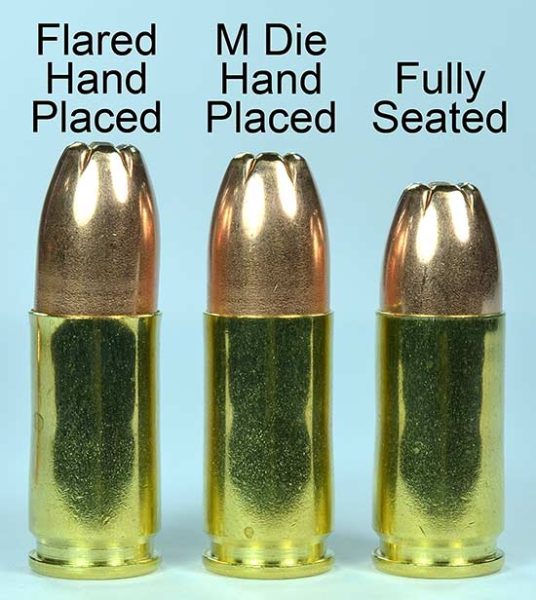
Below jacketed pistol bullets with the center case using a Lyman type "M" expander that aids straight inline seating. The case on the left has the bullet tilted with standard case mouth flaring.

vwgkeH3.jpg
 
Last edited:
I use a LEE factory crimp die for almost all my loading. How much of a crimp that places depends entirely on what I've got going through the press at the moment. I haven't seen a light crimp ever hurt accuracy, quite the opposite actually.
 
Last night I did some reading on neck tension. My fire formed then neck sized brass was about 1/2 thou larger once it had a bullet seated. I take that as 1/2 thou of neck tension?

Then I setup the crimp die and messed about. This is what I decided to try: seating the bullet till half the cannelure is covered then crimping. We’ll see how it does.

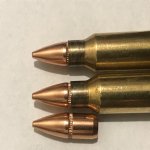
Top loaded round is what I decided on to try, thoughts? You can see it’s seated halfway into the cannelure and crimped. Should it be seated all the way into the cannelure?

Bottom loaded round is how I was loading before.

Thanks for the input.


106434A7-B2C9-4C8A-B5E6-4EB7F4C1D8F3.jpg
 

Attachments

  • 106434A7-B2C9-4C8A-B5E6-4EB7F4C1D8F3.jpg
    106434A7-B2C9-4C8A-B5E6-4EB7F4C1D8F3.jpg
    52.8 KB · Views: 115
Last edited:
Also I’m not sure if it makes a difference but the load is D8208BR at 20.9gr, cci primer and what I think are Hornady hollow points at 55gr. 2800 FPS out of a 18.5” barrel.
 
You are sort of missing the point of loading your own ammo for your rifle.

The bullet will perform best if it is close to (but not too close) to the rifling.

Seat a bullet very long and chamber. It will be marked by the rifling. Seat it deeper and test. Keep doing this until the bullet comes out without rifling marks. Back out the seater a quarter turn more and lock it. That is a reasonable seating depth.

Nothing to do with the crimp or cannelure.
 
In general, crimping a round for a bolt gun does more harm than good.

BUT, if you are using a light bullet and a ball powder, Like BLC2, H335 or 748, a crimp is a very good idea. It will help ignition.

So I'm new to reloading and I've been mainly loading 308 to learn to shoot better (I've now developed a load where I can put 5 shots under Quarter at 100 yards (the best shooting I've ever done). Because I was learning by reading the book, for crimps all my dies/books said was "in a heavier recoil load, a crimp is recommended". I didn't know where they drew the line for Heavier Recoil so I have been crimping the neck on my 308 loads. So... my question would be, if crimping ISN'T necessary, will I need to redevelop the load?
 
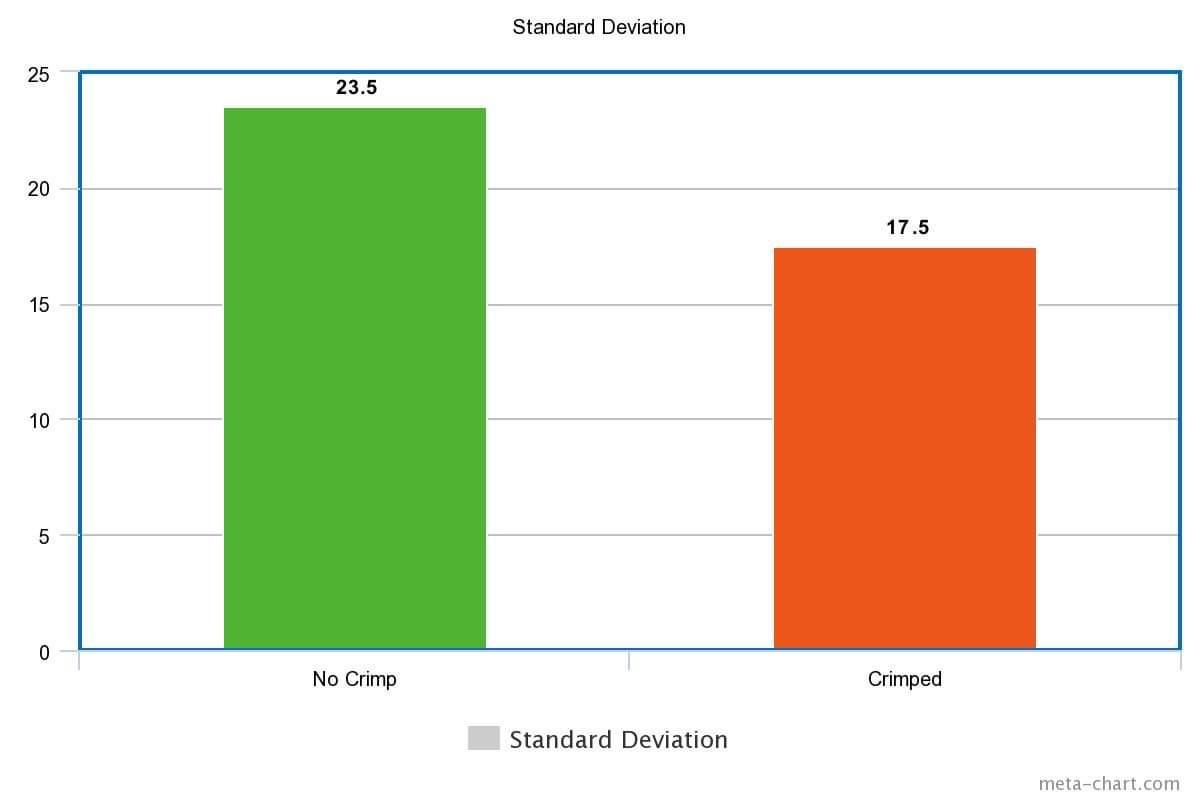
25% better standard deviation with 223 handloads crimped in a LEE factory crimp die

Two different rifles, two different bullets, about 30 rounds fired of each. Measured with Doppler radar

V0LbNPZ.jpg
 
Increasing the bullet grip with a smaller diameter expander or bushing can do the same thing as crimping. The more times a case is reloaded the harder the brass in the neck will become. And the harder the brass becomes the more it will spring back after sizing, meaning the bullet grip will decrease.

At accurateshooter.com the competitive shooters talk about the bushing size and the amount of bullet grip and standard deviation.

The average reloader who does not anneal their cases could very well see a lower SD if the neck is crimped. But they would see the same thing if a smaller expander or bushing was used. And this is why competitive shooters anneal their cases after each firing to keep the same amount of uniform bullet grip.

The same thing applies to competitive pistol shooters who use range pickup brass. They will use undersize dies to increase the bullet grip on well used cases that have more brass spring back.

 
the graph I posted was with virgin brass, sized in a Redding .245 bushing. I'll anneal and retry in 1xF fired brass
 
Back
Top Bottom