Problem Resizing 7 mm Rem Mag Brass

.223Savage

Member
Rating - 0%
0   0   0
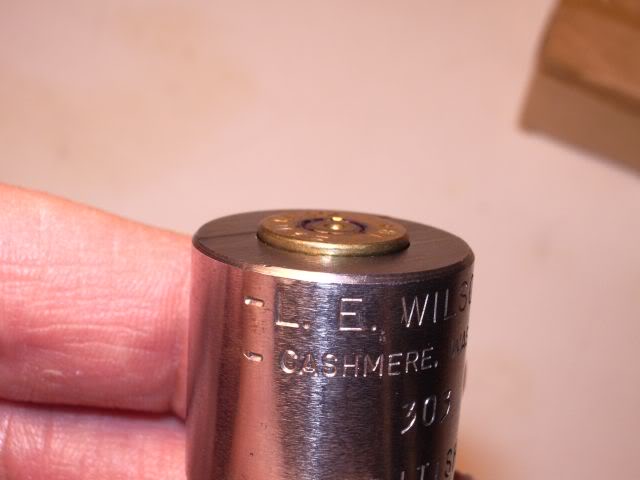
Having a problem resizing 7 mm Rem Mag brass, after running through a new RCBS sizing die the brass still sits proud about .065" high in a Hornady case gauge. The die was screwed down progressively for more than half a turn and the cases still protruded from the gauge. Headspace was well below the measure given the the Barnes manual. The die and gauge were carefully cleaned and the setup was done several times by two people carefully following the manufacturer's instructions accompanying the die. When tested in the rifle, a new Tikka T3x, the cases do chamber well with minimal effort on the bolt. The issue was similar with both once-fired FC and Barnes cases.

In a perfect world the sized cases fit both the gauge and the chamber. Anyone have experience with a similar situations? Any possible fixes?

Thanks.
 
The real question is what is the exact length of the casing? I can't see it being possible to be 65 thou longer than it came from factory with 1 shooting.
Headspace is determined by the chamber, not some gizmo and being a belted magnum case OAL or cartridge OAL has nothing to do with head space.
IF the sized casing fits into the chamber with no issue and the casing is within SAMMI spec for length, you are good to go.
All of these new fangled gizmos that Hornady is marketing seem like inappropriately named tool and really serve no important function.
 
Use a black felt tip marker and color the entire case, then chamber the case in your rifle and check for rub marks.

Many belted cases will bulge just above the belt and rub the chamber and case gauge.

The problem is many resizing dies do not size all the way down to the belt and leave a bulged case.

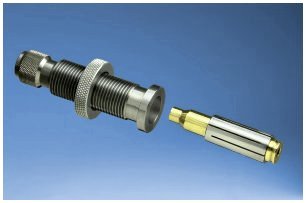
Belted Magnum Collet Resizing Die "Finally a resizing die that works on belted magnum cases."
http://www.larrywillis.com/

diesmall.jpg
 
Below is a "fired" Lake City 7.62 case in a Dillon .308 case gauge. And the case has not been resized and the case body diameter is preventing the case from dropping all the way into the gauge.

UPCvxyL.jpg


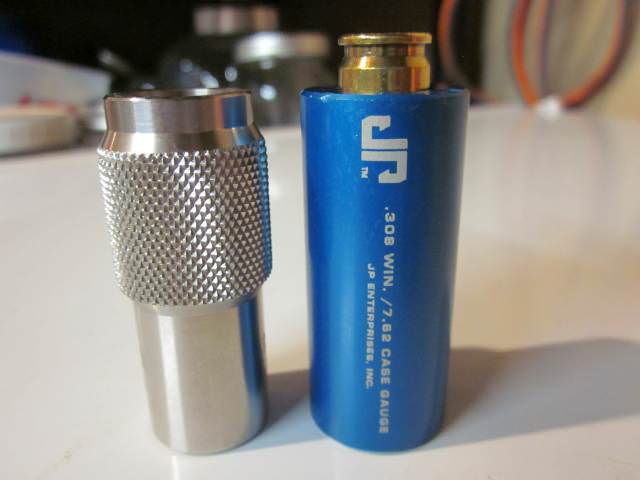
Below is the same case in a JP Enterprise .308 case gauge. And this shows the JP Enterprise case gauge is smaller in diameter.

zOVqgmU.jpg


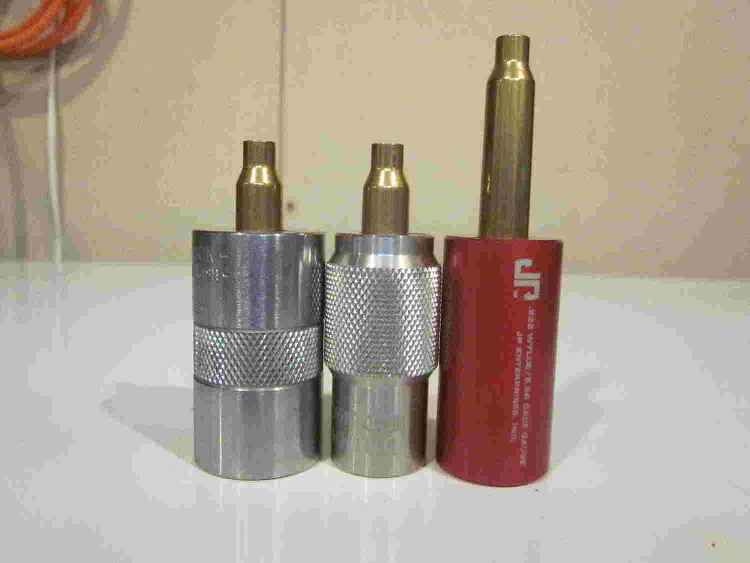
Below a Wilson, Dillon and JP Enterprise .223 case gauges, showing how much smaller in diameter the JP Enterprise .223 case gauge is compared to the other two. And the rim on the cases have no dings and are the same diameter. I use this gauge to check resized cases and loaded rounds because I'm loading for three different AR15 rifles.

KSB3ZvP.jpg


This gives meaning to "your chamber is the best gauge" and many case gauges are only good for checking the case headspace and "NOT" case diameter.

I use the JP Enterprise case gauges when reloading for multiple rifles in the same caliber. These gauges are closer to minimum SAAMI dimensions and if it fits in the JP Enterprise case gauge it will chamber in any rifle.

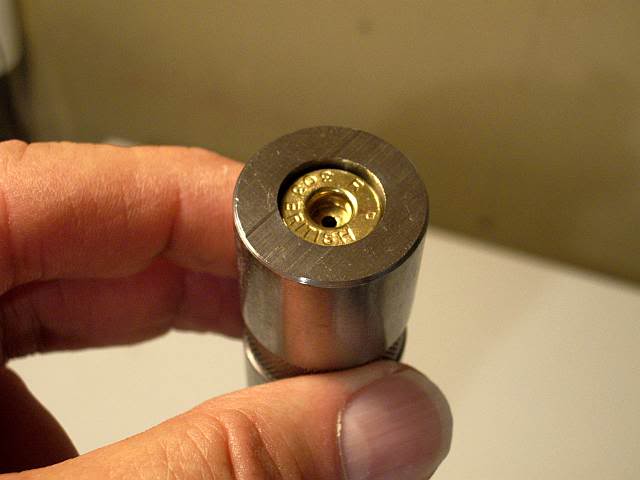
Below a new unfired .303 British case in a Wilson case gauge, all this shows is how far short the case shoulder is on a new case.

RBeuevm.jpg


Below is a fired .303 British case resting on its shoulder showing how much further forward the military Enfield rifles chambers shoulder is compared to American SAAMI standards.

HrqwFOG.jpg


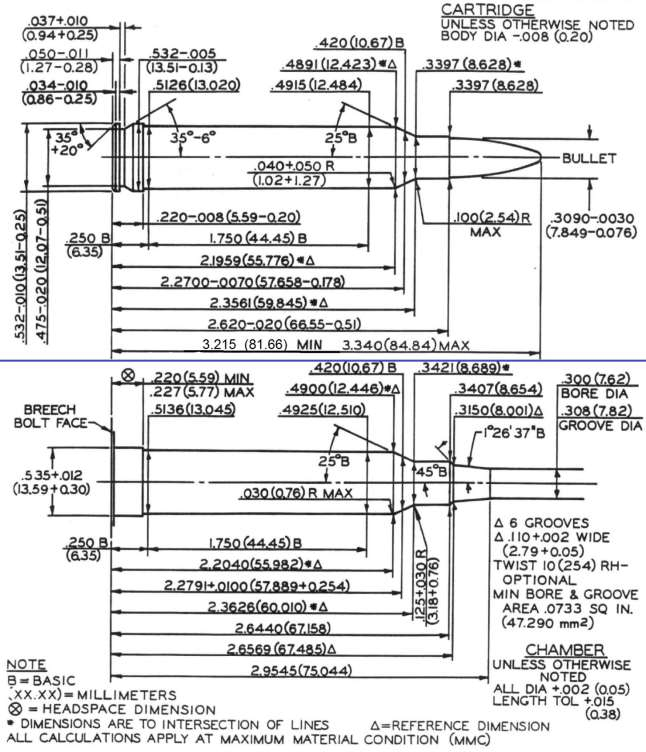
If you would look at a SAAMI case and chamber drawing you could see the manufacturing tolerances. Meaning the diameter size differences you can have between the chamber and case. And then you have the manufacturing tolerances in resizing dies, example I have a Lee FL .223 die that will reduce the case diameter more than my RCBS small base die.

Below the belted case just forward of the belt is .5126 to .5046 and the chamber diameter at the same point can be .5136 to .5138. Meaning the case diameter just forward of the belt can vary .008 in diameter and the chamber can vary .002 at the same point.

O3zQ5WP.png
 
Last edited:
If they fit in the gun, screw the gauge.

Exactly

I think there should be an adapter to mount a picatinny rail to a gauge so people can shoot their gauges instead of their rifles. ;)

It would sell like hot cakes I'm sure

Save yourself some aggravation, throw away the gauge ,load yout ammunition, and enjoy shooting it.

Exactly. Go shoot

Its amazing we were able to reload back in the day with out all these tools.

Truely is. Sometimes there is a thing as to much information
 
Having a problem resizing 7 mm Rem Mag brass, after running through a new RCBS sizing die the brass still sits proud about .065" high in a Hornady case gauge.

Sometimes there is a thing as to much information

And many times the person asking the question needs more information, and more equipment to measure their cases.

We live in a plus and minus manufacturing world and sometimes the pluses and minuses do not line up.

And the OPs case "might" be bulging just above the belt and not dropping into the gauge. Meaning the case gauge can still be telling the OP something. And a vernier caliper or micrometer would give the OP his answer.
 
And the OPs case "might" be bulging just above the belt and not dropping into the gauge. Meaning the case gauge can still be telling the OP something. And a vernier caliper or micrometer would give the OP his answer.

You don't shoot the ammo from the gauge. Try it in the gun its to be used in. That is your gauge. You can have every gauge and measurement in the world and if it doesn't fit in your guns chamber all of that information is useless.

People somehow managed to reload for many many years without all of these sales gimmicks.

I still do not see the point in all of these gauges either.
 
You can measure your feet; or you can try on your boots. If they don't pass the second test you'll correctly conclude that the first didn't mean much. Chamber fit isn't much different.
 
Back
Top Bottom