
When scoring using the Boone & Crockett system the score sheet has 4 measurements for each side when measuring the circumference. My question is this. What do you do when measuring an 8 pointer (4x4) or a 9 pointer (4x5) or even a 12 pointer (6x6) or bigger? I hope the question makes sense














































You are using an out of date browser. It may not display this or other websites correctly.
You should upgrade or use an alternative browser.
You should upgrade or use an alternative browser.
Question about scoring a whitetail
- Thread starter Underthegun
- Start date

You measure the Diameter and length of the base beam, then the same measurements for each point after that on the remainder of the side. Both sides add together to make the gross score, then deduct the difference between the two sides to make the net score. On a 4x4 ONLY, you get one additional measurement to add: the diameter 1/2 way up the last point.
For simple math argument:
left side : 50 inches total
right side: 54 inches total
Equals : 104 gross - 4 inches difference = 100 inches net
For simple math argument:
left side : 50 inches total
right side: 54 inches total
Equals : 104 gross - 4 inches difference = 100 inches net

mossyhorns
CGN Regular
- Location
- The city that rhymes with fun
The circumference measurements are taken at the base of the main beam between the burr and the brow tine at the narrowest location and then between the brow tine (G1) and second point (G2) and so on. Only four circumferences per side are ever taken and they are taken in order from the base measurement up until you are done or run out of points but only up to 4. If you have an 8 point then you take the fourth measurement half way between the base of the third point (G3) and the tip of the main beam. All circumference measurements are taken off the main beam and not the points. Only the length of the points is recorded.


http://www.boone-crockett.org/bgRec...sp?area=bgRecords&type=Typical+Whitetail+Deer
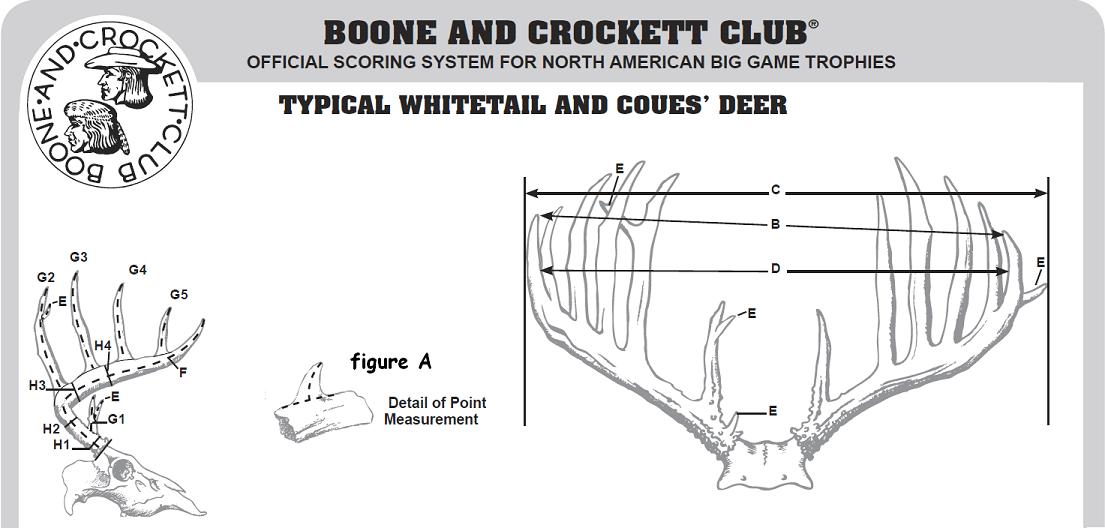
ON-LINE SCORING STEP ONE - Entering Your Measurements
All measurements must be made with a 1/4-inch wide flexible steel tape to the nearest one-eighth of an inch. (Note: A flexible steel cable can be used to measure points and main beams only.) Enter fractional figures in eighths, without reduction. For example, if a point measures 7 and 2/8 inches, you would enter 7 2/8 in the space provided.
KIND OF DEER: whitetail deer Coues' whitetail deer
A: NUMBER OF POINTS ON EACH ANTLER
To be counted a point, the projection must be at least one inch long, with the length exceeding width at one inch or more of length. All points measured from tip of point to nearest edge of beam as illustrated in Figure A. Beam tip is counted as a point, but not measured as a point.
Number of Points on Right Antler:
Number of Points on Left Antler:
B: TIP TO TIP SPREAD
The tip to tip spread is measured between the tips of the main beams.
Tip to Tip Spread:
C: GREATEST SPREAD
The greatest spread is measured between perpendiculars at a right angle to the center line of the skull at the widest part, whether across main beams or points. See Figure B.
Greatest Spread:
D: INSIDE SPREAD OF MAIN BEAMS
The inside spread of main beams is measured at a right angle to the center line of the skull at the widest point between main beams. See Figure B. Your Spread Credit will be automatically calculated.
Inside Spread of Main Beams:
E: TOTAL LENGTHS OF ALL ABNORMAL POINTS
Abnormal points are those non-typical in location (such as points originating from a point or from the bottom or sides of the main beam) or extra points beyond the normal pattern of points. Measure in the usual manner (See Figure A).
Right Antler: Left Antler:
F: LENGTH OF MAIN BEAM
The length of the main beam is measured from the center of the lowest outside edge of the burr over the outer side to the most distant point of the main beam. The beginning point is on the burr where the center line along the outer side of the beam intersects the burr, then generally following Line F as shown in Figure C.
Right Antler: Left Antler:
G. LENGTH OF NORMAL POINTS
Normal points project from the top of the main beam. They are measured from the nearest edge of the main beam over the outer curve to the tip. Lay the tape along the outer curve of the beam so that the top edge of the tape coincides with the top edge of the beam on both sides of the point to determine the baseline for point measurement (See Figure A). If there are more than five abnormal points to a side, add them together and input in the last field.
H: CIRCUMFERENCES
Circumferences are taken at the narrowest place as detailed in Figure C for each measurement. If the brow point is missing, take H-1 and H-2 at the smallest place between the burr and the G-2 point. If the G-4 point is missing, take H-4 halfway between the G-3 point and the tip of the main beam.
Congratulations! You have completed the measuring process! Click on the button below to get your final score.
Thanks guys. It is the 4th circumference measurement that I was wondering about. So take the 4th measurement halfway from the tip and the G3. Thanx Rod
Yes, only on a 4x4 this applies with B&C






















