Question on dogs

Bustercluck

CGN Regular
Rating - 100%
27   0   0
Location
Fort McMurray
My red and white setter seems to do two different methods of finding birds. Most of the time he’s sniffing the ground and when he picks up scent he usually does a bit of a back forth movement looking for the freshest scent and then takes off following trail with his nose in the dirt. When he does this he normally bumps the bird. I’ve adapted to his hunting style and when I see the obvious “bird-tail” on my pooch I just get into shooting position.

The only time I actually see him point is if he can either see the bird, or if he’s just walking up a trail and the scent catches him off-guard with his head higher up. This style of scent wil stop him dead in his tracks and make him whip his nose in the direction of the bird and lock up, but he doesn’t do this often. The first time he hunted pheasant in open fields with tall grass this really confused him.

Is this a normal thing? I have a retriever puppy who’s also doing the ground/trail scent thing too.
 
Get him on a check cord to stop him from flushing them.
It's a bit more complicated than that, but we can talk about it .
Some wing training might be in order as well
Cat
 
Last edited:
Tall grass diffuses the direction of the scent at ground level. So if the common grass and shrubs are above the head they don't get a definition. It's even harder for them with swirling wind... Trust the original head direction first. The dog is trying to tell you it's not sure BTW. Just my humble opinion. Cheers
 
through the years all my good dogs came from proven hunting stock and proved to be smarter than me. Training is good but time in the field hunting is key. The more you hunt them the better the good dogs get you have to start with a dog with a good nose . You don't want to turn them into a brainless machine with over training. A good dog will figure it out as they mature and that takes a while. X2 with 270WSMXBolt post
 
through the years all my good dogs came from proven hunting stock and proved to be smarter than me. Training is good but time in the field hunting is key. The more you hunt them the better the good dogs get you have to start with a dog with a good nose . You don't want to turn them into a brainless machine with over training. A good dog will figure it out as they mature and that takes a while. X2 with 270WSMXBolt post
One thing I have found over the years is that many hunters try to tell the dog where to go and start calling their name too much when they don't respond. The dog wants to go one way, the hunter the other- I'll take the dog's nose over my desire to hunt a certain area every time! LOL
Cat
 
One thing I have found over the years is that many hunters try to tell the dog where to go and start calling their name too much when they don't respond. The dog wants to go one way, the hunter the other- I'll take the dog's nose over my desire to hunt a certain area every time! LOL
Cat
Spot on cat I had a little female Britt that taught me that lesson many times.
 
I like training my dogs to be steady at wing for safety reasons and it also seems to help them mark a downed bird better than when their prey drive is wound up by chasing a bird. A little time training things like being steady on point and coming back when in the field saves some aggravation later.
 
How old is the dog?
And, has he hunted wild birds or are they pen raised?
He just turned 4. He mostly hunts ruffed grouse in thick bush. We’ve hunted raised pheasant a few times which was a learning curve for him too but lots of fun on e he figured it out.

This is my first upland dog and I’m just noticing the way he hunts and what makes him tick. I like him the way he is and I have no plans on changing him. We hunt at least once per week(or more) during bird season and we’re out quite often in the off season. I can see his experience growing all the time and most of it is self-taught by trial and error. I can see two distinct reactions to how he tracks and I was wondering if other dogs do the same. He definitely scent trails like a hound on the ground which isn’t wind based because he doesn’t follow a direct line and other times he picks up scent in the wind and locks up on point.

I was wondering if other people notice the same thing
 
I can see two distinct reactions to how he tracks and I was wondering if other dogs do the same. He definitely scent trails like a hound on the ground which isn’t wind based because he doesn’t follow a direct line and other times he picks up scent in the wind and locks up on point.

I was wondering if other people notice the same thing
That's pretty typical behavior, yes.
Cat
 
With my first Brittany, I tied a grouse wing to the line on a fishing rod. Then, I “cast” it out past her on the lawn (maybe 20 ft.). If she held a point, the wing didn’t move. If she went for it, I’d yank it into the air high over her head and let it rest where it landed. Same deal once it was on the ground again. I made a point of not letting her touch it if she made a move on the wing.

She turned out to be a reliable pointer, when the birds would sit. When she pointed, the bird was always roughly 10 ft. straight in front of the point. She learned to stay within shotgun range most of the time, although she would often bump one up into a tree, sometimes 50 to 75 yards through the bush.

My current Brit didn’t get the wing training. He has only one gear - full speed. Birds seldom sit while he’s rocketing up to them. The vast majority of his presentations are flushes. Sometimes he’s out of range and out of sight. But, it’s wonderful to watch him work a scent. He does the same head down, tail wagging excitedly that you describe.

I have(had) never called either dog back, unless they are out of sight and we are leaving the field. Both were taught that it’s their job to keep track of us, not the other way around. This is(was) true at the off leash as well as in the field. This works well up until they get old and half deaf. Then, you need to keep an eye on where they are.

I find that this sense of independence allows them to leverage their skills and abilities to the fullest. My current dog, Monty, has achieved incredible feats that my first hunting dog never came close to. For example, he has just turned 5 and he already has 5 birds to his credit - birds that he brought back that we didn’t shoot. Three of those had minor injuries. They were probably injured and lost by other hunters. But two of them were in perfect health. He just ran them down and caught them before they could get up Into the air.

Once, he went 100 yards out-of-bounds, up a hillside, into a farmer’s field. We were wondering what he was doing when he bumped up 6 pheasant and pushed them back into the release zone. Of those 6, I got one, my partner got one, and two hunters from another party got one each as well. Needless to say, we don’t question his motives after that!

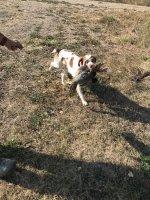
In this photo, he was one year and a few months old:

IMG_1790.jpeg
 
Last edited:
Back
Top Bottom