Re-barreled Swedish M38 origin?

The_Shmoo

CGN Regular
Rating - 100%
3   0   0
Location
Missisauga, ON
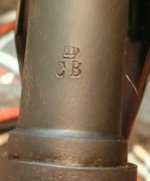
Pawn shop find. Barrel is ~24" (I misplaced the scientific stick of measuring), no irons or trace of them ever being there, recessed crown. Pulled the stock, no serials or markings anywhere on the barrel except a CB (not JB, my eyes are getting bad) under crown proof on the bottom of the chamber. Working on pictures.

I'm going to slug the barrel to make it is actually a 6.5 barrel, it wouldn't be the first time...
 
Last edited:
Pawn shop find. Barrel is ~24" (I misplaced the scientific stick of measuring), no irons or trace of them ever being there, recessed crown. Pulled the stock, no serials or markings anywhere on the barrel except a CB (not JB, my eyes are getting bad) under crown proof on the bottom of the chamber. Working on pictures.

I'm going to slug the barrel to make it is actually a 6.5 barrel, it wouldn't be the first time...
I had my m38 rebarrelled. I bought the new barrel from Tradex several years ago and had it installed by Gunco. The new barrel doesn't come with sights but I had them transferred from the old barrel to the new one. I don't recall seeing any markings on the new barrel.
 
Those barrels were available from Marstar and International back in the day, in the white for $15

They were NOS Swede replacement barrels, which the Swedes did quite often to keep their rifles acceptably accurate.

I bought several of them, 18 inch, 23 inch and 29 inch. They were all the same price and a great value, even back then.

Most folks didn't bother rebarreling their Swede Mausers back then or even later, because they were cheap and it was cheaper to purchase another rifle than it was to rebarrel, if you took it to a smith for the job.

To bad, because a lot of those great little actions ended up as scrap metal after the nimrods shot corrosive ammo down perfect bores and didn't clean them after shooting.

The biggest issue with the milsurp Swede Mausers was the lack of 6.5x55 ammunition, after CIL/Dominion, shut down their production and sold off the equipment to a manufacturer in the US, who never did put the cartridge into production.

It was only after thousands of these great Mausers were available in the US, that a few North American manufacturers started to produce it.

We had very limited options if we wanted to shoot our rifles for about ten years. Find CIL/Dominion, find or order very expensive ammunition/components from Europe, or fire form cases from 308 Win/7.62Nato brass.

I had access to lots of 7.62 Nato cases at the time and preferred it over commercial 308Win, because it was thicker in the web area and stood up to fire forming better, and several reloads later. Yes, I know the necks were "short" and the web expanded .008, but at the pressures generated from these cartridges, 45,000psi., the cases were safe and plentiful.

As for the short necks, we weren't loading them for battle and the long bullets we were using, usually 140 grain BTSP/160 grain round nose, there was plenty to grasp the bullets well enough to keep them straight and provide enough tension for good ignition.

OP, I still have a couple of the short carbine barrels in the white, and they don't have any stamps on them, other than an "inspector's initial"

They're some of the best barrels I've come across, considering price and mass production. Very few other similar replacement barrels are as good or as consistent.

 
We had very limited options if we wanted to shoot our rifles for about ten years. Find CIL/Dominion, find or order very expensive ammunition/components from Europe, or fire form cases from 308 Win/7.62Nato brass.

I had access to lots of 7.62 Nato cases at the time and preferred it over commercial 308Win, because it was thicker in the web area and stood up to fire forming better, and several reloads later. Yes, I know the necks were "short" and the web expanded .008, but at the pressures generated from these cartridges, 45,000psi., the cases were safe and plentiful.

As for the short necks, we weren't loading them for battle and the long bullets we were using, usually 140 grain BTSP/160 grain round nose, there was plenty to grasp the bullets well enough to keep them straight and provide enough tension for good ignition.


I’ve seen reference in my Lyman loading manual about not using 30-06 cases due to the Swedes slightly larger base and rim diameter. But tried it once, noticeable bulge at the base.

Do you have pics of your .308/nato based rounds? Did you fire form and hope for stretch into the neck?
 
Pics???? that was long before cell phone cameras and digital cameras were anything more than ideas in a Sci Fi movie, or we had laptops or even desk top computers in every home.

Once Norma and other European companies started selling bulk quantities of components and cases to International, I stocked up with a couple of thousand cases.

Of course you're going to see a "stretch" mark on the web where the case expands. You will see that with just about any handload after the first firing.

The secret was to neck size only after fire forming the case.

It was an easy conversion.

One pass in the die to reduce neck diameters and you created a false shoulder for the case to seat on when chambered. Never lost a case.

Cutting down 30-06 cases came about because some writer just couldn't handle shorter necks, and insisted on doing a simple job the hard way, so the rumor stuck.

I used to pick up the fired "blanks" used by the militia because of the short neck issue with brass. Just cut off the petals, size down the necks and trim to desired length.

I would get up to ten reloads on these case conversions, without any issues, other than brass hardening.

Look at it this way, people shoot reloads from their 303 British chambered Lee Enfields on a regular basis. If they don't full length resize, those cases last for many reloads.

Most Lee Enfield chambers are purposely cut to maximum dimensions, for all sorts of good reasons, and most hand loaders don't have issues with reloading the "expanded cases" unless they're using the same reloads in more than one rifle.

The nice thing about Swede 6.5x55 chambers is they were extremely consistent dimensionally and you could use the same reloads in several different rifles without feeding or chambering issues.
 
Back
Top Bottom