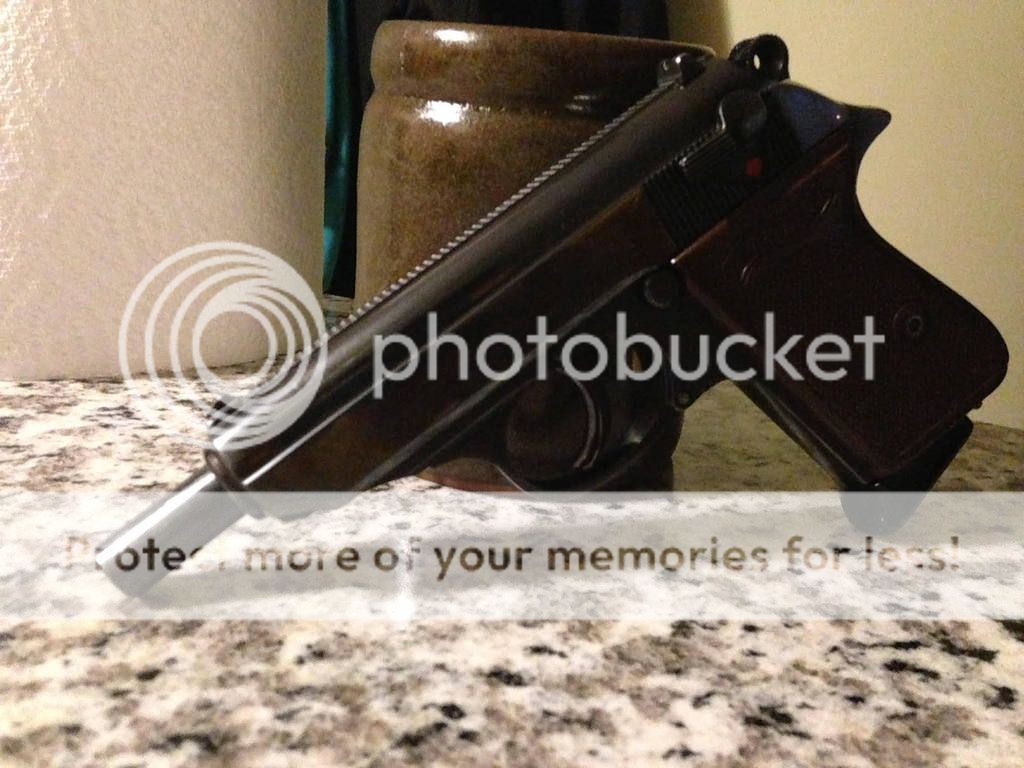
I spoiled 3 (three) .32 ejectors before I gave up on trying to regrind .32 ejectors to allow .380 to pass, but still lock open the pistol on empty.
By all means try Tradex, but don't just buy one ejector. You may find a much smarter guy than me, which shouldn't be that hard, but I doubt he'll get it right on the first try.
Barry Jensen claimed (to me) that he could re-grind the ejectors to work. Most of his conversions don't lock open on empty, and again, Epps gave up on this idea too. It is remotely possible that someone with CNC grinding equipment, or maybe just a CNC mill, could adjust these ejectors consistently, and have them work. I couldn't get a prototype working, and again, Barry's pistols usually don't lock open, or if they do, they have your problem. It doesn't sound like he figured out anything, and he is a pretty clever guy who has been doing this for a long time. He didn't have a CNC grinder or mill the last we spoke.
Walther cut a channel in the frame, flattened the ejector, and used a tab in the magazine to lock open the pistol. Pre-war, they used bottom magazine release for .380 pistols, since the bigger round would hit the standard side magazine release on feeding and result in a single shot pistol.
The .380 conversion requires the breech face on the slide to be opened for the larger cartridge with a special milling cutter, the slide barrel opening to be opened up for the thicker barrel, a heavier recoil spring, and then there is the issue of the ejector / slide lock. I have a broach cutter and a guide block in a box somewhere, the same thing that's used to cut keystock slots in pulleys (except my guide is Walther magazine shaped). You don't have to remove a lot of metal, and it's all the same frame -- Walther didn't make a lot of changes in the 50 plus years they made these pistols. A 1930's barrel will fit a 1980's frame. They are wonderful pistols to work on.
If you want the pistol to lock open, you will need to have the frame cut and can then have the existing ejector ground to work, or simply buy a .380 ejector. You will need modern magazines (with the rib). Otherwise, the existing ejector needs to be ground to allow the cartridge to pass, and you will have to give up on the "lock open on empty" feature.
Please let me know if you find someone who can do industrial magic and regrind an ejector that works in your pistol as is. Cutting the frame is ugly, even with tools.
It's a shame that no commercial reloader is interested in the .30 Reid cartridge. That is a simple barrel replacement, and would make a lot of people happy for a lot less money. I have a few different ideas that I hope to make real this summer, but there will no doubt be interesting new problems.
One of the very few people in the USA who owns a PSM pistol, converted one of his .32 PPK pistols to the Soviet-era PSM 5.45 x 18 pistol ammunition with a simple barrel change. The 5.45 x 18 is a hopped-up center fire .22 with a lot of snap, and apparently cycles and ejects reliably. The ammunition is even worse than .30 Reid though -- Tula still makes it, but Russian goods are embargoed and, until that changes, we're S.O.L. on the "easy conversion with factory ammo" for PPK pistols.
I didn't believe it, so I tested the fit of the 5.45 x 18 in a PPK magazine. It fits nicely:
The 5.45 PSM ammo is quite snappy and accurate, from my preliminary 3 shots.
.30 Reid or 5.45 x 18 (PSM) are simple conversions, barrel only. Either requires a custom chamber reamer, and at this point, either requires that you reload. .30 Reid is easier and cheaper to make. When we make peace with the Russians, the Tula 5.45 x 18 PSM ammo will eventually find its way here, if Tula Canada manages to survive.