Reloading for an AR: Questions

powdergun

CGN Ultra frequent flyer
Rating - 100%
250   0   0
I have a new AR varmint model coming. It is chambered for 5.56 and I know I can shoot .223 out of the gun

My questions are about reloading.

1) Do I use .223 dies with 5.56 brass ?
2) Are there 5.56 dies available ?
3) Can I achieve the best possible accuracy with ..223 brass ?

Thanks
 
1).. yes you use 223 dies but ideally, you only want to bump the shoulder enough for safe and proper chambering. Oversizing is as bad as not enough.

2) same thing

3) True nato 5.56 brass should have a heavier web and lower case volume but some commercial brass is made in a similar way so... Proper brass prep in either case will lead to excellent results. the most important is being able to meter your powder very precisely. AR and other semis tend to be very sensitive to powder charge variations.

But if your rifle has a true 5.56 chamber, then it has a very long throat and that can really limit the accuracy potential if using lighter bullets.

Jerry
 
I use standard lee dies with both .223 and 5.56 brass and no issues with accuracy or reliability.

Case prep is key. Also, since we are talking case prep, get yourself a deburring tool or a swage die to remove the primer pocket crimp found on a lot of .223/5.56 brass.
 
Would small base dies be better ?


A small base die will reduce the case diameter approximately .002 to .003 more than a standard die. "AND" it will also push the case shoulder back .003 to .003 "MORE" than a standard die.

A small base die will size the case back to minimum SAAMI dimensions, meaning size the case to the dimensions of a new unfired case.

But chambers and dies vary in size, example I have a standard Lee .223 die that will size the case smaller than my RCBS small base die.

In a semi-auto the resized case should be .003 to .005 smaller in diameter than its fired diameter. This allows the case to spring back from the chamber walls and extract reliably.

The AR15 5.56 chamber is approximately .002 larger in diameter than a .223 chamber. And this is why the vast majority of reloaders can use a standard .223 die and "NOT" need a small base die.

Bottom line, start with a standard .223 die and if you have extraction problems then get a small base die.

If you have not purchased you resizing dies yet I highly recommend the Forster full length benchrest dies with the high mounted floating expander.

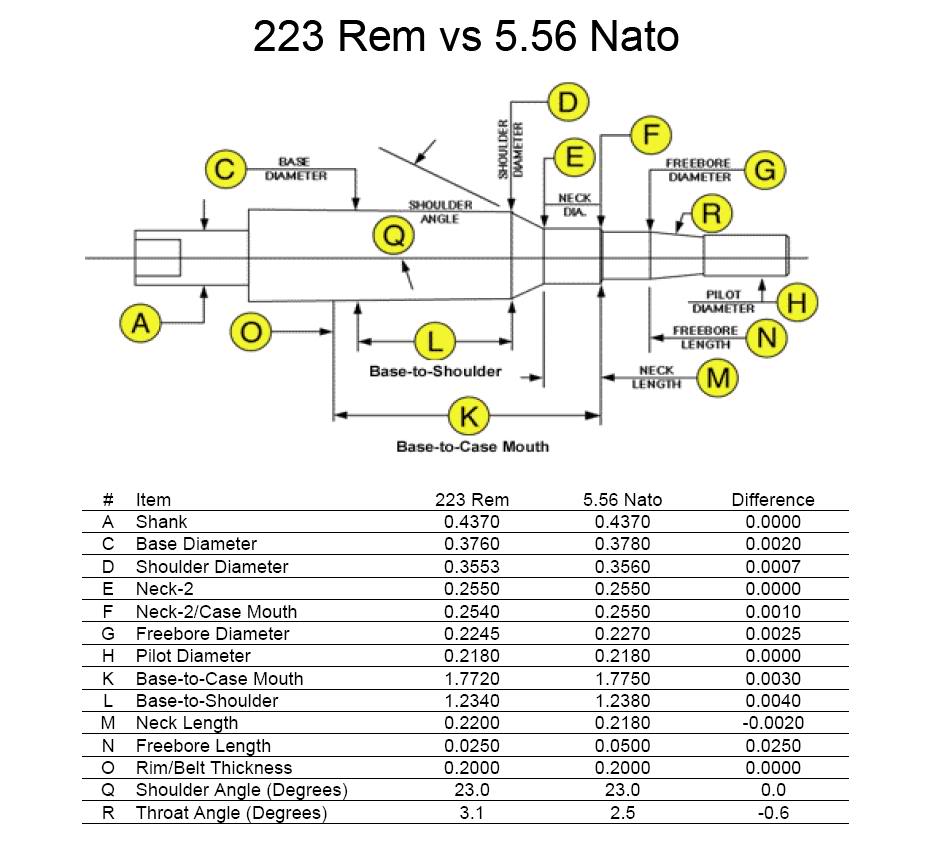
Below almost all military rifles have a larger chamber than a commercial chamber. BUT some target AR15 barrels "might" have different dimensions to improve accuracy.

msOmURi.jpg


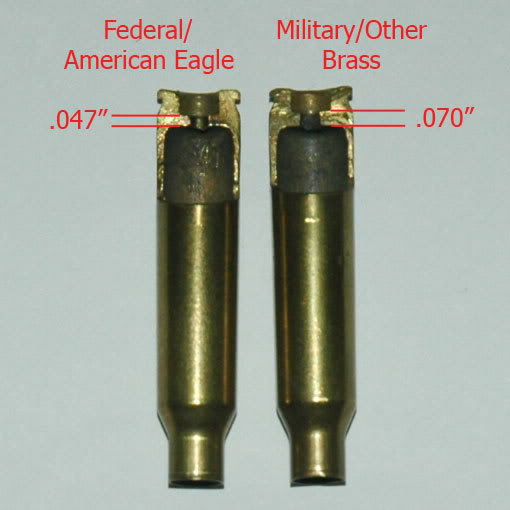
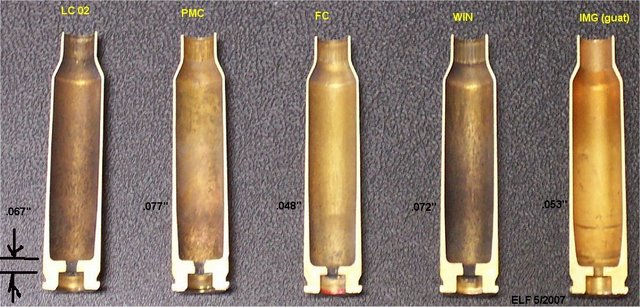
Some .223 cases have a thinner flash hole web like pictured below. And the primer pockets will become over sized very quickly and should be avoided if reloading.


cYeTsDp.jpg


ohI86Bf.jpg
 
Would small base dies be better ?

I've used the regular Lee dies as well, and so far, haven't had any resizing issues. As long as your sizing die is adjusted properly, you should be good. If you have a particularly tight chamber, you might need a small base die.

Oh yeah, don't forget the lube.

As others have mentioned, you will need to remove the crimp left-overs from the primer pocket if you are reloading 5.56 brass. I've used both the RCBS swager and a chamfer tool, and I prefer the chamfer tool.
 
Get yourself the Lyman 223 case headspace/length gauge. Super fast to check each case without having to measure.
 
I use Lee FL die. No problem with 7 different rifles.

If you want accuracy, get a bunch of the same cases. Same manufacture from the same lot # fired in the same rifle. That will reduce a lot of variables.
 
Back
Top Bottom