Reloading for multiple rifles using same cartridge.

Potashminer

CGN Ultra frequent flyer
Uber Super GunNutz
Rating - 100%
589   0   0
Location
Western Manitoba
Have been reading about Swedish shooting federation competitions - apparently the "standard" ammo used by all competitors in a match is / was the same - 130 grain Norma factory rounds. No special loading allowed to compete.

I have a number of Swede 6.5x55 rifles here - various from older ones (1905 or so) to newer ones (1943?) so, mix of M96 and M38 originally. None are M98 or "modern" commercial actions. Barrel lengths from 20" to 29". I have no difficulties working up an appropriate load for one rifle, but am wondering how to go about making up a "standard" target shooting load for, say, 5 or 6 rifles, that would be drawing cartridges out of the same container. Not for hunting - for shooting at targets, gongs, etc. Of course, reloading will all have to be full length sizing to ensure chambering in all rifles. Full length size so it fits all; check and minimize runout so loaded straight; loaded length must fit into standard Swede Mauser magazines.

I have some Norma 130 grain Golden Target bullets on the way. I have a supply of Norma previously fired brass. From Nosler 7, I see they use Norma brass for their loads - with 130 Accubonds, they list best powder as RL-19 - start at 43.5 grains; most accurate at 45.5 grains and max at 47.5 grains. Speer #14, Sierra 5th, Hornady 9th do not list 130 grain bullets, although Hornady does list 129 grain - but no "recommended" loads that I can see.

Has anyone done this? Just load up a pile of Start loads and go with that? Or steal idea from Ganderite and do up a pile of incremental loads and try them in each rifle until satisfied all will work? Looking for ideas how to proceed - I suppose can work up each rifle one by one - not real sure how Norma can supply one standard load that seems to work fine in hundreds of similar rifles??
 
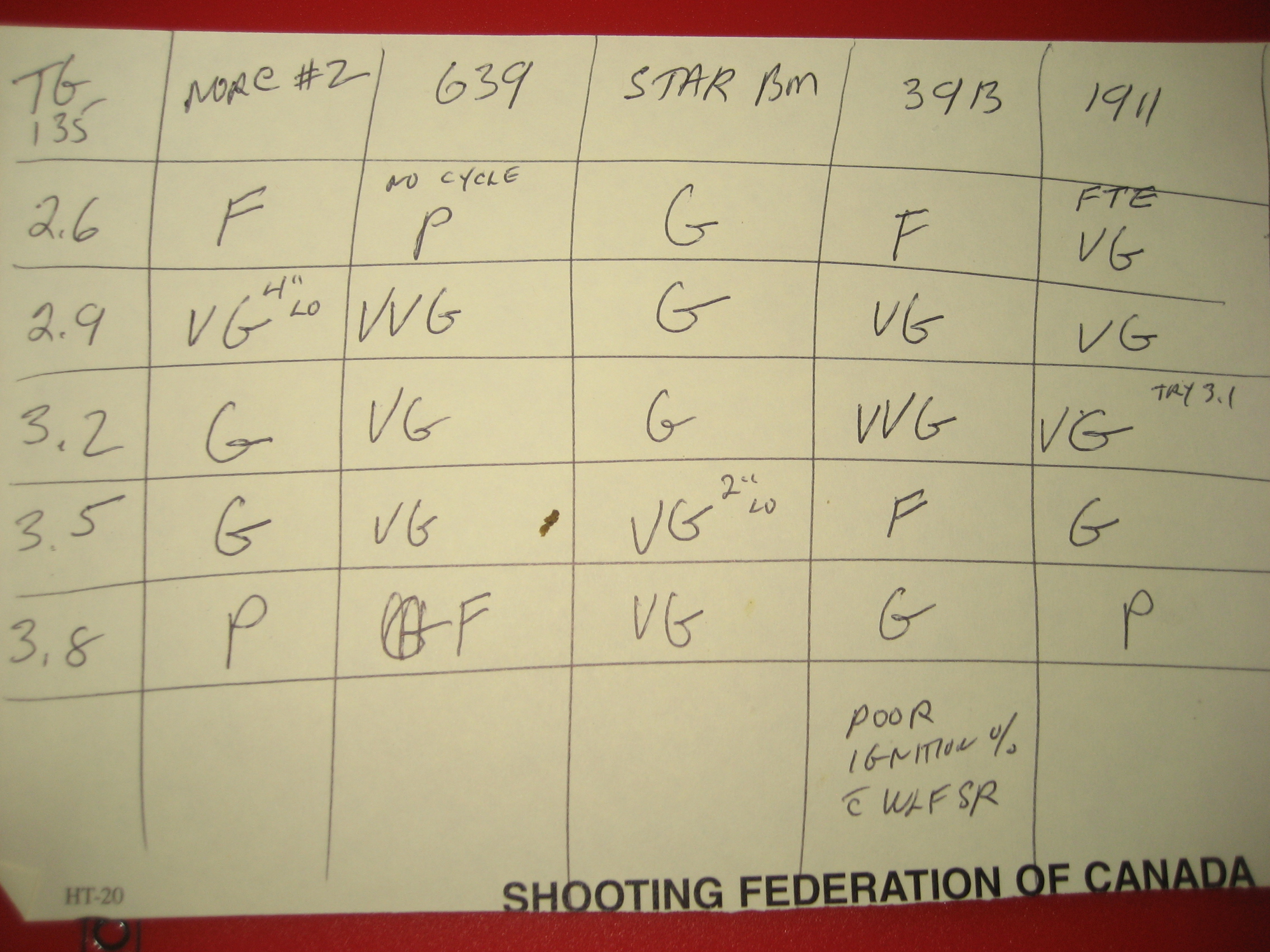
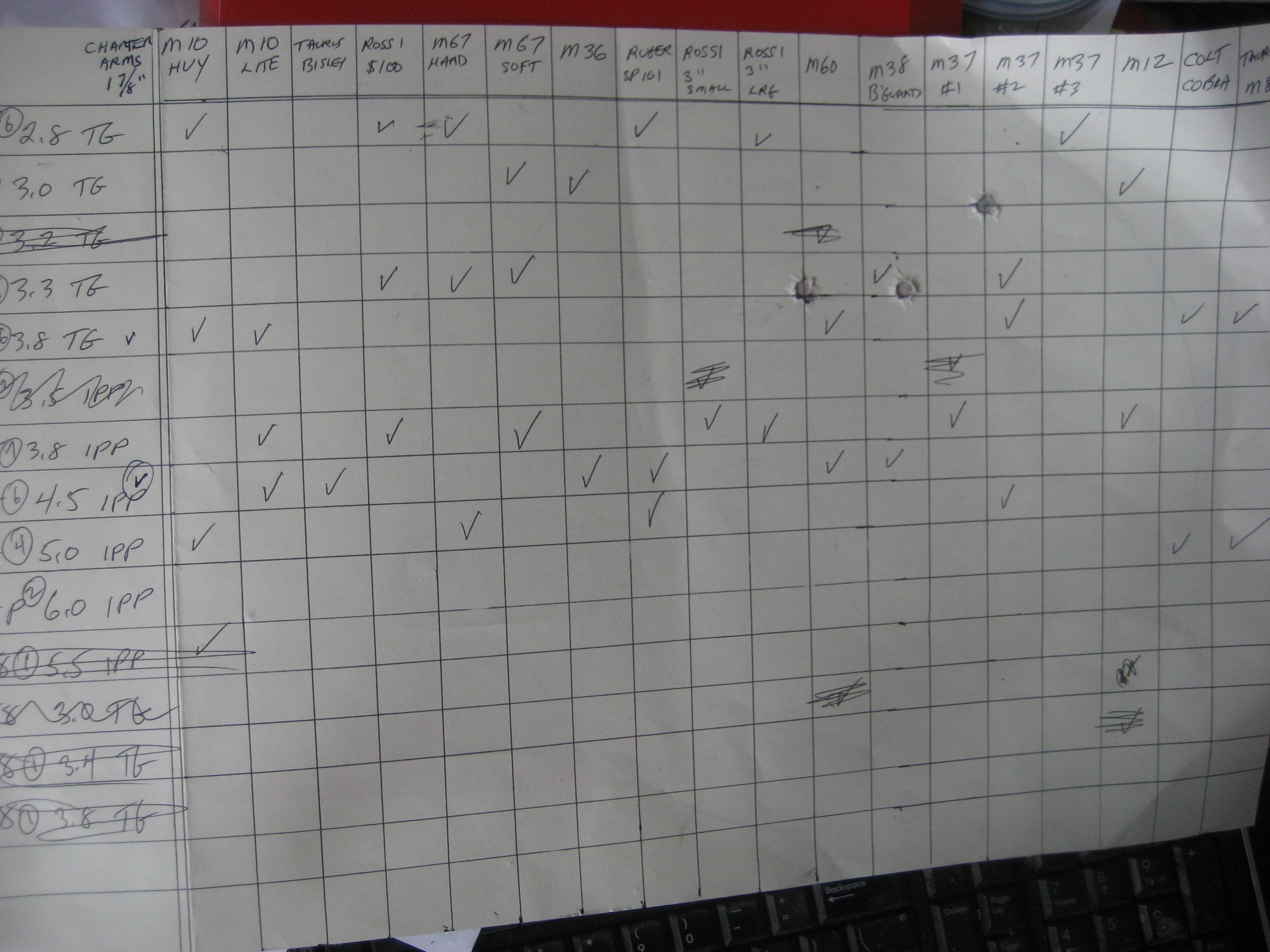
You could load a test of the ammo with increments of 0.5gr of powder. Shoot all the rifles with all the ammo.

Shoot each rifle with the mildest load. Then repeat with the next load. This allows the rifles to cool.

Then record the results and see which load got the most VG or better results.

oyyCBcw.jpg


HZKsIZp.jpg
 
I am at present loading for 3 different rifles chambered in 308 Norma Magnum. All have favorite loads that differ.
I have a separate set of dies for each rifle, so I do not have to re-set the adjustments.

As Ganderite has stated, you can start each with milder loads and work up carefully. A Chronograph is mandatory, IMHO.
If a specific load shows promise in one or more firearms, that can be pursued. Otherwise, different components may need
to be explored.

Here is how my 3 rifles eventually turned out. Loads are listed, but DO NOT USE any of these unless you work up carefully.
All rifles are custom/ semi-custom.

M700 Remington action, 26" McGowen 1-10" twist, Favorite: Norma case, WLRM primer, 74.5 grains of IMR7828, 180 grain Scirocco II
Commercial Mauser [Santa Barbara] action, 26" Benchmark 1-9" twist, Favorite: Norma case, Fed 215 primer, 75 grains of Reloder 25, 200 Accubond [or Partition]
Ruger #1B [A re-chambered factory barrel] 26", 1-10" twist, Favorite: Norma case, WLRM primer, 75.5 grains of Retumbo, 210 grain LRAB

All these loads are sub-moa in the rifles shooting them. Other loads do work in each rifle, but these are what works best.
All velocities are what I expect to get from these rifles. [180 @ near 3100, 200 @ 2975, 210 @ 2950]

I also load for multiple 30-06 rifles and 6mm Remington rifles, each with differences in preference. Dave.
 
Eagleye - yes, I agree - I do have rifles here with a "favourite" load that is different from the "favourite" of another rifle in same chambering. I think that is part of reloading challenge - to fine tune to get as best precision as possible.
The various competitions over the years got me wondering though - how do they do that? 308 Win Gold Medal Match, for example. The Norma loads for Swede competitions that I mentioned. I suppose everyone is not getting to use the most "precise" for their rifle, but seems to be a way to come up with "good enough" for many rifles? Without having "excursions", etc.
I will likely follow advice in Post #3 - essentially do up a pressure test involving each rifle here and see where the commonality or "good enough" ends up. Not sure that approach allows me to bring an additional rifle into the group, though, without doing the increments first. Maybe that is just the way it is for us home hand loaders. We do not have pressure barrels, so have to go with surrogates...
 
Personally, I'd just pick a middle of the road loading and give it a try. If it's acceptable for you're level of plinking, just use it. In my iron only bush guns I just load for max velocities and don't even bother with putting it on paper until I'm done. Even then it's just a sighting and rough consistency check. I kind of consider doing this generic loading the same as buying factory loads as they're just a generic single loading. If you have major problems, then consider a different loading.

If I'm loading for a non precision rifle(eg. Lee Enfield), I just pressure check and roll with it a lot of the time. Keep it consistent and it'll be ok.
 
Last edited:
Have been reading about Swedish shooting federation competitions - apparently the "standard" ammo used by all competitors in a match is / was the same - 130 grain Norma factory rounds. No special loading allowed to compete.

If all competitors use standardized ammo, they are likely choosing a rifle that works well with that specific ammo. Kind of a reverse engineering from how we normally experiment with different loadings to find an accurate load for a specific rifle, they probably experiment with different rifles to find one that likes that specific ammo.
 
From the experience of many years of doing the Swiss Matches, you realize you may be able to tune a rifle to a particular batch/lot of decent issued ammo.
I'm talking GP11 here, not old IVI. :)

Action screws torque, barrel bands, shims..etc.

When a K31 eventually starts opening up it grouping, then it gets retired from military matches to handloads.
 
Last edited:
If all competitors use standardized ammo, they are likely choosing a rifle that works well with that specific ammo. Kind of a reverse engineering from how we normally experiment with different loadings to find an accurate load for a specific rifle, they probably experiment with different rifles to find one that likes that specific ammo.

Actually, from what I read in the Crown Jewels book, it is a pretty finite list of rifles that are allowed, and a very finite list of mods or authorized gunsmiths who can work on them. Apparently the old Model of 1896 is still "approved", on up through the CG63 and CG80 and now includes a Sauer (202?). But the list of rifles was quite short - 5 at the most? It seemed they went to quite an effort to standardize what the shooter's came to the line with - shooter skill was supposed to be what counted - not the depth of his or his sponsor's pocket book.
 
In general, Swiss and I assume Swedish regs are for pretty much as issued military rifles with minor enhancement in the way of sights.
Over the years more commercial extras have been allowed, but if taken too far, then you have to compete in the Match Rifle category with the $,$$$.00 rifles.
 
Many countries still use issued ammo for competitions and practices. I have shot in some countries where it is illegal to have ammunition in your possession unless you are on the range. These countries do not allow handloaded ammunition.
 
OP, I went through a long process of doing chamber casts from 20 different Swede Mausers.

All were in excellent condition.

They consisted of 7 M96, 7 M96/38 and 6 M38.

I couldn't measure more than a thousandth of an inch difference on any diameter and even that could be attributed to the casting media.

The chambers were about as close to identical as you could hope for.

The differences showed up on the bolts locking lugs and the locking recess shoulders in the receiver first and when the bores were measured second.

I went through a similar conundrum as you presently are, around thirty years ago.

I was hand loading for a dozen or so "friends" who just weren't interested in reloading themselves or couldn't grasp the fundamentals to the point I didn't trust them to use my equipment at the time, especially concerning powder types and resulting pressure curves.

You've been at this long enough to understand the ramifications.

The cartridge I agreed to load for them was the venerable 30-06 Springfield. They had to provide all of the brass and I would purchase the primers, powder, bullets, which they paid me for later.

I agreed to load two bullet weights for them, 165 grain, Speer, flat base, spire point, over 57 grains of IMR4350 and CCI250 LR primers/2800fps. The second was again Speer, 200 grain round nose, flat base over 57.0 grains of surplus "4831" from three blended lots and CCI 250 LR primers/2600fps.

That was the easy part.

The most difficult part came with Overall Length of the loaded rounds. All of the rifles had different chambers and throat lengths as well as mag well lengths.

These rifles consisted of several different commercial makers and a couple of bolt action, sportered milsurps, from P17s to K98s, to Springfield O3s.

This proved to be a bit of a dilemma for me. I was really into Hunter Bench Rest at the time and had the accuracy bug (still do). The thing is, none of the folks I was reloading for, were interested in anything more than adequate for Bear, Deer, Moose out to 300 yards.

Sooooooooo, this is what I settled on.

Partial resizing of necks and bodies, keeping the brass from each rifle as a proprietary lot and loading to 3.365 in overall length.

None of the rifles proved to be tack drivers with these loads, but all shot within 2moa out to 300 yards. Adequate for most hunting conditions.

Now, back to the Swede Mausers.

I wanted to put together a bunch of components I had purchased from International Firearms and gifted by Tom Higginson, back around 1980, including brass, 160grn round nose bullets and CCI200 primers with #44 powder (imr3031).

I didn't want to just shoot one of the rifles I had but several, for whatever reason I had at the time, which I believe was to use the rifles with the Junior Shooters from our club, that were interested in shooting center fire, open sights.

As the chambers were close to identical, it boiled down to a powder charge, seating depth combination that would be reasonably accurate in all of the rifles.

The load I settled on was 34 grains of #44, slightly slower than imr3031, 160 grain cupro/nickel, exposed core, round nose bullets over CCI 200 primers/2200fps from the M96s, seated to 3.175 overall length. Again, when the cases were reloaded, partial body/neck resizing only, but this time, the brass wasn't kept proprietary to any specific rifle.

The results, were very similar to the 30-06 experiment.

The 6.5 x 160 grain surplus bullets I was using were acceptable but certainly not match grade.

They shot as well as could be expected out of rifles that all appeared to have been freshly rebarreled before going into long term storage, before dispersal.

With experienced shooters, those loads all shot to sub 2moa at worst and mostly better. They just fit into the mag wells.

The issue with surplus M96 and M38 rifles is their LONG THROATS, which, if over generous in diameter, as milspecs usually are, is not conducive to accuracy.

My mixed batch of rifles shot well enough, with a "standard" load for all. Well enough that none of the shooters or even the Juniors felt hard done by, if they didn't get a specific rifle.

When I developed the "standard round" for these rifles, I found they all shot best at close to maximum for this particular powder.

I didn't bother to try lighter bullets, simply because I had 20k of the 160 gr fmj and recoil was mild enough for small statured shooters. No sense in fixing what was working.

In your case, you'll likely be using 130 grain match projectiles and, your results might be better.

Hope this helps a bit.
 
Last edited:
Actually, from what I read in the Crown Jewels book, it is a pretty finite list of rifles that are allowed, and a very finite list of mods or authorized gunsmiths who can work on them. Apparently the old Model of 1896 is still "approved", on up through the CG63 and CG80 and now includes a Sauer (202?). But the list of rifles was quite short - 5 at the most? It seemed they went to quite an effort to standardize what the shooter's came to the line with - shooter skill was supposed to be what counted - not the depth of his or his sponsor's pocket book.

That was the original intent, basic issued weapons, issued ammo. As the Swedes started falling behind in the ISSA matches, more and more mods were allowed, first with the CG63, but it still had to be all "Swede Made", then with the CG80. Then when they still were not up to snuff, they turned to Danish S&L barrels/sights/triggers as permitted mods. The Danes had been using the same kind of setup, same ammo, but rifles were built up on surplus K98's, and were doing quite well in ISSA matches.
The 96 has a slower lock time and lighter, less stiff action then the 98's, just can't make up that difference. In the end the CG80's had American laminated walnut stocks, mostly Danish barrels and triggers, sights from various makers, not much Swede left in them except the receivers.
 
I load for around 20 M1 carbines. I use a standardized load with plated bullets that runs at about 85% of std load. It functions all of my rifles and is reasonably accurate in most. None show pressure signs, some are quite accurate. In my specific shooters, each has an accuracy load for that rifle.
 
I set the die for the rifle that required the shortest seting. Then made washers out of shim stock for the other one.
 
Actually, from what I read in the Crown Jewels book, it is a pretty finite list of rifles that are allowed, and a very finite list of mods or authorized gunsmiths who can work on them. Apparently the old Model of 1896 is still "approved", on up through the CG63 and CG80 and now includes a Sauer (202?). But the list of rifles was quite short - 5 at the most? It seemed they went to quite an effort to standardize what the shooter's came to the line with - shooter skill was supposed to be what counted - not the depth of his or his sponsor's pocket book.

And any shooter who has spent any time in competition would be testing several of those rifles and choosing one that shot better. That's what I was getting at, because we know some rifles will shoot better than others, even if they are the same model from the same factory.
 
Gotcha, now! Had read similar in Ganyana's writing (Dr. Don Heath) - his younger days shooting competitively - has good discussion about "precise" rifle - with specific loadings, etc. versus what he calls an "accurate" rifle - does "good enough" for task no matter what kind of loads it is fed. Was using 303 British in his day, I think - competitions could end up using ammo from just about anywhere around the globe - did not know what it would be until it has handed to you (the particular lot had to have met some sort of British service ammo standard) , but everyone up and down the line got the same, that day.
 
Back
Top Bottom