Reloading for semi 223 opposite of what I expected to happen

Munkey1973

CGN frequent flyer
Rating - 100%
79   0   0
Location
Regina, SK
I've been reloading for F Class T/R for quite some time now, but I have no experience reloading for black rifles.

If you're familiar with Sierra 77 MKs, you will know that they do not have cantaloure (spelling ?) rings so you can't crimp the case mouth.

My black rifle seems (to me) to have a very strong spring that really slams hard into battery.

I made a few dummy rounds as I wanted check the Cartridge Base To Ogive CBTO before and after they peel off the mag and go into battery.

My expectation was that if anything was to change in CBTO, then it might get shorter.
Thinking maybe the gun won't ramp/feed quite right and in the worst case scenario, the bullet tip might hit the chamber on the way into position and shorten it up.

This was not the case at all.
One round increased in CBTO by 0.002, another increased by 0.003, and a third was completely unchanged.

Why is this happening?
Is just like the effects of using an inertia hammer to separate projectiles ?

Can I possibly correct this with more neck tension (again, can't crimp Match Kings)?

I usually induction anneal my brass... but I have read an NRA article regarding semi reloads and they advise against annealing for semi... thoughts on this aspect as well?
 
I use a Lee Factory Crimp Die for semi-auto loads. If you're loading on a progressive press it takes no extra time to use it and case length is not totally critical as long as it's in the ballpark. I've seen bullets pushed into the case but I've never checked for bullets pulling out; that's interesting. You probably have less neck tension than most people so a little bit of crimp should help. I like to give it 3-thousandths on the FCD.
 
I use a Lee Factory Crimp Die for semi-auto loads. If you're loading on a progressive press it takes no extra time to use it and case length is not totally critical as long as it's in the ballpark. I've seen bullets pushed into the case but I've never checked for bullets pulling out; that's interesting. You probably have less neck tension than most people so a little bit of crimp should help. I like to give it 3-thousandths on the FCD.

Lee Factory Crimp die if that 2-3 thou bump is bothering you.

Are you guys saying that a crimp die can still be used even though the Sierra 77s do not have a cantelour ring ?

Currently reloading on Foster Co-Ax press, with Redding Body die and Lee Collet Die for the neck... Seating die is overkilled with a Forster Micrometer.

Sorry if it sounds like a dumb question.. but like I said, I am green at semi auto reloading.
 
Yes, I crimp Hornady 60 grain Varmint and 68 grain Match with a Lee FCD - no cannelure

OK well that is good to know. I just had it in my head that only projectiles that have cannelures could be crimped.

I like how the Lee FCD are only a $20 die.

But my god though.. it is going to take a hella long time to make a 1,000 rounds on a Co-Ax with a die 4 die process (Body, Neck, Seat, Crimp).

Good thing winters are long here in Saskatchewan!
 
OK well that is good to know. I just had it in my head that only projectiles that have cannelures could be crimped.

I like how the Lee FCD are only a $20 die.

But my god though.. it is going to take a hella long time to make a 1,000 rounds on a Co-Ax with a die 4 die process (Body, Neck, Seat, Crimp).

Good thing winters are long here in Saskatchewan!

You're thinking of roll crimping. The die rolls the case mouth into the cannelure. The Lee FCD uses a collet with an internal rib to press a ring into the neck near the mouth that transfers to the bullet kind of like an interlock bullet. This is how rifle ammunition is commonly crimped at the factory. The beauty of course is it doesn't matter if the bullet has a cannelure or not.
 
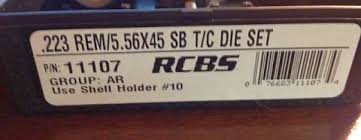
You can also use a taper crimp on your AR15 loads, the RCBS AR Series dies have a taper crimp.

rlWf7Uw.jpg


"RCBS® AR Series Die Sets are a must for progressive reloaders. They feature a Small Base Sizer Die designed for semi-automatic firearms, and a Taper Crimp Seater Die. The Small Base Sizer guarantees the cartridge will rechamber in AR-platform weapons."
https://www.rcbs.com/reloading-dies/rifle/small-base-taper-crimp-die-set---ar-series/780.html

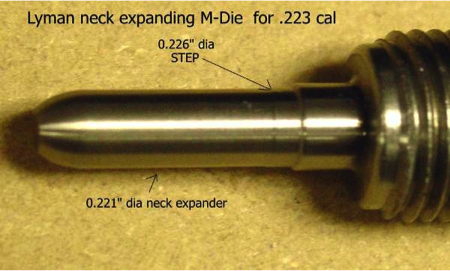
And the Lyman type "M" expander for the .223 has .003 bullet grip. You just bump the case mouth onto the .226 section and the bullets will start "straight" into the case with just your fingers. Meaning NO bullet tilt during seating, then use the taper crimp to streamline the case mouth for improved feeding.

ohIUcpd.png
 
OK well that is good to know. I just had it in my head that only projectiles that have cannelures could be crimped.

I like how the Lee FCD are only a $20 die.

But my god though.. it is going to take a hella long time to make a 1,000 rounds on a Co-Ax with a die 4 die process (Body, Neck, Seat, Crimp).

Good thing winters are long here in Saskatchewan!

you could do the 3 usual steps first in 50 or 100, then come back and crimp them all later
 
With the dies and projectiles you're using I'm assuming this is a precision application. I sometimes use a Lee factory crimp die but set it very light. Too much crimp and it'll impact precision by distorting the bullet. A small change in OAL is probably not going to matter, though.
 
I usually induction anneal my brass... but I have read an NRA article regarding semi reloads and they advise against annealing for semi... thoughts on this aspect as well?

A quick internet search did not bring up anything like this statement. My first instinct is that this is silly advice from someone with no knowledge. Do you recall what the rationale was?
 
Making sure the position of the brass changes with each step ensures you don't miss any. For example, raw brass goes from box to bowl as each piece gets sized, then as you prime each piece goes inverted into the loading block so you can inspect all the primers, then bell and fill and they go in open-end-up, then inspect powder, then each round gets a bullet set and can go back to the loading block as you can easily tell which ones have bullets, then as you crimp they go into the ammo box you take to the range. The sizing and crimping steps are the key ones that don't obviously make a huge difference so you have to be careful not to mix pre- and post-processing rounds by intentionally migrating them to a different container.
 
A quick internet search did not bring up anything like this statement. My first instinct is that this is silly advice from someone with no knowledge. Do you recall what the rationale was?

https://www.shootingillustrated.com/articles/2019/6/23/reloading-for-semi-automatic-rifles-dos-and-donts/

I guess they don't outright advise against annealing in the article I read, but I seems implied to me.

A harder composition helps, because it’s more resistant to expansion and not as elastic. That might sound like a bad thing because harder brass is also more brittle, so it could succumb easier to the toll of additional expansion. Softer brass will conform more agreeably. This is true. It might seem like an equitable trade, but I assure you that it is hardness ultimately that matters most. I notice the softness mostly in primer-pocket expansion—harder cases don’t “loosen” as quickly. A softer case is also more resistant to extraction.


The way I look at, if what they say is true regarding soft cases and difficulty in extraction, then I should avoid annealing (as it prevents hardening).

Obviously I am not worried about soft primer pockets part of the statement as no one I know would willing anneal their primer pockets.,, shoulders and neck only (everybody knows this).
 
Or the OP could make an investment in a 4 hole turret press. I use a Lee. And even though I got rid of the silly auto index rod and turn it by hand, it is much faster then my Co-Ax.

Here it’s set up with pistol caliber dies. Full length, flare, seat, and crimp. For the OP in his case; body, neck, seat, and crimp. Easy, and much faster then a single stage press.

Nice set-up! I have the FX120i with the V3 too.

I used to have a a Hornady Lock n' Load Progressive /with case feeder that I divested of about 12 years ago. It owed me nothing from back in the day when I would burn through 200-300 rounds of 45 & 9 mm a week for about 4 years... that old setup would have worked beautifully for high volume 223.

Unfortunately, with my current volume of shooting for black rifle (about 150 rounds /month) I could not justify the purchase of another press (even if it was a good deal for used).


With the dies and projectiles you're using I'm assuming this is a precision application. I sometimes use a Lee factory crimp die but set it very light. Too much crimp and it'll impact precision by distorting the bullet. A small change in OAL is probably not going to matter, though.

The dies that I am using are remnants of a time when I use to compete in F Class with a 223 (with 90 VLDs).... until I got more experienced and wiser and upgraded to a 308.

While I will always seek the most accurate load possible (in any rifle), these dies are likely all massive overkill for a black rifle application.
Might look at trading them off in the EE for RCBS small base or a Lee FCD set.
 
https://www.shootingillustrated.com/articles/2019/6/23/reloading-for-semi-automatic-rifles-dos-and-donts/

I guess they don't outright advise against annealing in the article I read, but I seems implied to me.


The way I look at, if what they say is true regarding soft cases and difficulty in extraction, then I should avoid annealing (as it prevents hardening).

Obviously I am not worried about soft primer pockets part of the statement as no one I know would willing anneal their primer pockets.,, shoulders and neck only (everybody knows this).

You only anneal the neck and shoulder, and I doubt that makes much difference to extraction - dirty chamber and bolt make a far bigger difference..
 
The dies that I am using are remnants of a time when I use to compete in F Class with a 223 (with 90 VLDs).... until I got more experienced and wiser and upgraded to a 308.

While I will always seek the most accurate load possible (in any rifle), these dies are likely all massive overkill for a black rifle application.
Might look at trading them off in the EE for RCBS small base or a Lee FCD set.

Whether the dies are overkill... maybe, but better than the other way around. In 308 and 6.5CM AR-style rifles with so called match chambers I never had problems with using regular full length sizing dies. No need for a small base die; I imagine a 223 would be the same.
 
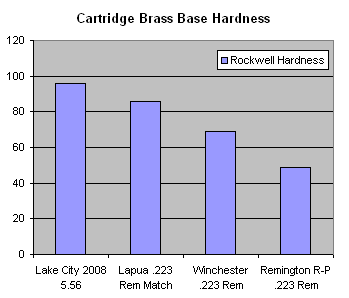
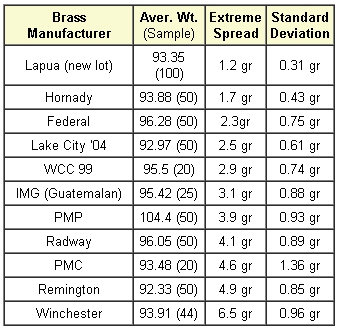
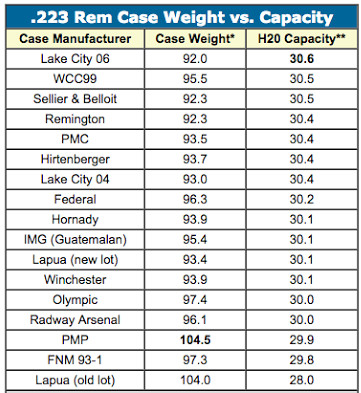
I buy bulk once fired Lake City 5.56 brass because military brass is harder than .223 brass and above average in quality and uniformity. And I would never use Lapua or other higher quality brass in any semi-auto rifle. This is because a semi-auto is hard on brass and makes you go look for your cases after they have been fired. Meaning if I lose a Lake City case I don't cry because they are a fraction of the cost of Lapua.

I size all this once fired brass the first time using a small base die to bring them back to minimum SAAMI dimensions. Then after firing this brass in my AR15 I use a standard Forster full length die. This is because the Forster dies gives me the least amount of neck runout than any otherfull length die.

4kXrGuI.png


PExmCCk.jpg


LjAQ7L9.jpg


The link below will tell you a lot about using military brass and your accuracy. And again if recoil allows the bullet to move then use a smaller diameter expander for more bullet grip.

Save $$ By Using Lake City 5.56x45mm Once-Fired GI Brass
http://bulletin.accurateshooter.com/2019/10/save-by-using-lake-city-5-56x45mm-once-fired-gi-brass/

Accuracy Potential of Mil-Surp 5.56×45 Brass

So, how accurate can previously-fired GI surplus brass be in a good National Match AR-15? Well, here’s a data point from many years ago that might be of interest. A High Power shooter who wrote for the late Precision Shooting magazine took a Bill Wylde-built AR match rifle to a registered Benchrest match. His first 5-round group ever fired in a BR match was officially measured at 0.231″ at 200 hundred yards. This was fired in front of witnesses, while using a moving target backer that confirmed all five rounds were fired.

He recounted that his ammo was loaded progressively with factory 52gr match bullets and a spherical powder using mixed years of LC brass with no special preparation whatsoever. Obviously, this was “exceptional”. However, he had no difficulty obtaining consistent 0.5-0.6 MOA accuracy at 200 yards using LC brass and a generic “practice” load that was not tuned to his rifle.
 
Back
Top Bottom