











































fat tony
CGN Ultra frequent flyer
http://www.okieboat.com/Warhead history.html

Continuous rod warhead test:
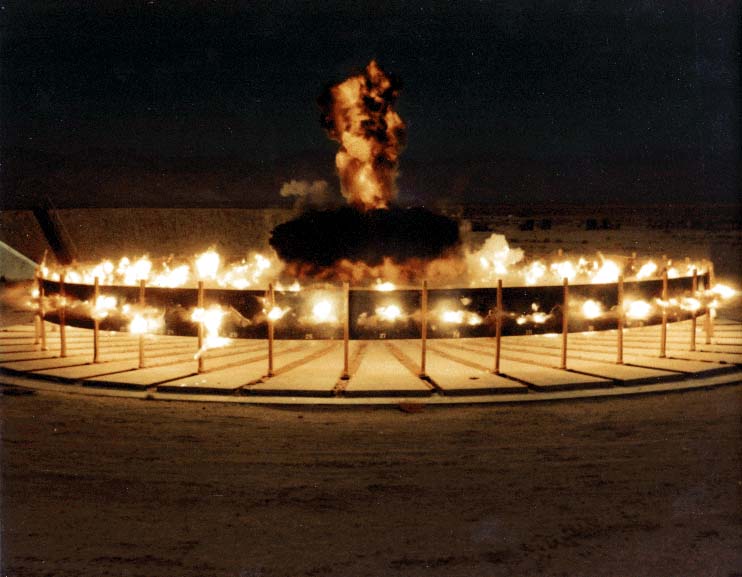
I guess the Rim 8 Talos was huge and not many USN surface ships could accommodate them.
History of the Talos Missile Warhead
Phillip R. Hays PhD LT USNR-R
During World War II most anti-aircraft artillery rounds used explosive fragmentation warheads that scattered small pieces of the shell in all directions around the explosion. Early anti-aircraft artillery rounds used a time delay fuze that was set to detonate a specific time interval after firing. This time delay was calculated to detonate the shell at a desired altitude and was set into the projectile before firing. The time between the calculation of target height and actual firing of the gun caused significant errors, and the error increased as the target speed increased. Often the projectile exploded before reaching the target's altitude or it passed by the target before exploding.
AA fragmentation The development of the radio proximity fuze by Johns Hopkins University Applied Physics Laboratory (APL) during the war improved anti-aircraft accuracy greatly, causing the projectile to detonate when it came close to a target. However, fragmentation warheads had low lethality. During the war many airplanes returned from missions with dozens of holes caused by shrapnel and bullets, with no serious damage. Unless a piece of shrapnel hit a critical component, such as a crewman or an engine, all it did was punch a small hole in the aircraft skin.
A major problem with fragmentation warheads is that the distance between fragments increases rapidly as they move outward from the explosion. At some distance the space between fragments is larger than the dimensions of the target and the chance that a fragment will hit the target is very small. To have a high probability of causing serious damage the shell must explode very close to the target where blast effects become significant. Further studies at APL in 1944 showed that for shrapnel to penetrate deep into a target it needed a velocity near 10,000 feet per second, much higher than the 3,000 to 4,000 feet per second common with anti-aircraft shells.3 Clearly the fragmentation shell was marginally effective.
Direct attack on an aircraft's airframe is the most effective method of destroying the target. The airframe is the largest component and cannot be protected. The effect of damaging the airframe may be immediate disintegration of the target. Experiments were conducted using larger fragments that might be sufficient to cut through structural elements in an aircraft. Artillery shells were machined with parallel grooves as shown in the picture.3 When the shells exploded they broke apart into long rods which were much more massive than small fragments, and were capable of cutting through heavier parts of an airplane. When they ripped through the aircraft skin the resulting gash often tore open in the airstream causing great damage. However, these shells produced a relatively small number of rods, and like ordinary fragmentation shells, these rods moved apart rapidly and the chance of hitting a target decreased with range. It was necessary to explode the shell very close to the target. Still, these shells were considerably more lethal than ordinary fragmentation rounds.
When the Johns Hopkins University Applied Physics Laboratory began development of Talos they realized that they needed a more effective warhead for the missile. Unlike anti-aircraft gunfire, which attempted to fill the air with numerous rounds to improve the chance of hitting a target, only one or two missiles were to be fired at each target. They must have a much greater probability of success than an anti-aircraft projectile.
Continuous rod warhead test:
I guess the Rim 8 Talos was huge and not many USN surface ships could accommodate them.
Last edited: