Rookie reloading question

dariush49

Member
Rating - 100%
11   0   0
Location
Markham, Ontario
Hi, I'm rather new to reloading and have a rookie question.

Up to this point every cartridge I've reloaded was using a bullet weight that exactly matched the loading specs in the Lee handbook, but I'm getting into 6.5 Carcano and 8x57 mauser and PPU bullets on the market are a little off from the weight in the manual. For the 8mm the bullets I have ae 198gr FMJ but the loading data is for 200gr, for Carcano its the (.268) 139 gr when the manual load is for 140 gr.

Does 2-3 grain difference in bullet weight matter? I'm assuming it will effect the speed a bit which would change some of ballistics and point of impact, but is unsafe to substitute the bullet when the weight is so close?

Thanks
 
I do not like using inaccurate data, so do spend time looking - and sometimes not finding - actual lab pressure tested data. As a rule, I would see nothing "risky" about using a 198 grain bullet in a "Start" load from 200 grain bullet data. I probably would not worry too much about using 202 grain bullets with 200 grain "Start" loads. But ALL my loading is based on having started from a published pressure tested Start load, and working up in 1 grain or even .5 grain steps to get where I want. For every cartridge (I have 19 different die sets) and for every bullet weight, and for every powder used. So I have done many "pressure" series, and do not remember ever getting a "surprise" - some rifles, cartridges, bullet and powder combo's "hit my limit" before the book said they would. For some others, I think I could probably go further than the "book" says. But all started at a "Start" level.

Can not swap out bullet styles, either - a solid mono - like a Barnes, versus a Speer HotCor, versus a Partition can behave much differently, so my reference above was using data for same bullet type...

So far as I know, the Richard Lee organization does not do pressure testing - pretty sure all that they publish comes from powder or bullet makers who do actually do pressure testing. I always prefer to see more than one data set - recent example - an acquaintance loading 175 grain bullets in a 7mmSTW - went to Nosler website and used their table - which has an error - the powder weights show there for 175 grain bullets were exactly the same numbers as shown for their 160 grain bullets - we found that by checking against actual Nosler, Speer, Hornady and Sierra manuals, and also an older Hodgdon manual that did list loads for 7mm STW with 175 grain Partitions using H1000 powder.
 
Last edited:
Using a bullet a few grain lighter is of no concern. If you were using bullet a few grain over what is published - then you will have to go back to starting load and work up.

I like to use data from the bullet manufacturer or powder manufacturer since they do pressure testing and generate data based on their own current components specs.
 
Last edited:
The SAAMI lists its max chamber pressure for the oldest and weakest action the firearm will be fired in. Meaning the reloading data can be very conservative and on the low side.

That being said the reloading manuals tell you to start at the suggested starting loads and work up. Meaning even if the bullets are a few grains off what is listed start low and work up your loads. And inspect each fired case in your workup load and study the primers. Every rifle and the components used will affect the chamber pressure.

Learn your rifle, then as experience is gained with that rifle your start loads can increase if you change powder or components.

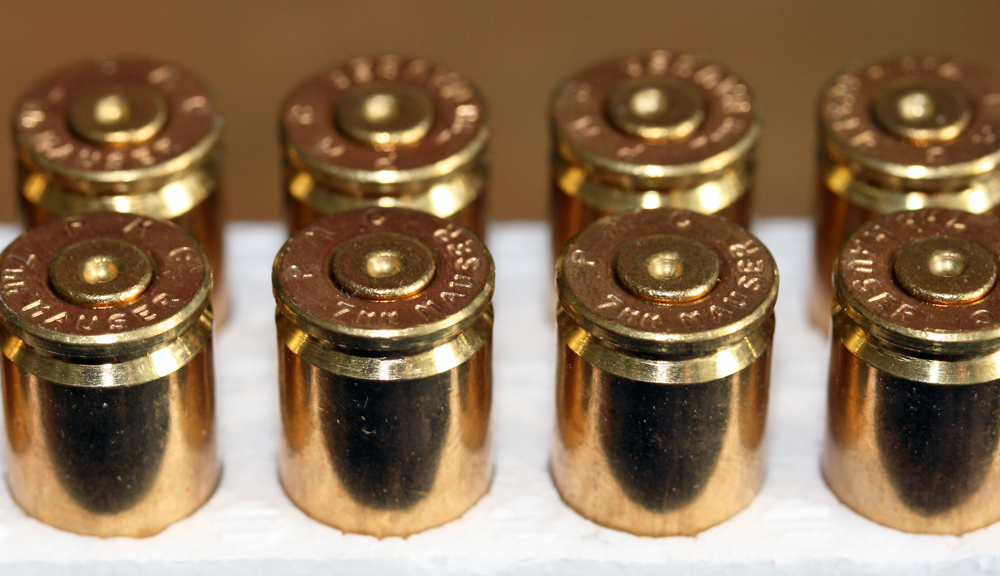
Below is a photo of factory loaded 7mm Mauser ammunition that was fired in a old military Mauser. Look at the protruding fired primers, this means the chamber pressure was so low the base of the case was not pushed back against the bolt face. This could have been caused by a conservative factory load and a worn throat and bore and low pressure.

My point here is when you make a workup load your start loads will have the primers protruding. Then when the pressure increases the primers will become flush with the base of the case. And at this loading point, the pressure is great enough to make the case stretch and contact the bolt face. And from this point on you want to watch for signs of excess pressure.

YLNgBO6.png


Bottom line, look at a few loading manuals and average the start load and work up. And a few grains in bullet weight will not be a problem. And remember any time you change any reloading component reduce the load 10% and work up again.
 
Does 2-3 grain difference in bullet weight matter?

No. The whole point of starting well below maximum and working up is to account for all the tiny differences in leade length, bullet weight, jacket friction, case capacity, etc. As you work up you will eventually hit the point where your specific combination of equipment and components hits its limit, then you stop.
 
The difference in weight does not matter. The difference in bullet shape (bearing surface) is a bigger deal. And each rifle is quite different. Even rifles of the same make and vintage.

Start with the START load, and go from there. Your rifle will tell you what it likes.
 
If you read other manuals, they are going to give you different numbers.

But are you guys all using chrony, how did you know you are at the limit?
 
If you read other manuals, they are going to give you different numbers.

But are you guys all using chrony, how did you know you are at the limit?

Velocity is the by-product of pressure, if you are loading ### powder with ### bullets from the manual, in a barrel the same length as the manual and velocity is close, pressure is close as well.
 
I do use a chronograph. Have read too many credible articles that velocity is the only reliable indicator for a home hand loader to measure, since can not directly measure the actual pressure or pressure curve. Nothing for free - velocity = pressure. If you are magically exceeding book speed, you are also exceeding book pressure. (as Hitzy mentioned though - factoring in barrel length, etc.) Various things like "reading primers", tight bolt extraction, measuring head expansion have all been shown to work sometimes, but not reliably - when measured side by side at Western Powder's lab in Myles City, Montana - pressure techs and writer John Barsness doing the work-ups and comparisons. If you are getting deformities on brass case - like ejector mark, you are not a little bit hot, you are a LOT hot - like way up in the 70,000 psi range where brass starts to flow. Not a "sign" that you actually want to go by - you actually never want to get anywhere near that high.

Works the other way also - if pressure tested data in manual says they got 2,800 fps with x grains powder with y bullet, Z case and Q primer with a 22" barrel, and you are getting 2650 fps with yours, using identical components - your bore is worn, your free-bore (aka: ball seat) is longer or larger, your chamber is larger, your powder lot is different - no reason can not increase powder charge beyond the book until you get to that speed - you will have matched the pressure they got to with their outfit. But can only play that game if you match exactly the components that they tested with - no substitutions. And vice versa - quite possible to be a grain or two short of book loading, and have hit that 2,800 fps. You are done - you are matching their pressure.

Can not tell you were this came from - but I am very comfortable with a load if about 3rd or 4th reload, the primer pockets are still nice and snug when seating new primer - that case head has not been "mushed" by excess pressure. But have to get to that 4th or 5th load to know that. Not really helpful on the first firing - unless the primer falls out - that is bad - too much for what you are using - could even be defective brass, but for whatever reason, that combo is not good at all.
 
Last edited:
I will also add that you need to pay attention to the gun you are using any load in...not every gun design is as strong as the next...there are new-manufactured rifles currently on the market that will come apart long before any pressure signs become visible to the fired case or primer.
 
The SAAMI lists its max chamber pressure for the oldest and weakest action the firearm will be fired in. Meaning the reloading data can be very conservative and on the low side.

That being said the reloading manuals tell you to start at the suggested starting loads and work up. Meaning even if the bullets are a few grains off what is listed start low and work up your loads. And inspect each fired case in your workup load and study the primers. Every rifle and the components used will affect the chamber pressure.

Learn your rifle, then as experience is gained with that rifle your start loads can increase if you change powder or components.

Below is a photo of factory loaded 7mm Mauser ammunition that was fired in a old military Mauser. Look at the protruding fired primers, this means the chamber pressure was so low the base of the case was not pushed back against the bolt face. This could have been caused by a conservative factory load and a worn throat and bore and low pressure.

My point here is when you make a workup load your start loads will have the primers protruding. Then when the pressure increases the primers will become flush with the base of the case. And at this loading point, the pressure is great enough to make the case stretch and contact the bolt face. And from this point on you want to watch for signs of excess pressure.

YLNgBO6.png


Bottom line, look at a few loading manuals and average the start load and work up. And a few grains in bullet weight will not be a problem. And remember any time you change any reloading component reduce the load 10% and work up again.

I had this happen with the starting loads using published (nosler and hodgdon) load data for H4831SC in my .25-06. There were some fairly large discrepancies with that cartridge/bullet/powder combination for some reason.
 
Back
Top Bottom