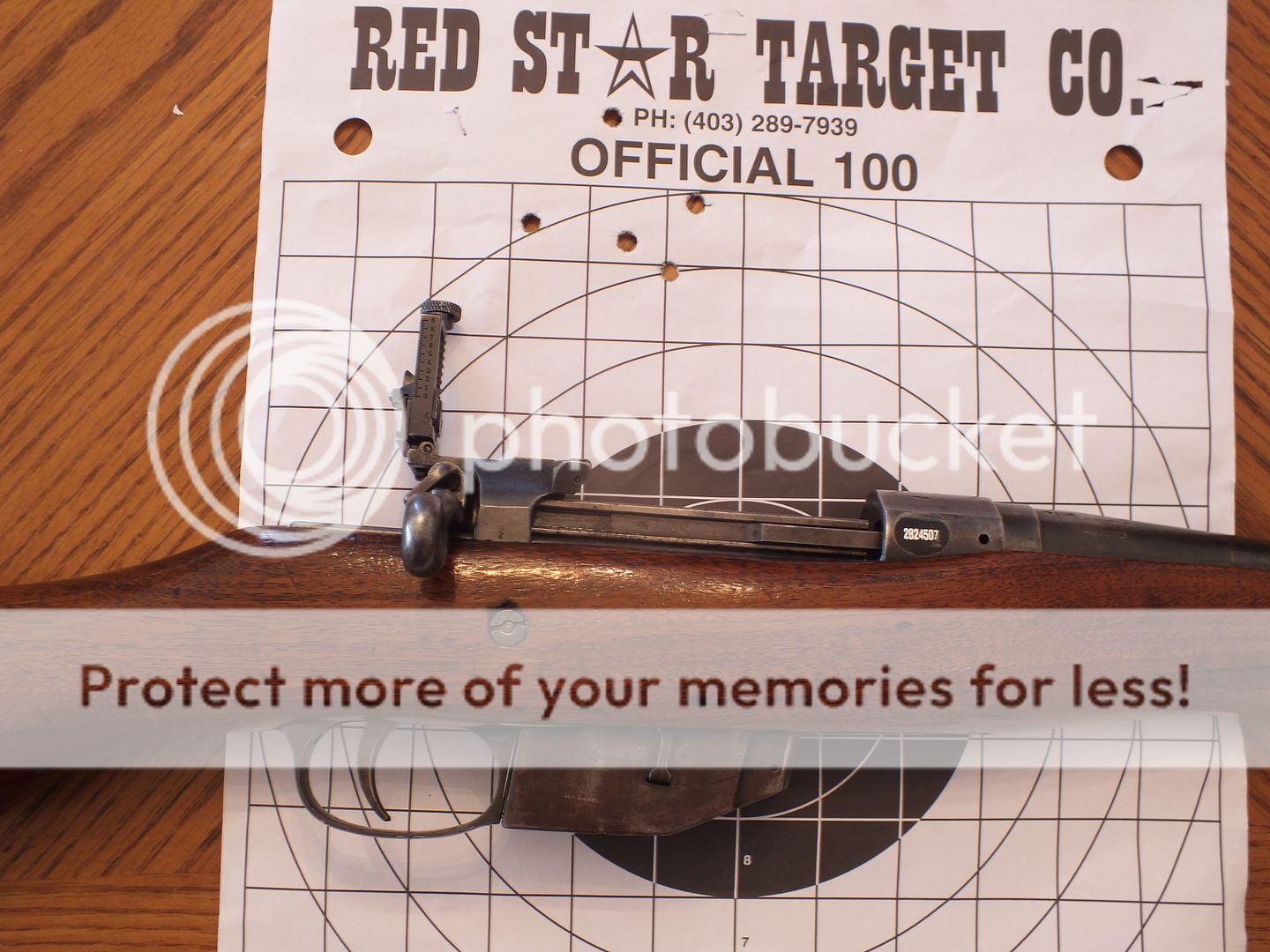
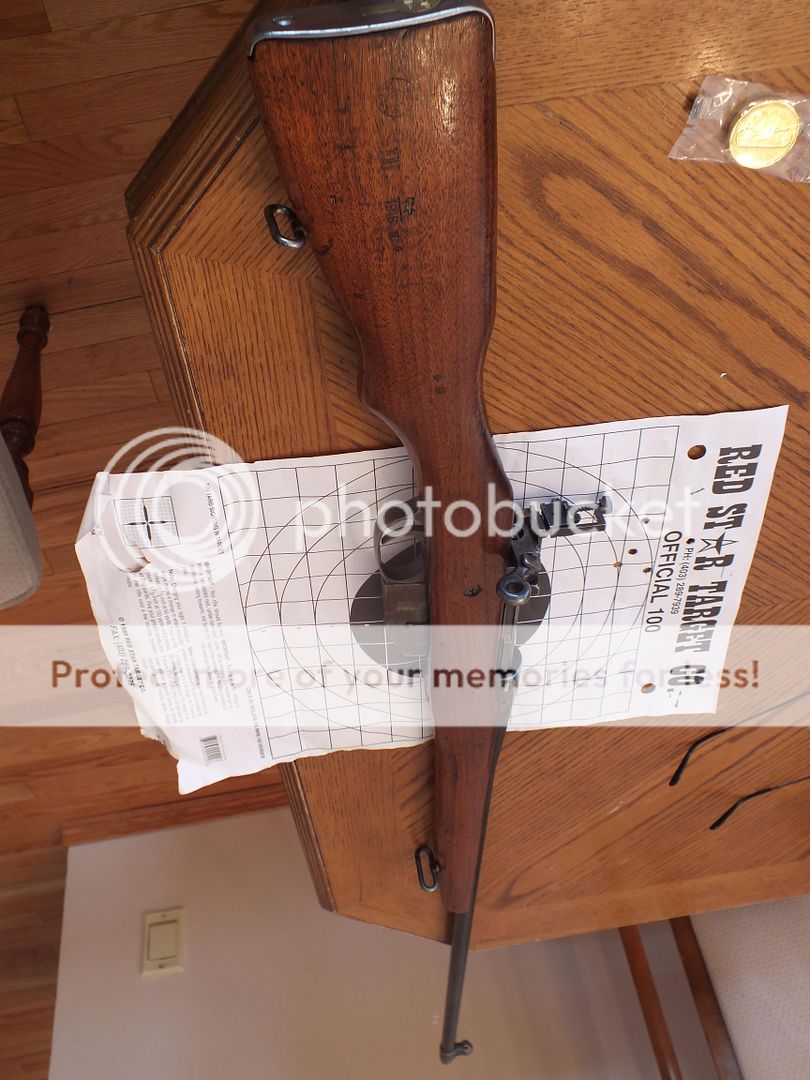
Ross M10 loads.

Dogleg

CGN Ultra frequent flyer
Rating - 100%
115   0   0
My son decided that his first ever purchase on his PAL was going to be a gunshow M10. The stock has been cut and its not exactly wearing all its blueing. After test firing it with a long string:) and some factory Remington Corelocts it seems at least safe. I was able to squeeze out one 3 shot group of about 1 1/2" at last light, but for the most part he was shooting it and I was "coaching". Coaching to the extent that I don't know anything about Ross sights beyond what I could surmise by staring at it. With him shooting 2" to 4 inch 5 shot groups seemed to be normal.we found a position on the thumb-wheel windage adjuster and on the numerical scale to get it approximately sighted in. I tightened the tension screw a bit so it would stay there.

Anyway, here's some questions. The rear sight seems to have about 30 thousands of vertical play on the aperture. Whether that is normal or due to wear or a bent frame I don't know. When I lift on the screw the aperature scribe line does seem to align better with the yardage marks.

Next, handloads. I think there are both Hornady and Sierra bullets available locally and I have a pretty decent stock of powders. I've got a ton of 4320 and if its suitable it wouldn't hurt my feelings to start with that. Ordinarily I'd just assume that neck-sizing is the way to go, but these straight pull bolts are un-charted territory.

Any thoughts or advice besides keeping that roll of string handy?


Last edited:
Yummy I like Ross rifles. Firstly, get rid of that stupid sticker. The serial number is present and it is located among the markings on the butt.

The scale on the face of the sight is in yards and the scale on the right of the sight is in minutes. When you say that the aperture moves, do you mean the entire unit, or just the little plate with the hole? If the whole thing, including the screw, moves up and down then your frame is bent and not providing the proper tension to keep it stable.

As for loading, you should always bump the shoulders back for the Ross. It does not use straight and flat lugs like a Mauser or Remington rifle, but in fact locks on a screw. If the cases are too long, the lugs will not fully engage and you will have different head space for each and every cartridge. The difference is not great enough to be dangerous, but it is plenty large to reduce accuracy. You don't necessarily need to full length re-size the cases, but they do need to be closed upon without any effort.

Another thing to look out for is the bolt. If there is a small rivet on the left side of the bolt then you never have to worry, but if there isn't you have to be very careful when dis- and re-assembling the bolt. Easy to remember though, when the bolt head is horizontal, there should be about 1" or one thumb-width between the back of the lugs and the front of the carrier.

also, and this from experience, ALWAYS have the bolt stop engaged. On many occasions I have forgotten and whacked myself in the face with the bolt when cycling. Also, if the gun fires out of battery (which with proper assembly will never happen) that stop will prevent the bolt from exiting the rifle.

Other than that, fire away. If your bore is in good condition, you can usually accurately use the boat-tail bullets.
 
Nice looking rifle. Hard to tell from the photos but is the barrel full length? I see it has the front sight hood. If the barrel is full length it would make a great restoration project for him.

For load, you could try 35gr of 4895 under a Sierra 180 pro hunter and see how that goes.
 
Very nice rifle!!

I have one that is identical to that one. The Ross rear sight is a very good sight but they seem to get a little sloppy with age. Mine has a little play like you've described but it doesn't seem to effect my groups.

If the barrel is indeed full length then light loads are all you need.

My go to load for 100-300 yards is 35 grains of IMR 4895 with a .312" 174 grain round nose bullet. That load is usually good for MOA to .75 MOA groups.

I also more often then not shoot 180 grain gas checked cast bullets with 13 grains of red dot shotgun powder. Some of my best 200 yard groups have been while shooting cast.
 
The barrel is 30 inches. So I have to lose the sticker, straighten the sight frame, find .:
312 bullets. I do have lots of both 4895s.

Restoration might be a little ambitious, but what would we need besides a stock? Oddly, I have a bayonet, there was one on the farm for as long as anyone can remember. Nobody even knows where it came from.
 
Is it 30 inches from the muzzle to the bolt face with the bolt closed?

You will need a hand guard, mid band, nose cap, and a stock. Some parts are only available as repros. As far as I know they aren't readily available yet, but maybe soon. I'd like to get my hands on a restorable MkIII soon.
 
With that 35 grains of 4895 under a 180 Sierra bullet you should be getting about 2340-2350 ft/sec from that 30.5" barrel.

This is 100 ft/sec UNDER the standard 2440 from the SMLE, but the Ross DID "shoot harder" by about 150 ft/sec just from the extra length of barrel. If you are firing genuine Mark VII Ball ammo from a Ross, it will come out over the chronograph about 2600 ft/sec: quite respectable for a 174-grain bullet and just 100 ft/sec less than what the .30-'06 was doing with a 150. The old .303 is no slouch! This seems to be a very accurate velocity for these rifles, well in line with the by-test investigations made at the Royal Laboratory during the development of the Mark VII cartridge. Military ammo was loaded a bit (about 10%) hotter than the most ACCURATE load.

Be sure to seat your Sierra 180 Pro-Hunters out to full length of a military Ball round (3.05"). Due to the different ogives on the slugs, this crowds the leade just a tiny bit, but the rifles like it like that. Your accuracy with factory ammo tells you one thing: THIS one can SHOOT!

I neck-size and slightly bump my brass. After initial firing, I have no idea how long it will last. Have some brass here which is coming up to 20 shots apiece and no sign of problems, although I do anneal the necks every so often.

Isn't that Trigger just WONDERFUL???

It would be nice if we could see a close-up of the markings on the Butt. The original Factory numbers are there but there look to be other markings as well. Rosses carried their Canadian military histories on their BUTTS, much as in Australian practice. When they were in BRITISH Service, some were marked on the metal. There is an excellent chance that you can trace at least a part of this actual rifle's Service career...... and that can be awe-inspiring. Last year, for example, I was able to find a Ross (chopped) which had been used in combat by MY old regiment, 30 years before I was even born! What a RUSH that was!
 
Hey Smellie,

Where do you get those Sierra Pro Hunters? I have asked just about every gun shop around here and Nada. Some carry sierra brand but never heard/cant obtain the pro hunters you are talking about. If you have a source, please share!
 
BTW, I threw away my roll of Ross Rifle String about 50 years ago.

If you are still nervous about the tales, pull the Bolt halfway back. You should be able to lay your THUMB across the Bolt between the from edge of the Bolt Sleeve and the back end of the Locking Lugs. If you can do this, it is safe. Actual clearance is about an INCH (25mm).

The ONLY thing that can make it UNsafe is removal from the rifle, followed by a partial disassembly, followed by reassembling it the WRONG way, followed by reinserting it into the Rifle. Using the "Rule of Thumb" test, an UNSAFE Rifle will show only a quarter-inch (about 6mm) between the Bolt Sleeve and the Bolt Lugs.

A Ross Bolt with the PIN installed can NOT be assembled incorrectly.

Very important point: the Ross Bolt CAN NOT get out of adjustment by itself. It REQUIRES human intervention to become unsafe, same as most other rifles.

There is a Sticky on Ross assembly on this forum.

I would advise scooting over to milsurps dot com and taking out a (free) membership. Then you can download the original MANUAL for this rifle, along with a pdf copy of "Shoot to Live!", which is by far the best manual ever written on using aperture-sighted military rifles. the book was written around the Number 4 Rifle, the Ross having been relegated to POW guarding and to the RMLI, but most of the book is applicable to shooting the Rosses anyway.

Nice rifle! Welcome to the most exclusive Club in Milsurpdom!
 
@ Dannyd123:

Gun shops around here stock them. It might be because I have told them that if they don't, I will damn well go to the Denturist and get some teeth so I can BITE them. They seem to be worried about being bitten by an Old Phart, anyway!

Actually, the Pro-Hunter is Sierra's cheap line of bullets. I usually have them because they are the only thing for a Lee-Enfield, which has that everlasting ENFIELD rifling but which often requires OBTURATION..... which the nice FLAT base will give you.

They are a standard item and any shop should be able to order them in for you.

If you can't find the Sierra 180 Pro-Hunter, try for a box of Hornady 174 RN flatbases. They work very well also at the moderate velocities at which the .303 shoots its best.

I have a Ross here which likes the same ammo as my scoped P-'14: 40 grains of 4064 with a Hornady 150 Spire Point. I seat these to the OAL of a Ball round also: 3.05". Looks a bit funny but the rifles like it.

Hope this helps.
 
Hey Smellie,

Where do you get those Sierra Pro Hunters? I have asked just about every gun shop around here and Nada. Some carry sierra brand but never heard/cant obtain the pro hunters you are talking about. If you have a source, please share!

The reason that you can't find bullets is because both sierra and hornaday have stopped production of their .311 and .312 bullets for 6 months to a year to catch up on production of their more common bullets.

I feel your pain, this summer I shot 4-5 boxes of hornaday 174 grain .312 bullets, when I got down to my last box I went to get more. Couldn't find any, then I thought "ok, I'll buy some of those Sierra bullets Smellie shoots" and came up empty handed. I placed an order at 2 stores but they haven't gotten any in.

Oh well I guess it's cast bullets in my Ross, Lee Enfields, and my mosin this summer.
 
Yeah, we all feel the pinch.

Looks as if I am gonna be on the Harris Load this year myself. O'Bummer still has the USA's knickers in a knot although it seems to be getting a bit better.

Nice to know that we MIGHT expect some slugs by deer season, anyway.

BTW, Remington and Winchester both make a FLATbase .303. Have you looked for those?
 
The string just seemed like a reasonable precaution, considering that it was a completely unknown and old rifle. I've got 18 years invested in that kid, and I'm too old to start over with another one.;) The empty cases look reasonably good, and if it never let go in 2 boxes I'm thinking it probably won't.

I'll see about getting Caleb to take some more pictures of the butt stamps, and perhaps get some help tracing some of the history. His great grandfather whom he was named after fought and was wounded at Passendale.
 
Yeah, we all feel the pinch.

Looks as if I am gonna be on the Harris Load this year myself. O'Bummer still has the USA's knickers in a knot although it seems to be getting a bit better.

Nice to know that we MIGHT expect some slugs by deer season, anyway.

BTW, Remington and Winchester both make a FLATbase .303. Have you looked for those?

Thanks for the info! Already have the 150gr Hornady and 4064 for my P14 from your suggestions a couple years back. Thanks for the suggestion to use it on the Ross. I will try her out. I can also get my hands on some 174 hornady flat. Because its round nose I gues the OAL is different than the Sierra OAL you posted. I will play around with it. Didnt know rem and winchester made flatbase! I'll keep my eye out for em.
 
Sunnuvvab**ch! Another!!!

That little marking under the wrist of the stock is an UNKNOWN marking. It is done in the same place as some Canadian Overseas Battalions marked their rifles. It LOOKS LIKE a Canadian marking. But there is one tiny problem: there is, never was and quite possibly never will be, a Canadian military formation with the initials PHAB.

Our best thinking to date is that it is a BRITISH marking standing for PRIDDY'S HARD AMMUNITIONING BASE. Priddy's Hard now is a combined museum/housing development in Portsmouth, England, outside the area of the original Harbour installations. It was the storage depot for all the ammunition used by the Navy. A ship leaving the Dockyard and preparing for sea would make a final stop at Priddy's Hard for ammunitioning. Once tied up, the ship could take on board all the ammunition, pyrotechnics, torpedos and explosives they could ask for, everything from .303 to 15-inch. The facility was as far away as they could get it from the main Dockyard, this for safety reasons: who wants to spend a year repairing a ship, only to sit it next to 10 million pounds of Amatol which is one of the enemy's main targets?

Information is scarce on exactly what was stationed at Priddy's Hard for security staff. But we DO know that a very few Mark III Ross Rifles exist with PHAB-1 and PHAB-2 markings. I have both here.

We DO know that the Royal Marines Light Infantry marked many of their Rosses with PLY for Plymouth, CRB for Crombie..... and a few have popped up marked PH, which we assume means Marines stationed at Priddy's Hard. The PHAB rifles marked as yours are believed to be NAVY rifles, the RN making use of many thousands of Rosses during BOTH World Wars. So much for the rifle that wasn't good enough!

But nobody knows for sure.

Other markings on the Butt are the Ross Rifle Company - Quebec roundel, the DC with Broad Arrow denoting Canadian Government property, the III with which all Mark III rifles were marked, and the serial number of the rifle.

The serial is in 3 parts, the NUMBER above the YEAR, with the LETTER GROUP off to the right. So far (with my poor eyesight) it looks like Rifle Number 74, Letter Group HG, of 1918. Perhaps someone with better eyes might correct me (I hope).

Hope this helps.
 
Here is a set of instructions for the Ross MkIII backsight written by a British marksman during WWII for the use of Home Guard formations equipped with the Ross. The language is a bit idiosyncratic, but he understands the subject! [Previously posted first by MkVII and later reposted by Diopter]

Our military authorities occasionally issue weapons, especially to the unfortunate Home Guard, with totally inadequate, and some cases complete absence of information as to how to use them. The Ross rifle is a case in point. Most people manage eventually to worry out the mysteries of the bolt, but generally the backsight defeats them. The Editor has asked me to ensure that readers at least of The Rifleman shall be properly informed.

There have been several variations of this sight issued in past years, but all those I have seen in this country are of the model described here. It has two " battle sights", which are cut-away apertures both fixed to the slide, which also has an ordinary or closed Aperture. The normal position of this slide is of course, at the bottom of the leaf, and the leaf down. The battle sight which then shows is set for 600 yards, NOT 400 yards. There is no 400 yard battle sight on this Ross.

If you now flip up the leaf, the other battle sight shows. This is (with the slide at the bottom as stated) set for 1,000 yards. The idea is that against an advancing enemy, the soldier starts shooting with this battle sight up, when they are 1,000 yards away and until they reach 600 yards away. He then flips the leaf down and continues with the 600 yard battle sight aiming down (if he knows the trajectory) when they get closer. A very good idea, too - if anyone were ever told about it. Both these battle sights have, as I said, cut-away apertures. They are variously referred to by the ignorant as "open sights," "modified U's," "buckhorns," and all kinds of things; and instructors instruct recruits to "get the blade in the centre of the U and level with the shoulders."

It is pathetic! Imagine any rifle designer fitting an open sight at two inches from the eye! Not outside Bedlam [an insane asylum now the home of the Imperial War Museum.] No - use them exactly like any other aperture. Just imagine if you like, that the bit of the ring cut away at the top is still there, and go ahead. It is cut out to let more light through in bad light, and to enable you to pick up your object quicker. But as no British soldiers or Home Guards ever practise shooting in dusk at natural targets, they would not know this. Nor would they know anything about the virtues of white sight-paint and shooting with both eyes open - things which the stalker learns in his cradle and which soldiers should be taught but never are.

However, we are supposed to be talking about the Ross Sight. As stated, there is an ordinary aperture, at the bottom of the slide, which has the 1,000 yard battle sight at the top. This aperture is for all accurate deliberate fire. It is raised up the leaf by a quick thread screw, and on the face of the leaf are range markings in yards. This series of figures starts at zero, and then 2, 3, 4, 5, 6, 7, 8, 9, 10, 11 and 12 hundred yards. There is no 100 yards. One hundred is never used as a range marking in war, and if you want to set your sight accurately for 100 for practice (grouping) you have to find the elevation, somewhere above zero, for yourself.

On the right edge of the leaf is a scale. This is not another series of hundreds of yards markings; its zero is level with the other zero. There is no other connection. It is meant to be used for targeting the rifle exactly like the scales on civilian .22 rifle sights which have no ranges marked on. This scale is marked from 1 to 9. These are tenths of an inch. Each division is again divided up into four. One-tenth of an inch, at this sight radius, gives you near enough, ten minutes of angle. A quarter division therefore gives you a quarter of this, or 21 minutes of angle; and this is the finest adjustment shown. There are no "clicks" but you can of course set the sight to finer adjustment by judgment. The scale is probably intended chiefly to enable a man to take exact readings of the sight on this scale for the various ranges, if the rifle does not agree exactly with the range markings, as it seldom does, owing to the impossibility of standardising precisely such things as stocking and barrel flip and jump.

Behind and at the bottom of the leaf is a triple knurled head which works the wind gauge. There is on the front of the leaf a wind gauge scale marked in twentieths of an inch. Each of these of course, gives five minutes of lateral angle. They are not divided any more finely and intermediate settings are obtained by the knurled head. The wind gauge is of course a very convenient means of adjustment for straight shooting. [Once zeroed] It should then be left alone. Wind allowance is not done now by wind gauge in military shooting.

By the way, there is a very simple way of checking the range to which these or any other battle sights are supposed to be set as follows. Fix the rifle firmly in a vice or the like with the 600 yard battle sight and foresight lined up correctly at a mark - any mark, at any distance - it doesn't matter. Now raise the leaf (without moving the rifle) and screw up the slide until the aperture in the bottom of it comes correctly to the same aim. If you have done it right, you will find that it has come up to the 600 yards mark. That is your check. Similarly, with the leaf up and slide at the bottom, line up the leaf battle sight with the mark. Then screw up the slide until the aperture comes to the aim; it will be at the 1,000 yards mark. You can check a P.14 or M.17 similarly. When with the P.14 you will find that the battle sight aim agrees with that of the slide aperture at 400 yards, as a rule. I have found a few which were set for 300 yards. The battle sight on the M.17 agrees with the leaf at 450 yards. This is because the battle sight is identical and the same height on both rifles, and thus gives a longer range, by 50 yards, to the higher velocity .30-06 cartridge. The leaf sights are not the same, each being correctly marked at the range elevations for its cartridge. (September, 1942.)

 
Last edited:
Back
Top Bottom