












































You are using an out of date browser. It may not display this or other websites correctly.
You should upgrade or use an alternative browser.
You should upgrade or use an alternative browser.
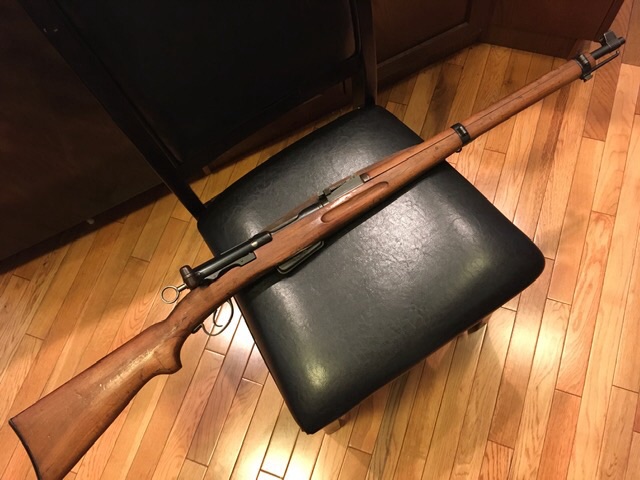
Schmidt Rubins
- Thread starter diopter
- Start date



Come on, it's part of the national ego to claim they have the best of anything.
Grizz
Yeah but buddy is Hungarian.
Yeah but buddy is Hungarian.
Yes sir.
Capandball.eu
Hungary, Budapest, 1036 Bokor street 15-19.
Show map
Phone: +36 1 242-3488
E-mail: info@kapszli.hu

Come on, it's part of the national ego to claim they have the best of anything.
Grizz
Is the same with Lee-Enfield rifle for Canadians. For me as East European Enfield look just an ugly bolt action.

MauserMike
CGN Ultra frequent flyer
- Location
- SW Ontario
Capandball is one of my favourite youtubers. Love his hunting videos - my grandfather used to hunt wild boar in the same woods.

The K31
" The Karabiner Model 1931 was a new design by the Eidgenössische Waffenfabrik in Bern, Switzerland under Colonel Adolf Furrer (1873–1958). The first 200 K31s were made in May 1931 for troop trials (serials 500,001 – 500,200), thus the model number of 1931.
The K31 is a straight-pull carbine broadly based on previous Swiss "Schmidt–Rubin" service rifles and carbines, the K31 was not designed by Colonel Rudolf Schmidt (1832–1898) as he was not alive in 1931 to do so.[1][2] Mechanical engineer Eduard Rubin (1846–1920) was the designer of the 7.5×55mm Swiss ammunition. "
From; https://en.wikipedia.org/wiki/K31
" The Karabiner Model 1931 was a new design by the Eidgenössische Waffenfabrik in Bern, Switzerland under Colonel Adolf Furrer (1873–1958). The first 200 K31s were made in May 1931 for troop trials (serials 500,001 – 500,200), thus the model number of 1931.
The K31 is a straight-pull carbine broadly based on previous Swiss "Schmidt–Rubin" service rifles and carbines, the K31 was not designed by Colonel Rudolf Schmidt (1832–1898) as he was not alive in 1931 to do so.[1][2] Mechanical engineer Eduard Rubin (1846–1920) was the designer of the 7.5×55mm Swiss ammunition. "
From; https://en.wikipedia.org/wiki/K31

Adolf Furrer
Furrer was born in November 1873 in Zürich. He enlisted as an officer in the Swiss Army and rose to the rank of Colonel. In 1921 he was appointed as head of the state small arms factory, Waffenfabrik Bern. He also worked to a lesser extent with SIG.
Furrer designed much of the Swiss Army's arsenal during the first half of the 20th century, including the K31 rifle, the M25 light machine gun, and the MP41 submachine gun. The latter gun was plagued with production issues that caused a great amount of trouble for the Swiss Army; Furrer's reputation was damaged by the debacle, as he had invested a lot in marketing the weapon for military adoption.
Many of Furrer's designs incorporated the toggle-lock mechanism popularized by the Luger P08. Even into the 1930s and 40s, when the toggle-lock system had significantly declined in popularity and had been replaced by much simpler designs, Furrer continued to utilize the mechanism in his guns.
After World War II, Furrer retired. He died in 1958 in Minusio, aged 84.






















