









































Scope leveling

AB3006

Member
Rating - 100%
1   0   0
Quick question to the hivemind.

All my rifles have scopes on Weaver bases (rails for Husqvarnas are a bit... spendy).

With the rings and scope mounted, the base doesn't stick out more than 1/8" towards the centre of the scope. It sticks out more to the front, but the "bell end" is pretty close to it, and I can't see the level being able to clamp on.

Do you have any tricks for leveling the scope to the gun?
 
Quick question to the hivemind.

All my rifles have scopes on Weaver bases (rails for Husqvarnas are a bit... spendy).

With the rings and scope mounted, the base doesn't stick out more than 1/8" towards the centre of the scope. It sticks out more to the front, but the "bell end" is pretty close to it, and I can't see the level being able to clamp on.

Do you have any tricks for leveling the scope to the gun?
Step one: check the level. I bought the level level kit. First thing I did was check the level that came with it to two other real levels I had. It was not level.
If you have a framers level and a wall you don’t mind drawing a vertical line on you can set your rifle in a gun vise in front of this line. Take out the bolt and with your scope on low power back sight through the barrel so you can see the vertical line centred in the bore. Then rotate the scope until the vertical cross hair is exactly parallel to the vertical line on the wall.
I find it helps to centre the cross hairs in the scope before you start the process. This also tells you whether or not your rings/mounts are parallel and centred above the bore.

I have found a few Ruger integral mounts and rings to have not been machined perfect and result in the scope mounting crooked to the line of the barrel and action. Sometimes it’s a matter of lapping the rings.

It’s like bore sighting in reverse. Also if you have a target with cross hairs on it that you can mount vertically/level on a wall in front of your rifle you can compare it to when you have the cross hairs vertically lined up with the line behind the gun. This is also used to bore sight.

Put a piece of masking tape on the rear ring and one on the scope tube so you can take a fine sharpie and mark both when they are lined up level. This way when you snug down on the rings you will know the scope hasn’t rotated at all.
The whole idea is to have the exactly aligned above the bore and not have the scope canted.
Clear as mud?
 
I took a proven scope mounted rifle that had the scope mounted as 'square' as could be and gripped it in a padded vise using a level. I inserted a bore sighting device that displayed a grid when looking though the scope. I adjusted the bore sighter to be square with the scope reticle.

Then I placed some Brownell's epoxy gel on top of the bore sighter and placed a plastic level on top of that expoxy and pushed and prodded it until it sat level... checked that the rifle was still level... then let the epoxy cure.

Now I have a bore sighting device that when inserted in the bore of a rifle held level in a vise, I can adjust the reticle to be square to the grid and every scope I mount with this set up will be very close to being square, every time, quickly...

It has worked well for many years... and with various calibers of rifles that were sighted in... you can establish where on the grid you should use as a sighting reference. Seldom do any bore sighting devices line up different calibers on the same spot.
 
I take the rifle out of the stock. Put in a vise. Upside down and put on a bubble level on a flat spot. I got a level that clamps to the barrel. So when I put it in the stock I got a reference. Then I mount the rings. Then I got a plumb line that I hang from the celing, that I align the reticle. And monitor it while I tighten the cap screws.
 
I took a proven scope mounted rifle that had the scope mounted as 'square' as could be and gripped it in a padded vise using a level. I inserted a bore sighting device that displayed a grid when looking though the scope. I adjusted the bore sighter to be square with the scope reticle.

Then I placed some Brownell's epoxy gel on top of the bore sighter and placed a plastic level on top of that expoxy and pushed and prodded it until it sat level... checked that the rifle was still level... then let the epoxy cure.

Now I have a bore sighting device that when inserted in the bore of a rifle held level in a vise, I can adjust the reticle to be square to the grid and every scope I mount with this set up will be very close to being square, every time, quickly...

It has worked well for many years... and with various calibers of rifles that were sighted in... you can establish where on the grid you should use as a sighting reference. Seldom do any bore sighting devices line up different calibers on the same spot.
That ^ is slick. I'm going to pay this idea the ultimate compliment...and steal it. :)

To the OP...whatever you do, don't fall for one of those silly levelling devices that sit on the turret cap of the scope. I have seen a surprising number of scopes of numerous brands...Leupolds, Weavers, Bushnells, an older Zeiss...in which the crosshairs were not perfectly aligned with the crosshairs. If you got the top surface of the elevation turret perfectly level...the crosshairs were visibly off kilter, sometimes to a laughable degree. And if you got the crosshairs leveled using a plumb bob or similar...the turrets were visibly off kilter. No functional problem with that, but heaven forbid if you have even a touch of OCD...:)
 
If your using a Pic or Weaver base the Sphur tool is a great way of getting the scope squared to the rifles bore. I use machinists set up blocks and feeler gauges between the mounting rail and the bottom of the scope. the flat below the elevation and windage dials. Most quality glass has the reticle squared off this flat. Short ranges dont really matter but cant at long distance will cause huge problems.
 
I use the ‘old fashioned’ method. I have a few knowledgeable friends come over for beverages and then I ask everyone to look through my recently mounted scope and render an opinion. Some will say just a few minutes past 12 oclock, others say a few seconds to 12 o’clock, the opinions vary with age, glasses, astigmatism, too many beverages ….and just maybe I ‘might’ tweak it based on the opinions of the most experienced and sober shooters. I’ve tried all the gimmicks out there and as mentioned by others here they may not necessarily yield the correct results for a variety of reasons. At the end of the day when you step back from the rifle/scope and look at the crosshairs at the lowest power you should see the 6 o’clock portion of the crosshair dead center over your breach/barrel. The tricky part is to then tighten down your ring screws carefully/equally without inducing a slight rotation to the scope tube. If it twists, and it will, you have to go through the whole process again including more adult beverages for your assistants. Cheers !!
 
I get the bottom 1/2 of the rings installed loosely & put the scope in place so I can adjust both the spacing of the rings on the scope tube & figure out positioning of the scope for eye relief. Then I'll tighten down the bottom half of the rings.

Then I mount the rifle in a gun vice that I have, using a small bubble level to get the rifle level & ensuring it doesn't move. I've used the receiver, rail or more rarely, the bottom half of the rings to accomplish this.

I then put the bubble level on the elevation cap of the scope & place it into the rings.

I slowly tighten down the top rings, ensuring the bubble stays centred.
 
Last edited:
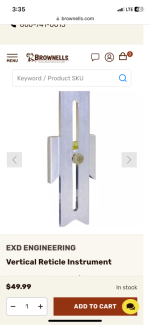
The product in post #7 is perfect for non pic rail bases. It will allow for you to center to the center line of the barrel, then follow the plumb line reticle method and mount a level to the scope using a level object ( vertical or horizontal ) at whatever range your focus is good like J. Eagleman explains. This can reduce horizontal error by cant, that increases by multiples with increasing distances. A properly leveled scope with a scope mounted level is one of the best things you can do to improve your consistency. Cheers
 
I use the paper method. make a straight line lengthwise on a sheet of paper, make marks with a felt pen on the buttstock on the top and bottom of the buttstock exactly in the middle on the recoil pad. (you are marking the center point of the stock) now put the paper on the floor and put the buttstock of the rifle exactly on the line so the marks on the top and bottom of the buttstock line up exactly with the line on the paper. ( the rifle doesn't have to be perfectly vertical) with the scope loose enough to adjust, look backwards through the scope down to the paper. ( you have to leave enough paper showing so that you can see it through the scope, as much showing as possible) align the crosshairs in the scope to the line you made on the paper and the scope is aligned to the rifle. works very well with a bright light shining down on the paper, but not through the scope.
 
Do you have a reference scope mounted level on you rifle (electronic or bubble level) when you shot? Even if you mount your scope level you may not be holding the rifle level when you shot.
 
I've been using Jay's method for over 10 years, although first levelling the rifle in a solid vise per the rail - or ring base if a dovetail. I have a small torpedo level I use for all these processes. I get the ring position set for the scope and eye relief and then level again with the ring bases (verifying both match), then mount the scope by slowly tightening the rings and keeping the level centred - as Jay has described. I've 'checked' with the plumb-line method and my (and Jays) process is verified. I no longer 'do that check' with the plumb. And on a few of my rifles I have those "scope-mounted levels' to ascertain that I'm holding the rifle level - per Mik's question. And My VMTR is on a 419 rail that has the built-in level, too. It does make a diff when I shoot 22LR for MOA accuracy.
 
You know wutt really pizzis me awff?
Clamping the rifle in a vice and then mounting the Weaver bases.
Level rifle by puttink a small level acrosst one base and twisting the rifle too’n fro until it’s level.
Move the level to t’uther base and it’s not level.

😵‍💫
 
You know wutt really pizzis me awff?
Clamping the rifle in a vice and then mounting the Weaver bases.
Level rifle by puttink a small level acrosst one base and twisting the rifle too’n fro until it’s level.
Move the level to t’uther base and it’s not level.

😵‍💫
Yeah... doubly pi$$y for me as all but one of my centerifre rifles are Husqvarnas needing the taller rear mount.
 
I took a proven scope mounted rifle that had the scope mounted as 'square' as could be and gripped it in a padded vise using a level. I inserted a bore sighting device that displayed a grid when looking though the scope. I adjusted the bore sighter to be square with the scope reticle.

Then I placed some Brownell's epoxy gel on top of the bore sighter and placed a plastic level on top of that expoxy and pushed and prodded it until it sat level... checked that the rifle was still level... then let the epoxy cure.

Now I have a bore sighting device that when inserted in the bore of a rifle held level in a vise, I can adjust the reticle to be square to the grid and every scope I mount with this set up will be very close to being square, every time, quickly...

It has worked well for many years... and with various calibers of rifles that were sighted in... you can establish where on the grid you should use as a sighting reference. Seldom do any bore sighting devices line up different calibers on the same spot.
Awesome, I’m absolutely stealing your trick/tip.
Many thanks for your contributions sir, I learn a ton from your comments and now you’ve inspired me to hit the shop as it seems I have a new project.
Thanks :)
 
Back
Top Bottom