Setting Up Resizing Dies

OldDude

CGN Ultra frequent flyer
Rating - 100%
13   0   0
Location
Ottawa
Has anybody tried or considered using a go headspace guage along with a feeler guage (0.002" to 0.004") under the base of the headspace guage to set up a resizing die? I'm thinking of the typical bottlenecked rifle cases here.
The thought occurred to me that with the go guage being the smallest end of the tolerance range, the feeler guage under the base would move the shoulder of the die into somewere about the middle of the acceptable headspace. Obviously, any internals (decapping rod, etc) would have to be removed for the initial setup, and only light to moderate finger tight before locking down the resize die's locking ring.

Any thoughts on this, or is this out to lunch?

OD
 
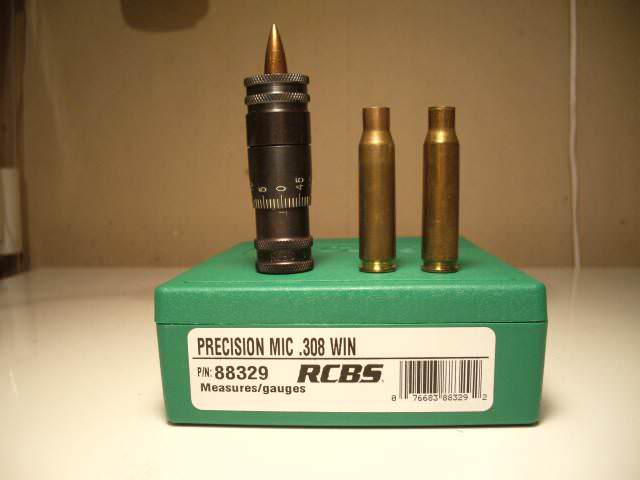
If you have a Hornady cartridge case headspace gauge or any type comparator gauge you can measure a fired case and set your die.

Right now I'm sizing 250 bulk once fired Lake City 7.62 cases and I adjusted the die using a .308 GO gauge by measuring the cases.

This give me a sized case .002 shorter than a fired case with these cases not fired in my Savage .308.

I'm also using Redding competition shell holders and the +.004 shell holder that pushes the case .004 "less" into the die.

This would be like placing a .004 feeler gauge between the die and shell holder for less shoulder bump.

Just remember that chambers and dies vary in size and if using a GO gauge length "plus" a .002 to .004 feeler gauge are used it could be excessive sizing, meaning shoulder bump.

Bottom line you need to find the headspace length of a fired case and set the die for minimum shoulder bump for the type rifle.

Below you need to set your die to bump the shoulder back .001 to .002 below the red dotted line.

wm05ArY.gif


NOTE, I was experimenting with these Lake City 7.62 cases using a standard .308 Lee full length die and a RCBS small base die. And the lee die would push the shoulder back .002 more than the RCBS die. And both dies were reducing the body diameter the same amount which means the Lee die is on the small side.

So again using a GO gauge and feeler gauges doesn't tell you the length of a case fired in your chamber. And each type and make die will need to be adjusted for your chamber.

A GO and NO-GO gauge is used to set headspace on a new rifle or when replacing a barrel. And you have .010 between the GO gauge and the Field gauge or approximately .007 wear from the NO-GO gauge before the rifle has excessive headspace.

Below the first comparator gauge I bought but it is caliber specific, meaning only good for the .308 or .243.

fXsKe7r.jpg


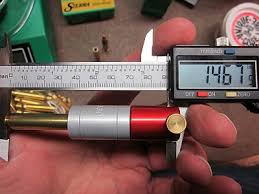
Below my Hornady gauge that can be used with almost every caliber and is much cheaper the the RCBS gauge.

In the photo below I'm measuring a fired .223/5.56 case from my AR15 rifle. And then I set the die for .003 shoulder bump, and do not need a GO gauge and feeler gauges to guess.

H0SXHH8.jpg
 
The only gauge that matters is the chamber.

You can measure your feet, or you can try on your boots. One might work; the second will work.

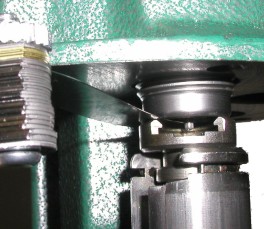
Dogleg is 100% correct and before comparator gauges the simple trick was to use feeler gauges between the die and shell holder until the sized case chambered freely.

7FfXhJ7.jpg


And you would use thinner and thinner feeler gauges until the case chambered freely with no resistance closing the bolt.

Meaning the comparator gauge is just another method to find the correct amount of sizing and not have to dissemble the bolt for using "feel" when closing the bolt.

I can't feel .001 to .002 shoulder bump and prefer using comparator gauges and check my fired and sized cases. This is because of brass spring back after sizing and the number of firings the case has had.
 
A head-space gauge works from a datum line that is entirely arbitrary. There is no reason to think that is the point where your case contacts the chamber or where the go gauge contacts the die, or where the go gauge contacted the chamber in the first place. The amount of spring-back on the case is variable, so measurements taken from it are just a good guess as well.

What you're suggesting is just a good guess, coupled to a good guess, combined with another good guess, based on a good guess.

Trial fitting might take a bit of trial and error but it isn't a guess. It is what it is.
 
Just to clarify, I was thinking of using the feeler guage under the base of the go guage, not between the shell holder and die, when setting up the die. This *should* move the guage up in relation to where the fired cases would be in the sizing die. I'm inclined to think that this would result in a case that's go guage length plus the thickness of the feeler guage. The feeler guage would not be used under the case when resizing.

I've thought about using a fired case to get an indication of the chamber length, but I'm puzzled on how, other than trial and error, one would set up the sizing die based on that measurement. There is an awful lot of free play in the 7/8-14 threads, after all.
 
Just to clarify, I was thinking of using the feeler guage under the base of the go guage, not between the shell holder and die, when setting up the die. This *should* move the guage up in relation to where the fired cases would be in the sizing die. I'm inclined to think that this would result in a case that's go guage length plus the thickness of the feeler guage. The feeler guage would not be used under the case when resizing.

I've thought about using a fired case to get an indication of the chamber length, but I'm puzzled on how, other than trial and error, one would set up the sizing die based on that measurement. There is an awful lot of free play in the 7/8-14 threads, after all.

A set of of Redding competition shell-holders will change trial and error into progressive testing until perfection is achieved. Setting FL dies by screwing coarse threads on springy presses is bit of a fantasy in the first place, although its better than nothing. Its a bit like measuring with a micrometer then cutting with a chainsaw.
 
A set of of Redding competition shell-holders will change trial and error into progressive testing until perfection is achieved. Setting FL dies by screwing coarse threads on springy presses is bit of a fantasy in the first place, although its better than nothing. Its a bit like measuring with a micrometer then cutting with a chainsaw.

I'd looked at those as well. But, me being the frugal type (aka cheap) a single go headspace guage is less than a set of the Redding competition shellholders.

On the topic of sloppy threads, I wonder if a layer or two of Teflon pipe tape might help to take up the slack in the threads, at least until the lock ring is tightened. Just a keyboard thought, BTW, I haven't done it yet.....
 
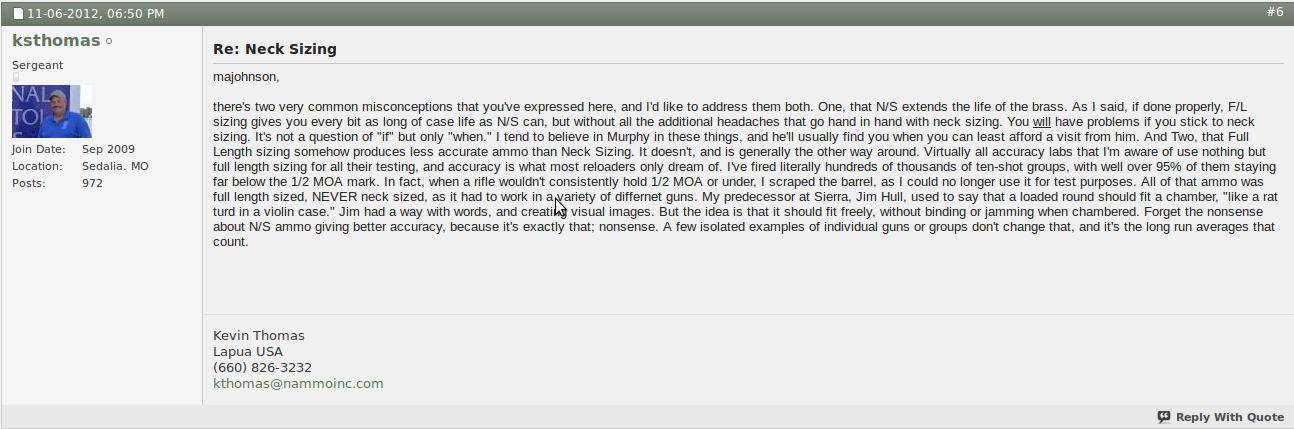
The late Jim Hull of the Sierra ballistic test lab had a humorous saying about full length resizing and proper amount of shoulder bump and said the following.

"The cartridge case should fit the chamber like a rat turd in a violin case." Meaning give the cartridge a little wiggle room and let the bullet be self aligning with the bore.

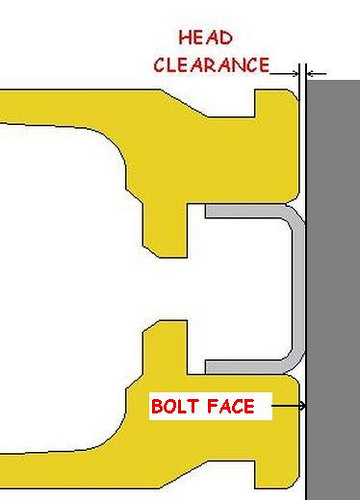
And one of the points with this is having enough head clearance between the rear of the case and the bolt face.

Meaning if the case warps when fired the first time the base of the case will not be 90 degrees to the axis of the bore. And if the case touches the bolt face it can tip the case and cause alignment error with the bullet in the throat. And when the case has .001 to .002 shoulder bump and head clearance a warped case has less effect on bullet alignment.

HK76WCp.jpg


I was just reading last night about a study showing brand new unfired cases having better accuracy than reloaded cases. And this dealt with uneven case wall thickness and the cases warping on the first firing.

German Salizar at the now closed "The Rifleman's Journal" website did a article on this and why shoulder bump/head clearance was important. What this boiled down to was the bolt face supported the rear of the case and the bullet in the throat supported the front of the cartridge. And the only part of the full length resized case that touched the chamber is the case shoulder. And the only thing touching the rear of the case was the ejector button.

So again you can not "feel" .001 to .002 shoulder bump or head clearance because the ejector is rubbing the rear of the case. And if you can feel the rear of the case rubbing the bolt face you do not know if the case is warped testing bolt closing force. And this one of the reasons the vast majority of competitive shooters full length resize with the proper amount of shoulder bump.

And the reason I bring this up is because I bought three boxes of Remington cases and over half the cases warped when fired the first time. And snug fitting reloads more than doubled the group size. The thumb rule is .001 to .002 shoulder bump for a bot action and .003 to .006 shoulder bump for pump and semi-autos.

And as another example below neck sized ammo has little to no head clearance and no wiggle room.

Y3IiYL5.jpg
 
Dogleg is 100% correct and before comparator gauges the simple trick was to use feeler gauges between the die and shell holder until the sized case chambered freely.

7FfXhJ7.jpg


And you would use thinner and thinner feeler gauges until the case chambered freely with no resistance closing the bolt.

Meaning the comparator gauge is just another method to find the correct amount of sizing and not have to dissemble the bolt for using "feel" when closing the bolt.

I can't feel .001 to .002 shoulder bump and prefer using comparator gauges and check my fired and sized cases. This is because of brass spring back after sizing and the number of firings the case has had.

BigEdp51:
I'll have to try this. It definitely appeals to my frugal side, especially since I already have feeler guages.
To be honest, the go guage idea came to me one day while on the throne. Some strange thoughts occur in there at times.......
 
I'd looked at those as well. But, me being the frugal type (aka cheap) a single go headspace guage is less than a set of the Redding competition shellholders.

On the topic of sloppy threads, I wonder if a layer or two of Teflon pipe tape might help to take up the slack in the threads, at least until the lock ring is tightened. Just a keyboard thought, BTW, I haven't done it yet.....

I find the Competition shell-holders actually save me money, because it makes it so easy to use the same FL dies on many rifles of the same caliber without adjusting in between. Just use the right shell-holder for that rifle and rock on. Besides; I have a ton of different rifles around and can load practically all of them with 3 sets.

Another advantage is that I can grab my dies and the chosen shell-holder and load on anyone's press anywhere and know that they are going to be sized exactly the same as at home. It's the gift that just keeps giving.
 
I find the Competition shell-holders actually save me money, because it makes it so easy to use the same FL dies on many rifles of the same caliber without adjusting in between. Just use the right shell-holder for that rifle and rock on. Besides; I have a ton of different rifles around and can load practically all of them with 3 sets.

Another advantage is that I can grab my dies and the chosen shell-holder and load on anyone's press anywhere and know that they are going to be sized exactly the same as at home. It's the gift that just keeps giving.

Dogleg, I my comp shell holders drive me nuts, I find they are out of sync 0.001" with my die. I wish they were in 0.001". ( example I wan't 0.002" bump, but the shell holders give me 0.001 or 0.003" )
 
I find the Competition shell-holders actually save me money, because it makes it so easy to use the same FL dies on many rifles of the same caliber without adjusting in between. Just use the right shell-holder for that rifle and rock on. Besides; I have a ton of different rifles around and can load practically all of them with 3 sets.

Another advantage is that I can grab my dies and the chosen shell-holder and load on anyone's press anywhere and know that they are going to be sized exactly the same as at home. It's the gift that just keeps giving.

Another good point about the competition shell holders is you do not need to touch the die for any change in the amount of shoulder bump.

This also allows you have the press cam over no matter which shell holder you use. This helps me because my Rockchucker press I bought in 1973 has a little slop in the linkage.
 
I adjust my dies in one of two ways:

If I get a batch of range pick up brass, or brass intended for a semi or pump or lever rifle (less extraction power) I full length size. I adjust the die so that it is down so far that the ram does not cam over. The die comes down hard onto the shell holder. That is a no-nonsense, no fiddling FL adjustment.

If I have rimmed cases (303 and 30-30) I size just enough that the cases will chamber without resistance, or just a slight pressure on the case shoulder. This reduces case stretch and head separation.

For match ammo I usually neck size. When I need to FL size, I use the +2 match shell holder and hit it hard with the die. With a bolt rifle, I like to feel the shoulder compression as the bolt handle is almost closed.
 
Back
Top Bottom