Shoulder Bumping with the Redding Full Length Die... am I doing this right

Munkey1973

CGN frequent flyer
Rating - 100%
79   0   0
Location
Regina, SK
I am a Type-A Personality (for F-Class reloading) and very new to bump sizing.

I bought some new Lapua 308 Palma brass and I am now getting them ready for their 3rd firing.
I have annealed my brass before every resizing.

Using a Hornady Headspace Comparator my fire-formed cases are reading an extremely consistent 1.627 to 1.6275 headspace before resizing.

I have taken out the neck bushing on my Redding Full Length die and have it set so that the comparator reads 1.6245 to 1.625 after they've been bumped.

(I obviously size the necks separately as the last step).

Approximately one third of my cases will not have the headspace "shrink-down" after bumping
Once in a while the head space will actually grow to like 1.628.
I can feel which cases these are while I'm running them through the Co-Ax Press.... they require lot more pressure and show a bit more wear on the shoulder junction.
I might put a wee bit more wax on them and run them through a second time... it may require less pressure second time around but they still might not shrink.

Firstly....are my expectations (such that all cases should have a near perfect uniform headspace of 1.625) unrealistic ?

If it is possible to a achieve absolutely perfect resized cases (in terms of uniformed headspace), then what am I doing wrong ?
  • Should I turn the die down a smidge more so that these 33% "stubborn cases" will have the same headspace as the "easy cases" all perfectly at 1.623 after resize ?
  • Should I try using a different die in my Co-Ax Press ? Should I try the Forster Shoulder Bump die ?

It almost seems me that an unloaded case that is 1.624 chambers with the same amount of bolt pressure as a case that is 1.628 with the firing pin removed from my Rem700.
So should I even give a sh#t that most cases are 1.624 and the others are still at 1.627 ?
 
The type and amount of case lube, slop in the press and how long the case remains inside the die will effect shoulder location. And pausing at the top of the ram stroke for a few seconds will make the shoulder location more uniform with less brass spring back.

Any excess case lube is squeezed upward and ends up on the case shoulder and effects the amount of shoulder bump.


During full length resizing the case grows in headspace length and then the die pushes the shoulder back down.

wm05ArY.gif


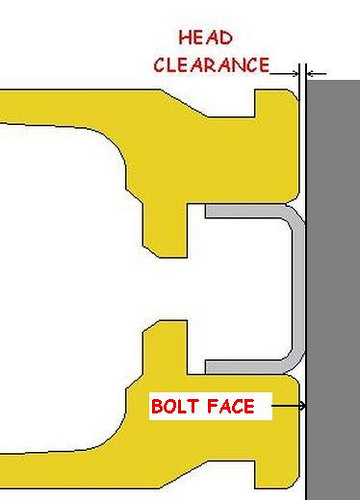
In the video, he ends up resizing the case with .002 head clearance and why the bold drops freely.

HK76WCp.jpg
 
Last edited:
During full length resizing the case grows in headspace length and then the die pushes the shoulder back down.

wm05ArY.gif


In the video, he ends up resizing the case with .002 head clearance and why the bold drops freely.


I've seen that video before (and his other video on how to find the lands) I am following both of these methods step by step.

Looking at the middle of the diagram, I have to wonder if need to walk my die down just a bit more.

Now that I think about it, all of my cases (the stubborn ones and the easy ones) didn't seem to "grow" at all after the first time I bumped them.
 
Munkey1973

With a once fired case it springs back from the chamber walls and becomes smaller than the chamber. And it would take several firing and only neck sizing for the shoulder to be blown out and the case to be a snug fit in the chamber.

I do not strip my bolt like in the video I posted to check the cartridge headspace. I just measure a once fired case and bump the shoulder back .002 to .003. And the video I posted shows his resized cases with .002 head clearance and the bolt handle dropping freely.

With a full length resized case the only part of the case that contacts the chamber is the case shoulder and you have clearance around the case body. The ejector pushes the case forward in the chamber and with the proper amount of shoulder bump the base of the case does not contact the bolt face.

My favorite expression about full length resizing was said by the late Jim Hull of the Sierra ballistic test lab and competitive shooter.

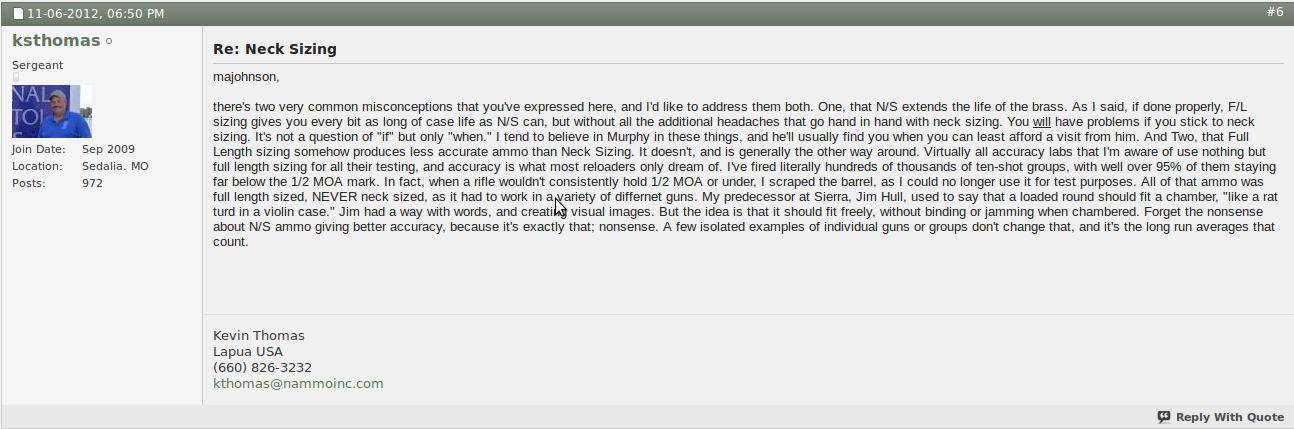
'The cartridge should fit the chamber like a rat turd in a violin case" And below is Kevin Thomas who also worked in the Sierra ballistic test lab and now shoots for Team Lapua USA.

Below Kevin Thomas is telling someone the disadvantages of just neck sizing and "NOT" having the case a snug fit in the chamber. A full length resized cartridge with proper head clearance is supported by the recessed bolt face and the bullet in the throat. Meaning the case body and the base of the case has no guiding effect on the bullet in the throat.

Y3IiYL5.jpg
 
Last edited:
OP, my first thought reading your opening post - maybe re-think just a bit what you are doing. "headspace" refers to the fit between the brass you are using and your rifle's chamber. I think what you are trying to do is to fit your brass to your chamber. But maybe getting hung up on what you are measuring. Most will want to have the cases fit closely - no one else in the world can tell you what "measurement" that might be in your rifle.

So, as has been previously posted on this site, take a case that has been fired in your rifle. It should be able to chamber again. Set up your press and screw down the full length sizing die, but stop about 1/4" or so from the shell holder. Run that previously fired case through - you will see it will have only sized part way down the neck. But it might have already squished in some of the body of your case. Depends how close or far apart your chamber and you sizing die are. Anyways, take that partly re-sized case and try to chamber in your rifle - it likely does. Now turn down the die, part of a turn. Size it again. Try in your rifle. Repeat. At some point, that resized brass will no longer chamber - the body will have been squished in a bit and the shoulder has been pushed forward a bit. You are now very close. Just a part of a turn at a time - 1/8th, 1/16, 1/32 at a time. You will find the point where your bolt will once again just close, whereas the previous one did not. The die is squishing the walls in to create some clearance, then pushing back the shoulder as it approaches the top of the stroke. You have now made a case that is nearly perfectly matched to your chamber, and never did have to measure a thing. Run two or three more cases through as a check. Depending what you are wanting, may need to fine tune a very tiny amount to get the amount of bolt closing force that you want. Lock your die in position - you have it set to match your chamber.

EDIT - I forgot to mention - re-lube the case every time that you resize it. I suspect every hand loader has to get a case stuck in a die once, to remember to ALWAYS do that...
 
I've seen that video before (and his other video on how to find the lands) I am following both of these methods step by step.

Looking at the middle of the diagram, I have to wonder if need to walk my die down just a bit more.

Now that I think about it, all of my cases (the stubborn ones and the easy ones) didn't seem to "grow" at all after the first time I bumped them.

This is exactly what was happening.
Last night I decided turned my die down just a little bit more.
All of the cases are now reading consistent 1.6245 to 1.6255 after re-sizing.

Problem solved
 
The type and amount of case lube, slop in the press and how long the case remains inside the die will effect shoulder location. And pausing at the top of the ram stroke for a few seconds will make the shoulder location more uniform with less brass spring back.

Any excess case lube is squeezed upward and ends up on the case shoulder and effects the amount of shoulder bump.


During full length resizing the case grows in headspace length and then the die pushes the shoulder back down.

wm05ArY.gif


In the video, he ends up resizing the case with .002 head clearance and why the bold drops freely.

HK76WCp.jpg

It's great to have you on here bigedp51!
Always good explanations with supplemental info. It helps us to think outside the box sometimes.
Enjoy your posts, they've helped me a lot!
 
It's great to have you on here bigedp51!
Always good explanations with supplemental info. It helps us to think outside the box sometimes.
Enjoy your posts, they've helped me a lot!

Thank you

I'm always worried that my two dyslexic typing fingers will not get my point across.

This is why I like to add images because a picture is worth a thousand words. And a visual image is implanted in your brain and sticks there, and my typing might just confuse your brain.

One of my English teachers in High School told me I spent too much time playing with my dangling participle.

That being said you have some very experienced well-mannered people in this forum with more reloading experience than I do.

Did I ever show you Canadians how to get the proper neck tension with a Lee collet die. :evil:

1vfVT3Q.jpg
 
Last edited:
Back
Top Bottom