













































You are using an out of date browser. It may not display this or other websites correctly.
You should upgrade or use an alternative browser.
You should upgrade or use an alternative browser.
single round feeding in the 1905 Ross
- Thread starter zuke
- Start date

Hi Zuke. I think what is best is to put the magazine cut off in the on position and single feed by simply placing loose in the
feed way so that there is a couple of inches of cartridge travel allowing the .303 rim to slide in position under the extractor as
the round is travelling forward into the chamber. That will produce little stress on the extractor. Always be sure the bolt when
closed on a round is in the same position as the bolt is when closed on an empty chamber. John
feed way so that there is a couple of inches of cartridge travel allowing the .303 rim to slide in position under the extractor as
the round is travelling forward into the chamber. That will produce little stress on the extractor. Always be sure the bolt when
closed on a round is in the same position as the bolt is when closed on an empty chamber. John
I just drop the round on top of the mag and close the bolt. I assume John is saying to make sure the bolt is fully closed. The 1905/Mk II bolt doesn't suffer from the same potential incorrect assembly flaw that the 1910/Mk III has. The bolt head on the 1905 can be misaligned but, in my experience, the extractor cannot be reinstalled when it is.
Please tell us more about your 35-303. Has the original barrel been re-bored or does it have an after market barrel? If it has been re-bored, do you know who did the work? What model is it? I have a shot our Mk II** that I would like to have re-bored to 338-303 or 35-303.
Please tell us more about your 35-303. Has the original barrel been re-bored or does it have an after market barrel? If it has been re-bored, do you know who did the work? What model is it? I have a shot our Mk II** that I would like to have re-bored to 338-303 or 35-303.
Well it worked out nicely! I have the brass I need to send to LEE for a set of collet dies and a case trimmer pilot.
It's a 1905 I picked up about a week ago. I brought it to the head gunsmith at EPPS and he confirmed it as a rebore of an original 303 barrel, not a commercial rifle.
I don't know who did the work, and neither did he.
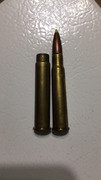
It's a 1905 I picked up about a week ago. I brought it to the head gunsmith at EPPS and he confirmed it as a rebore of an original 303 barrel, not a commercial rifle.
I don't know who did the work, and neither did he.
Is it a military Mk II with the slender 28" barrel or the Mk II** with the heavy 30.5" barrel? Photos would be appreciated.
I did not expect such a dramatic change in case dimensions. The case appears to have almost parallel walls and the shoulder has been moved considerably forward. I know precious little about the subject right now, but think I would favor a 338-303 for my conversion. I envision a case with standard 303 dimensions but necked up to 338, but I might be over simplifying it in my ignorance on the subject. Perhaps someone with first hand knowledge of the subject will chime in.
I did not expect such a dramatic change in case dimensions. The case appears to have almost parallel walls and the shoulder has been moved considerably forward. I know precious little about the subject right now, but think I would favor a 338-303 for my conversion. I envision a case with standard 303 dimensions but necked up to 338, but I might be over simplifying it in my ignorance on the subject. Perhaps someone with first hand knowledge of the subject will chime in.
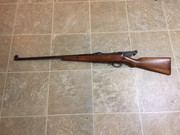
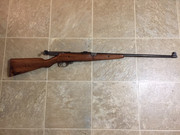
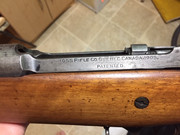

Z:
I see a a reworked military with a 28" barrel and no signs of the barrel band on sporters (or the Winchester sight).
Foresight is a dead giveaway and the rear you show is military for sure.
Somebody did a nice job of shaping the stock, if so, OR if the butt plate does not curl up over the top of the stock (military) you have an R sporter stock.
Enigma
OGC
I see a a reworked military with a 28" barrel and no signs of the barrel band on sporters (or the Winchester sight).
Foresight is a dead giveaway and the rear you show is military for sure.
Somebody did a nice job of shaping the stock, if so, OR if the butt plate does not curl up over the top of the stock (military) you have an R sporter stock.
Enigma
OGC
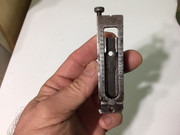
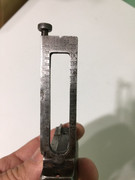
It looks like a commercial 1905R to me. I believe it does have the barrel band. Is there a serial number on the left side id the barrel just ahead of the receiver? There should be matching numbers on the inside of the butt plate and the mating surface of the butt. I believe the rear sight is a Canada Tool, which is missing it's entire slider assembly. The screws are likely a unified national thread, perhaps #5 x 44.
Nice looking commercial Ross.
Nice looking commercial Ross.
If there is the forend barrel band, stock could well be from a 1905R sporting rifle.
The rebored barrel or barrelled action could be from a Mk. II service rifle. 1905 barrels interchange without difficulty.
I would expect that a .35/.303 would be a standard .303 with the neck opened for a .35 bullet. This one is something else. The shoulder is blown way forward. I wonder if the barrel had been reamed oversized while still .303, and it was necessary to create this particular version of .35/.303.
The rebored barrel or barrelled action could be from a Mk. II service rifle. 1905 barrels interchange without difficulty.
I would expect that a .35/.303 would be a standard .303 with the neck opened for a .35 bullet. This one is something else. The shoulder is blown way forward. I wonder if the barrel had been reamed oversized while still .303, and it was necessary to create this particular version of .35/.303.

303EppsFan
CGN Regular
- Location
- Almonte,Ontario
Or could it be .35/.303 Epps Improved? It's similar to my .303 Epps. I don't know if Ellwood Epps did the re-bore himself back in the day or if he farmed it out. I do have the data sheet from Epps for his variations on the Improved .303 case.If there is the forend barrel band, stock could well be from a 1905R sporting rifle.
The rebored barrel or barrelled action could be from a Mk. II service rifle. 1905 barrels interchange without difficulty.
I would expect that a .35/.303 would be a standard .303 with the neck opened for a .35 bullet. This one is something else. The shoulder is blown way forward. I wonder if the barrel had been reamed oversized while still .303, and it was necessary to create this particular version of .35/.303.
This is what the Canada Tool rear sight would look like when complete.

This one is bridge mounted, but is the same sight. They are scarce and parts even more so. A standard rear sight for a Magazine Lee Enfield or Metford (Long Lee) or a carbine will fit your base and be quite serviceable. In fact, some Mk II's were equipped with that sight. They are much easier to find and would give you a usable sight while looking for a Canada Tool.
This one is bridge mounted, but is the same sight. They are scarce and parts even more so. A standard rear sight for a Magazine Lee Enfield or Metford (Long Lee) or a carbine will fit your base and be quite serviceable. In fact, some Mk II's were equipped with that sight. They are much easier to find and would give you a usable sight while looking for a Canada Tool.


It looks like a commercial 1905R to me. I believe it does have the barrel band. Is there a serial number on the left side id the barrel just ahead of the receiver? There should be matching numbers on the inside of the butt plate and the mating surface of the butt. I believe the rear sight is a Canada Tool, which is missing it's entire slider assembly. The screws are likely a unified national thread, perhaps #5 x 44.
Nice looking commercial Ross.
Here's what I have.
There's a thin layer of lead between the butt plate and the butt wood. The number is 8059 on the butt plate and the mating surface.
The number 829 is stamped over the right hand side of the chamber.


I think OGC and tiriaq have made some excellent points. The front sight and length do indicate it is a Mk II barrel. The 1905R was available with 22", 24" and 26" barrels but not 28". However, with Sir Charles, one should never say never. The stock and butt plate are 1905R, as is the barrel band. As with this one, the 1905R does not have a magazine cutoff, although that could have been removed. It could be a re-barreled 1905R, or it could be a 1905R that has had the barrel and receiver replaced with those of a Mk II. Since the receivers are identical, about the only way to determine which it is would likely be to look for military acceptance stamps. But, then again, the Mk II was also available commercially, so there is likely no definitive answer. It is also not beyond the realm of possibility it left the factory with that barrel.
And now to that rear sight: The Mk II rear sight base for the Enfield and related sights, which include the Canada Tool, mounted to a band or saddle on the barrel. At least, that is how it is mounted on the Mk II 5*. This rifle does not have that band, so it begs the question - how would that sight base be mounted to the barrel. The correct rear sight for the 1905R is the same as that found on the Model 94 Winchester of the same period.
One final point: Plate 70A on page 142 of The Ross Rifle Story shows a 1905R (with 26" barrel) chambered in 35 Winchester. Is there any possibility this rifle is chambered in 35 Winchester rather than 35-303?
And now to that rear sight: The Mk II rear sight base for the Enfield and related sights, which include the Canada Tool, mounted to a band or saddle on the barrel. At least, that is how it is mounted on the Mk II 5*. This rifle does not have that band, so it begs the question - how would that sight base be mounted to the barrel. The correct rear sight for the 1905R is the same as that found on the Model 94 Winchester of the same period.
One final point: Plate 70A on page 142 of The Ross Rifle Story shows a 1905R (with 26" barrel) chambered in 35 Winchester. Is there any possibility this rifle is chambered in 35 Winchester rather than 35-303?
I intend to try to compare cartridge dimensions today. I need to find specs for the 35 Winchester. The photo in Cartridges of the World looks somewhat promising.
Please post photos of the top of the barrel where the rear sight would mount and a closeup of the serial number on the barrel.
Please post photos of the top of the barrel where the rear sight would mount and a closeup of the serial number on the barrel.
1. SOME 1905 Rosses had a regular barrel/action thread which was the same as the thread on the 1910. MOST, however, had that awful 3TPI left-hand buttress thread, so you have to be more than a little bit careful when swapping barrels around.
2. MANY 1905 barrels exhibit chambers which are VERY loose and VERY long. I have empties from several of my own Rosses which look very like the specimen we are shown. I would call this a very good reason for neck-sizing your brass only. One good point about it: it rendered the rifle capable of handling epic quantities of dirt and muck..... and still cycling okay.
3. YES, 35 Winchester was an option when purchasing a civilian Ross Rifle at that period. Such a barrel should exhibit the small serial number on the Left side of the Chamber which identifies them as Commercial rifles, as well as a marking as to proper cartridge on the TOP of the Chamber.
4. 35 Winchester was loaded in Britain up to about 1962. The problem was getting the stuff on this side of the pond, although your local hardware could special-order it from CIL through their arrangement with ICI, just the same as they could get you .577 Snider, 577/450 Martini-Henry, 9mm Mannlicher and other big-bore nasties. Original 35 Winchester ammunition produced 2195 ft/sec with a 250-grain bullet for 2670 ft/lbs ME. Midrange trajectory for a 200-yard shot would be 4.5 inches. A couple of rounds should have made a Big Brown Bear most uncomfortable.
5. Barnes in COTW-6 gives 35 Winchester dimensions as:
All dimensions in INCHES:
Rim: .539
Base: .457
Mouth: .378
Diameter at Shoulder: .412
Case Length: 2.41
COAL: 3.16
Bullet Diameter: .358
Rifling Pitch: 1 turn in 12 inches
In appearance, this looked like a magnified 303 casing, but many dimensions are very close, mainly LENGTH being somewhat longer. It should be possible to manufacture your own 35 Winchester brass from available 405 Winchester casings.
Remember that rifling for the 303 was 1 turn in 10 inches; could be a way to determine exactly what has been done.
Do have fun!
2. MANY 1905 barrels exhibit chambers which are VERY loose and VERY long. I have empties from several of my own Rosses which look very like the specimen we are shown. I would call this a very good reason for neck-sizing your brass only. One good point about it: it rendered the rifle capable of handling epic quantities of dirt and muck..... and still cycling okay.
3. YES, 35 Winchester was an option when purchasing a civilian Ross Rifle at that period. Such a barrel should exhibit the small serial number on the Left side of the Chamber which identifies them as Commercial rifles, as well as a marking as to proper cartridge on the TOP of the Chamber.
4. 35 Winchester was loaded in Britain up to about 1962. The problem was getting the stuff on this side of the pond, although your local hardware could special-order it from CIL through their arrangement with ICI, just the same as they could get you .577 Snider, 577/450 Martini-Henry, 9mm Mannlicher and other big-bore nasties. Original 35 Winchester ammunition produced 2195 ft/sec with a 250-grain bullet for 2670 ft/lbs ME. Midrange trajectory for a 200-yard shot would be 4.5 inches. A couple of rounds should have made a Big Brown Bear most uncomfortable.
5. Barnes in COTW-6 gives 35 Winchester dimensions as:
All dimensions in INCHES:
Rim: .539
Base: .457
Mouth: .378
Diameter at Shoulder: .412
Case Length: 2.41
COAL: 3.16
Bullet Diameter: .358
Rifling Pitch: 1 turn in 12 inches
In appearance, this looked like a magnified 303 casing, but many dimensions are very close, mainly LENGTH being somewhat longer. It should be possible to manufacture your own 35 Winchester brass from available 405 Winchester casings.
Remember that rifling for the 303 was 1 turn in 10 inches; could be a way to determine exactly what has been done.
Do have fun!
Last edited:
smellie beat me to it
Rim dia: 303 British 0.540" 35 Winchester 0.539"
Base dia: 303 British 0.455" 35 Winchester 0.457"
Shoulder dia: 303 British 0.393" 35 Winchester 0.412"
Case Length: 303 British 2.222" 35 Winchester 2.41"
The difference in shoulder diameter would explain why your spent case looks so straight sided.
The difference in case length would explain why the neck in your spent case is so short.
I think there is an excellent chance you have a 35 Winchester. Look carefully at the breech end of your barrel. The caliber might be marked. The E 10 Ross was offered in 35 Winchester - different action and different barrel. The E 10 and Mk III barrels have a squarish thread profile. The Mk II** barrel has a V thread. The very coarse threads on all (?) other 1905/Mk II's have a squarish thread.
Congrats on finding a very interesting commercial Ross
I believe the only 1905/Mk II Ross that has conventional barrel threads is the Mk II** target rifle, which has a much heavier 30.5" barrel.
EDIT
Most commercial Ross rifles do have the serial number stamped on the rear left side of the barrel. However, a significant number of apparent commercial rifles show up with serial number stamped across the top front of the barrel reinforce in what appears to be correct font. There is hot debate among the collecting community concerning the origin and correctness of those serial numbers. In my limited experience, a surprising number of those (serial) numbers begin with a 4.
Rim dia: 303 British 0.540" 35 Winchester 0.539"
Base dia: 303 British 0.455" 35 Winchester 0.457"
Shoulder dia: 303 British 0.393" 35 Winchester 0.412"
Case Length: 303 British 2.222" 35 Winchester 2.41"
The difference in shoulder diameter would explain why your spent case looks so straight sided.
The difference in case length would explain why the neck in your spent case is so short.
I think there is an excellent chance you have a 35 Winchester. Look carefully at the breech end of your barrel. The caliber might be marked. The E 10 Ross was offered in 35 Winchester - different action and different barrel. The E 10 and Mk III barrels have a squarish thread profile. The Mk II** barrel has a V thread. The very coarse threads on all (?) other 1905/Mk II's have a squarish thread.
Congrats on finding a very interesting commercial Ross
I believe the only 1905/Mk II Ross that has conventional barrel threads is the Mk II** target rifle, which has a much heavier 30.5" barrel.
EDIT
Most commercial Ross rifles do have the serial number stamped on the rear left side of the barrel. However, a significant number of apparent commercial rifles show up with serial number stamped across the top front of the barrel reinforce in what appears to be correct font. There is hot debate among the collecting community concerning the origin and correctness of those serial numbers. In my limited experience, a surprising number of those (serial) numbers begin with a 4.
Last edited:























