













































Some .308 won't chamber

clockwrkz

Regular
Rating - 100%
9   0   0
Location
Calgary, AB
So all the details I can think of to start:

Brass: lapua - probably fired 5-6x
Bullets: SMK 175gr
Neck sizing and bullet seating die: Redding competition die with bushing
Press: forster co-ax

All worked great up until now. No changes to dies, bullets or brass.

Brass prep:

Run through neck size/decapping die
Clean - tumble with ss pins
Anneal neck
Neck size die again to be sure.
Prime, power, seat bullet.

The issue is that in some loaded rounds it looks like the bullet is flaring out the case neck and it won't chamber in the rifle. This isn't all loaded rounds but maybe half.

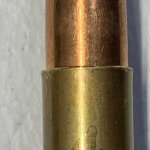
Attached is a photo of loaded round which would not chamber. You can see how the brass spreads out near the end of the neck.

A loaded round which will chamber the neck diameter is .3405" and a round that will not chamber is .3450". I can feel a ridge that has formed and if I sand that off it will chamber

The overall brass length is a bit under spec already. I've measure the body length and it's close to an unfired case in length.

Also, if I run a known well fitting case through the bullet seater die without a bullet there is no change to neck size. I originally thought the case might be hitting something inside the die.

Any ideas why the end of the neck would be flaring out like that?
 

Attachments

  • IMG_5901.jpg
    IMG_5901.jpg
    61.8 KB · Views: 435
Is the case mouth champfered?

Can you set the seater die so it crimp-kisses the case mouth, to knock of the flare?

As for the flare, if you are not doing it deliberately, then maybe the powder die is doing it. Raid it a half turn.
 
I've had the same problem, with lapua brass in my .308 rem700, even with no more than 1-2x fired brass (through a different rifle.)
 
Is the case mouth champfered?

Can you set the seater die so it crimp-kisses the case mouth, to knock of the flare?

As for the flare, if you are not doing it deliberately, then maybe the powder die is doing it. Raid it a half turn.

Thanks for all the comments!


Yes, just lightly chamfered.

I could raise the seater die but I get the feeling that doesn’t seem like the root of the problem since a case with no bullet doesn’t seem to change and this is a new ish problem. My only guess is that that the brass has changed over time since I only fire formed and only neck size. But measuring against unfired laupua brass I’m not seeing any glaring problems.

No powder die used. This is in a single stage press so powder is added manually out of the press with a funnel.
 
As per Post #2 - is something contacting that case mouth between sizing it and seating that bullet??

Not that I can tell. Pulled apart the seating die to see if there was debris or anything. Doesn’t feel like anything is hitting and without a bullet to be seated the case goes through the seating die without changing neck size or anything weird at least.
 
Perhaps is time for a full length resize?
Shoulder bump might help also.

maybe

I was thinking the same but was leaving that to plan B at the moment if I couldn’t find a clear solution.

Is it common to have to have full size the cases when fire formed over time? The body did have will bump the shoulders back at the same time.
 
First question, and forgive this sounding stupid, but, is your bushing right side up? Bushings are slightly flared to allow for easy entry, and many SAAMI case specs are 1 thou wider at the base of the neck than at the mouth of the neck. If the anneal result was too soft, I wonder if the flare could occur with an upside down bushing? I know this would not account for the 0.0045 difference you are seeing, so its a long shot, but getting that question out of the way.

Second question: How are you annealing, and could it be softening the brass too much? As the bullet base enters the neck during seating, if the brass was too soft the bullet base might bump it and it might flare out?

Third: Is your chamfer and de-burr aggressive enough? The photo shows a wicked outside burr. The chamfer and deburr cuts should be quite visible, and when chamfering/deburring for the first time you should see some major shavings coming off the inside and outside of the neck mouth. When I have over-annealed cases (when I was first learning and did not chamfer and deburr properly), and seated a bullet slightly off center, I have collapsed the entire neck and shoulder of the brass. That is a catastrophic failure of a bullet seating totally damaging a case, so it demonstrates that it does not take much to bend open a case mouth if it was annealed too soft.

To test if your anneal is too soft, did you do the needle nose pliers test? (I wrap the jaws in electrical tape so as not to scratch the brass). Give the brass neck a slight squeeze with the pliers to make it oval just slightly, then see if it springs back round. If it does not spring back, its overly annealed.

If the brass is too soft, good news, you can fix this. Do a full length resize with a resizing die with an expander ball on the decapping rod, NOT a bushing die. The double working of the resize and expander ball actions usually hardens the brass enough so that it will not deform or collapse with a tight or off center bullet seating. Before bullet seating you must check trim length as the last step, because both annealing and full length resizing can grow brass OAL. If it requires trimming, then it needs to be chamfered and deburred again.

EDIT: I don't use bushing neck sizing dies, I use Lee collet neck sizers. But in watching instructor videos of bushing neck sizing dies, they always emphasize making sure the bushing floats. They back off the top tightening screw so the bushing can move. If your top tightener was clamped down hard on the bushing, that might account for the neck being crushed and flaring out?
 
Last edited:
Yes - sooner or later you will have to size the body. You can do this with a body die, and continue to neck size, or use a FL die. Are you sure the problem rounds arent getting hung up on the body? How far will they go in the chamber?
 
I was thinking the same but was leaving that to plan B at the moment if I couldn’t find a clear solution.

Is it common to have to have full size the cases when fire formed over time? The body did have will bump the shoulders back at the same time.

Yes, you in time will have to bump the shoulders back.
Very much nearly identical problem happened to myself and a shooting buddy. We both attend a long range rifle meet once a year.
 
Tumbling with stainless steel pins will damage the case mouth and leave a burr. I don’t see anywhere in your process that states when you chamfer the cases.
 
I can feel a ridge that has formed and if I sand that off it will chamber You found the drawback of excess SS pin tumbling. It can peen over the case mouths making that edge thicker.

Yes, just lightly chamfered No indication of outside chamfer (deburr) in picture to remove damage from SS pin tumbling and thus your interference fit, which you were able to mitigate somewhat by sanding down a little to fit.
 
First question, and forgive this sounding stupid, but, is your bushing right side up? Bushings are slightly flared to allow for easy entry, and many SAAMI case specs are 1 thou wider at the base of the neck than at the mouth of the neck. If the anneal result was too soft, I wonder if the flare could occur with an upside down bushing? I know this would not account for the 0.0045 difference you are seeing, so its a long shot, but getting that question out of the way.

There's no stupid questions, anyone makes mistakes. I did confirm that the bushing is the right side up and floating inside the die.

Second question: How are you annealing, and could it be softening the brass too much? As the bullet base enters the neck during seating, if the brass was too soft the bullet base might bump it and it might flare out?

I'm annealing with a bench source case annealer. While I don't think they are over annealed I'll confirm.

Third: Is your chamfer and de-burr aggressive enough? The photo shows a wicked outside burr. The chamfer and deburr cuts should be quite visible, and when chamfering/deburring for the first time you should see some major shavings coming off the inside and outside of the neck mouth. When I have over-annealed cases (when I was first learning and did not chamfer and deburr properly), and seated a bullet slightly off center, I have collapsed the entire neck and shoulder of the brass. That is a catastrophic failure of a bullet seating totally damaging a case, so it demonstrates that it does not take much to bend open a case mouth if it was annealed too soft.

Not aggressive enough for sure. Long story but chamfer and de-burr tools weren't around. Have ordered a new set and trying to order a GIRAUD tri-way trimmer if I can get a call back which will handle this job as well.

To test if your anneal is too soft, did you do the needle nose pliers test? (I wrap the jaws in electrical tape so as not to scratch the brass). Give the brass neck a slight squeeze with the pliers to make it oval just slightly, then see if it springs back round. If it does not spring back, its overly annealed.

If the brass is too soft, good news, you can fix this. Do a full length resize with a resizing die with an expander ball on the decapping rod, NOT a bushing die. The double working of the resize and expander ball actions usually hardens the brass enough so that it will not deform or collapse with a tight or off center bullet seating. Before bullet seating you must check trim length as the last step, because both annealing and full length resizing can grow brass OAL. If it requires trimming, then it needs to be chamfered and deburred again.

EDIT: I don't use bushing neck sizing dies, I use Lee collet neck sizers. But in watching instructor videos of bushing neck sizing dies, they always emphasize making sure the bushing floats. They back off the top tightening screw so the bushing can move. If your top tightener was clamped down hard on the bushing, that might account for the neck being crushed and flaring out?

From everyone I've talked to so far it sounds like I'll need to bump the shoulders back since they have been fired 5 times without any shoulder and body resizing. I saw Forster has a shoulder bump bushing die which might do just this and leave the body fire formed. For now, will probably just full body/shoulder size as it sounds like that'll solve my problem in the short term, then fire form again, and read more about about bumping just the shoulder back and confirm I'm not over annealing as you wrote above.

Thanks for taking the time to write this all out. Good to check over all the steps in the process.
 
Back
Top Bottom






















