Stage Planning: "Decisions"

grimreefer

Regular
Rating - 100%
50   0   0
Location
Vancouver Island
I have a cool idea for this thread or even a series of threads if y'all are on board. How about we post a stage design. Then we draw on it and/or describe in detail our stage plan. Discuss why we would choose to plan the stage how we did, learn from each other, etc. In my case I will be doing most of the learning as I am new to this. Never the less I will go ahead and start:

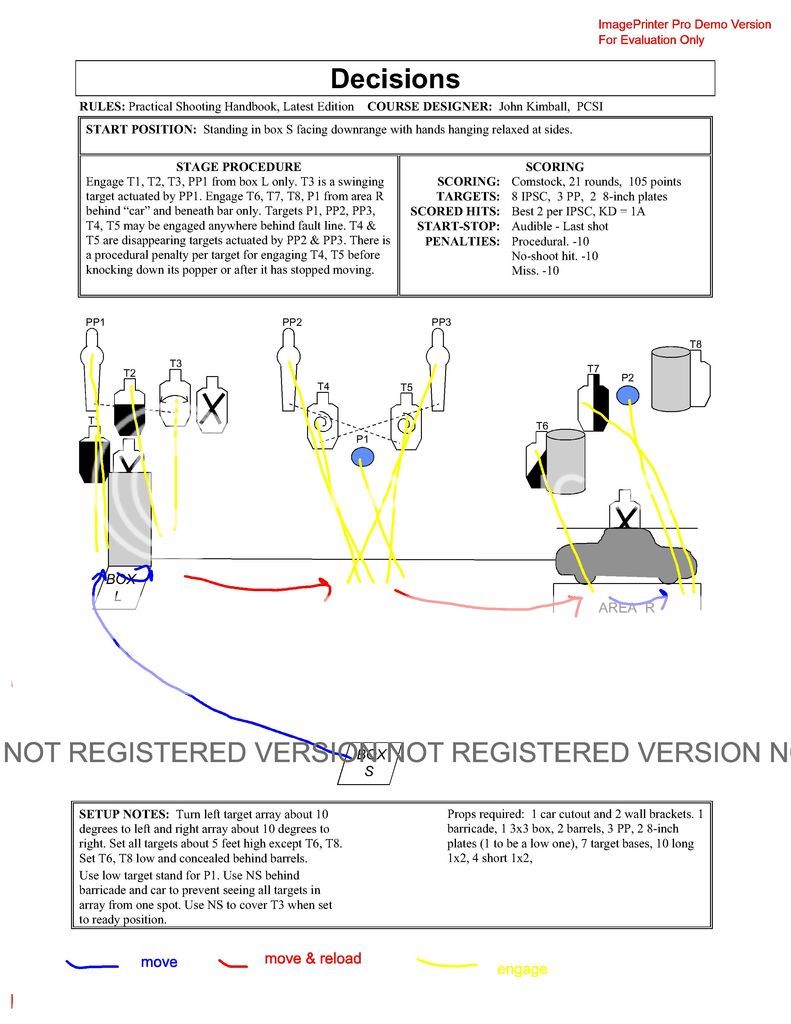
This stage is called "Decisions" and I downloaded it from here: http://www.k8nd.com/documents/Decisions.pdf

Here's my attempt at planning this stage:
decisions-grimreefer_1_1_zpsgbrkuhpl.jpg


On the drawing, target engagement order is left to right as I've drawn the lines. On start, move to left side of barricade in Box L, engage T1, PP1. Move to right side of barricade, engage targets T2, T3. Move and reload to area in front of center target array, engage PP3,T4, PP2,T5,P1. Move and reload to Area R, left side, engage T6. Move to right side of Area R, engage remaining targets.


So how can I improve this plan? Anyone have a better approach?
 
Lots of moving parts that makes it very difficult to say depending on how long it takes targets to activate/appear.
Good chance that middle part would be PP2, PP3, P1, T5, T4. But it all depends on how long it takes for the turning targets to appear and how good your transitions are.
 
Lots of moving parts that makes it very difficult to say depending on how long it takes targets to activate/appear.
Good chance that middle part would be PP2, PP3, P1, T5, T4. But it all depends on how long it takes for the turning targets to appear and how good your transitions are.

Those two in the middle are disappearing targets. I haven't encountered those yet, but I was assuming you have a couple seconds after hitting the popper before they're gone. Stage notes says there's a procedural for engaging the disappearing target before hitting their popper so it seems best to hit it immediately after hitting it's popper?
 
This is a very old course design. Those are drop turners, they won't be visible initially, they will turn and appear and then disappears. The warning about engaging before hitting the popper will be because you can see them side on from the rest of the course of fire
 
it has a lot to do with the distances as well. i would shoot all the stuff on the left from the right side of the barricade as opposed to going from one side to the other, again depending on how the actual stage is built. I might be tempted to shoot p1 on the move to area L as well, again depending on the distance.
 
So I think this could be a good exercise regardless...but how many of you actually sit down with a stage design like this "on paper" before seeing the actual stage? Obviously there are variables like target distances, target angles, obstructions, moving target timing, etc etc that aren't known until you're there. Do you go with a detailed plan, a rough idea in your head, or nothing at all?
 
With experience shooting matches, looking at a stage diagram can give you an idea of what it may look like, but until you actually get to walk the stage and see the distances and angles involved, its sort of a waste of time.

Also, if you get there with a preconceived notion of the best way to shoot the stage, you may be closed minded and not pick up subtle ways to game the stage better and save some time.

What a stage diagram is good for, is identifying what skill set you should be prepared to use at the match.
moving targets, shooting prone, weak and strong hand only etc etc, you should be able to identify this from the diagram and description.
Then practice before you get there.

For me, knowing that much detail before I get to the stage ruins it for me.
IPSC is about problem solving, and being able to execute your stage plan.
If the problem is pre-solved, there goes half the challenge.
 
That's a really good take, pauls, and it makes sense to me 100%.

Since we can't walk through a stage in 3D on this forum for the sake of discussion, I'd like to explore the stage on paper as if it was the actual stage in real life. Perhaps that could be a beneficial exercise as we can make some assumptions and still talk about movement patterns and target engagement order...basically all of the same strategy stuff that we would decide on the spot.
 
For sake of discussion, if all I had to go on was the diagram and what I know about the average activation time for swingers/drop turners, I'd likely do as follows:

on the beep, run to box L.
From the left side, T1, PP1, T2, transition to the right side and the swinger (T3) should be there.
Reason I'm shooting those targets from the left is because the no shoot right behind the barricade is likely blocking T1 from the right.
If I'm committing to the left side for a tight target (T1 A/B zone) I may as well take the others cause I'm in a stable shooting position and can likely get decent hits.
The swinger I can take from the right as I'm exiting the box and when it slowing/stopping to change directions.
I'd have to see it in action, but the timing should be roughly there.

Reload as I exit the box and depending on distance to the targets in the middle, I'll either try them on the move or stopping if necessary.
Order, probably PP2, P1, PP3, T5, T4.
P1 in between the poppers because I'd want a bit of delay between the drop turners being fully towards me to account for my transition time between them.
The targets are cross activating, so by the time I get to PP3, T5 should be showing itself and its a short transition. By the time I'm done with T5, T4 should be be making its move.

Reload while moving to the car and take the targets in whatever order makes sense.

Without a walk through and watching the timing of the activating targets, the actual order of what I'd take and when is just a best guess.
And If the no shoot behind the barricade in box L can be worked around, I'd probably try and shoot it all from the right side.
Can't know until you walk the stage.
 
Back
Top Bottom