Survey: Loaded case neck diameters of loaded rounds for neck bushings

cycbb486

CGN Ultra frequent flyer
Rating - 100%
30   0   0
Just doing a bit of research here.

These measurements are for ordering neck bushings for various COMMON off the shelf rifles. No neck turning involved.

What I would like to know is the caliber, brass manufacturer, whether factory or reload, whether the bullet used is a FB or BT, and the bullet manufacturer.

Again this is for factory off the shelf calibers. More along the lines of common calibers. Calibers that people who reload that would use bushing dies.

204 Ruger
222 Remington
223 Remington
22-250 Remington
6BR
243 Winchester
6 Creedmoor
6.5 Creedmoor
270 Winchester
7mm08 Remington
280 Remington
7mm Remington Magnum
7mm WSM
30-30 Winchester
308 Winchester
30-06
300 WSM
300 Winchester Magnum
338 Winchester Magnum

Look forward to replies.

Calvin
 
I'm kinda doubting you are going to be buying bushing dies for all of these, maybe some idea of a cross reference chart for make of brass to bushing size? Bullet is somewhat irrelevent to the bushing size unless you are working with for example 7.62x39 or 303 as they have varying bore sizes, as the need is by calibre + brass thickness, so a 284 bullet for example, may need a bushing .025 to .030 larger than the bullet, also depending on what neck tension the reloader wants to achieve with it.. A question as to what sizes are used can be answered by looking at the sizes the die mfgrs supply per calibre, as they are all used, that's why they make them. One way to find out a bit of what is not commonly used, is to look for what size bushings are on clearance at various stores.
 
209jones....

I am aware of all of what you have said. What I am trying to do is get a sense of what the average loaded neck diameter is. Yes there is some variation in bullet and neck thickness of brass but not enough for the average reloader who is NOT neck turning.

Here is my find with ammo I reload for a factory 700 .223
Win Brass 40grVMax BT .246
Win Brass 40grBerger FB .246
Win Brass 40grVarmageddon FB .246
Win Brass 52grMatchKing BT .246
Lap Brass 52grMatchking BT .249

So by this, on average of 2 to 4 thou neck tension with Win brass you could have a .242, .243, .244 bushing on hand. That pretty much is the rule of thumb.

Now with Lapua Brass and the 52gr SMK, there was a change in bushing needed. Loaded neck diameter was .249. So a .246, .247, .248.

The bushing size is dependent on many factors but I am talking the average reloader who shoots lots of rounds but is not the competitive guy.

There is a reason for my madness.

Unless anyone knows of a cross reference chart for this?
 
OP,
Your cheapest option would be to acquire the various caliber brass that you have listed & start micing neck thickness as there are 1000's of variations.
 
Why don’t you just measure your own brass thickness and ask people for their general neck tension preferences? I don’t use bushing becuz in order to use bushing consistently you have to neck turn the outside first, I use mandrels.
 
I just measured my .223 rounds I have loaded.

Fed brass, 90 grain JLK VLD BT varies from 0.247 to 0.2485.

Hmmm…. Not very consistent. I should stick to pistol reloading. Lol!
 
Well, I for one don't know why you would be bothered with neck bushings for any rifle with a SAAMI spec chamber or for off the shelf dies.

Most off the shelf dies have neck dimensions that are very close to or right on minimum and use the "expander ball" to determine proper neck tension etc.

I can see have specially ground "expander balls" on hand, especially if you have a rifle/rifles with tight chambers in the neck area.

Even then, I wouldn't reccomend going more than a thousandth below the existing ball diameter.

Absolutely no reason to use different neck sizing bushings, as long as you aren't turning/uniforming case neck wall thicknesses.

In factory chambers, it's a good way to throw good money away 99% of the time.
 
In response to some of the replies, if you were considering a business venture you would fork out money for every size of bushing out there recommended for a given caliber?

I am by no means uneducated when it comes to dies, bushings and reloading.

I am looking at what I would want to carry as a business in regards to a given brand of die, the model of die and the main bushings for a given off of the shelf common caliber. That is it.

Simple is it not to comprehend?

Sheesh making something so simple of what I asked into something so complicated.
 
depends on the resolution you are looking for, if you are ok with rounding numbers to 0.001" then from .17 cal to 50 cal there is only 383 variations if you want 0.0005" resolution then there is 766 variations


It's apparent that you have NOT mic'd brass from various manufacturers in the same caliber.
 
It's apparent that you have NOT mic'd brass from various manufacturers in the same caliber.

I did say if you are willing to round to 0.001 or 0.0005 of an inch. I doubt very much you are buying mandrels or bushings that are ground to more then a 0.0005 accuracy. in witch case you can buy every size between .170 and .500 and have less then 1000 even at size intervals of 0.0005"


Redding, RCBS and foster bushing only seems to list into the 0.001" resolution so if ordered form every seize between .170" and .500" them there would only be 383 bushing to have all the sizes

BUT

this is from reddings website (RCBS and Foster have less sizes available), if you bought every size they made you would only have 183 bushing in total.


"They are available in .001" size increments throughout the range of .185" thru

.368", covering all calibers from .17 to .338 and clearly marked with size I.D.

By selecting the correct bushing, you are now able to provide just the right

amount of neck tension to properly hold the bullet without excessive resizing."
 
Last edited:
Bushing dies work best with custom tight neck chambers and neck turned brass.

With a standard factory chamber the bushing die can create more neck runout.

A bushing floats and can move from side to side and even tilt when sizing the neck of a factory chambers neck.

In the Redding Bushing die FAQ it is recommended to use the expander with a bushing die if the necks are not turned

Tech Line & Tips (FAQs)
https://www.redding-reloading.com/tech-line-a-tips-faqs

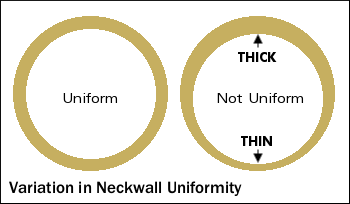
Below a bushing die will produce more neck runout with non-uniform necks

NlyA8oI.png


If you are worried about overworking the case neck then a custom honed Forster die would be a better choice.

 
Back
Top Bottom