switching regular recipes to magnum primers?

boxhitch

CGN frequent flyer
Rating - 100%
46   0   1
Location
Okanagan
Have seen several posts where comparison discussions are going on and someone uses or suggests using a magnum primer in place of a standard
I get it that they can be incorporated with good success but imo that changes the powder burn character enough to make a new equation

Doesn't switching just make for an entire different burn profile than the powder manufacture design?
If powders are ranked on a burn chart all tested the same with regular ignition, how much does the extra heat change things?
Certainly enough that it can no longer be compared to something beside it on the burn rate chart?

If a load needs a magnum primer to work, why not just pick a different powder down the chart, likely to the faster side?
 
In a general sort of way switching to a magnum primer is about the same as adding another grain of powder. It seems to bear out on chronograph results; and at the top end by the admittedly unscientific pressure reading that we all do.


How much of that velocity is due to changing the burning characteristics and how much to extra power from the primer itself is hard to say; but everything has an effect.

Powder burn rates aren’t measured in a gun; they are done in a caloriemeter bomb and for industry purposes not for load data for us.
 
I use mainly magnum primers in my big game hunting rifles, the reason is the temp can get quite cold up her sometimes like today, it was -21c this morning and we got 10” of snow in the last 2 days….
 
Being totally out of regular large rifle primers I decided to use magnum primers which I have plenty of for my 308win instead. I have searched through several message boards extensively to see if someone could nail the real difference between non magnum and magnum primers but I could only find two main groups of opinions; 1) "Some" manufacturers make them different with different quantities of chemicals and 2) The difference would only be in the primer cup thickness (which would make sense considering the higher pressures of magnum rounds).

Out of curiosity, I weigh CCI 200 non magnum primers and also some CCI 250 magnum primers. The difference was about 0.1 grain heavier for the CCI 250s... This leads me to think that if there is a difference, it's really not a big one. For CCI primers anyway. I have yet to try my 308 loads but I don't expect anything catastrophic happening. Especially considering that my powder weight is not close to the maximum.
 
In what way does a weight difference tell you anything about the chemical used - I do not know, but I would at least suspect there might be a different mix used? I do not "believe" they are the same - but as others have mentioned, I have used either - in same cartridge, but "worked up" separately. I do not think it is a good plan to just swap out magnum large rifle primers, for standard large rifle primers.
 
I use mainly magnum primers in my big game hunting rifles, the reason is the temp can get quite cold up her sometimes like today, it was -21c this morning and we got 10” of snow in the last 2 days….
what is the basis for the change?
do you just inter-change or work up a second load?
I have never seen any powder maker state that something in a load has to change due to ambient temperature
 
When I started reloading, I was using the magnum primers for all my rifles, and worked up loads that way in all of them. Even the 7mm-08.

The only rifle I was using different was a bench 6.5 CM, so I was using the match grade large rifle. Now I have converted this rifle to small primer brass and started using the cc450, small rifle magnum primers for it, and set my load accordingly. Small primer brass, and small magnum primers, so with the 2 changes, reworked my loads.

Almost to the point to shoot my last reloads for the 6.5CM with my budget tips and go back to my standard 139 gr lapua tips, so it will be interesting to see how far off from my original load these will be with the different brass and primers. This will more than likely now be a spring project.

Even with the same primers, same brass, just switching powders, even when they are close on the burn scale would net me around 100 fps difference. This has led me to believe it is more the powder type, than the burn rate or primers, and more of a complete combination to make it the pressure that was required for the speed increase.

Ran into the same kind of thing with my 6.5 PRC. Tried 4-5 powders before running into one that my rifle, reloading combination just likes, and an acceptable speed for the bullet I'm using.
 
what is the basis for the change?
do you just inter-change or work up a second load?
I have never seen any powder maker state that something in a load has to change due to ambient temperature
The reason is more reliable ignition with magnum primers or so I got told, so that is what I do!
 
in my limited testing I found that it depends on the powder charge
like this recent one:
223, 75gr bullet, 24gr CFE223 CCI400 2605fps, CCI450 2591fps (10 shot average)
223, 75gr bullet, 24.5gr CFE223 CCI400 2669fps, CCI450 2678fps (10 shot average)
the max load is 25gr
so, closer to the max load, the primer type becomes quite important.
 
I used to have an article published by the National Rifleman studying the effects of component swapping on the 30-06.
They swapped primers among other things, and there were instances of getting an extra 10,000 cup from just the primer swap. Sometimes there was a velocity increase with the additional pressure but sometimes there wasn’t. Results were basically all over the place, and that traditional pressure signs weren’t much help.

Mere mortals without a literal military arsenal and staff at their disposal and just reporting their own experience could be forgiven for concluding that there was no difference, or a big difference, or a predictable progression depending on their observations.
 
It is common practice to use mag primers with ball powders. I did that with my 30-06 and Win 760, just following a recipe by I think Jim Carmichael. I use IMR 4350 in that rifle now and regular LR primers, but if I ever ran out and had to use Mag, I wouldn't hesitate but I would work up the load to be sure.
 
Thats another contentious point
ball/spherical are said to be harder to ignite but that just doesn't compute
the kernels have much more surface area so burn unlike an extruded stick powder
so they are built with inhibitors in the recipe to retard the burn rate to where it fits what is target rate

I don't see reloading recipes from any powder manufacturer stating a change of primers is needed for any specific powder
as they burn as designed at the desired rate

Mag primers are suggested for load volumes at a certain point, but because of volume not burn rate
 
Thats another contentious point
ball/spherical are said to be harder to ignite but that just doesn't compute
the kernels have much more surface area so burn unlike an extruded stick powder
so they are built with inhibitors in the recipe to retard the burn rate to where it fits what is target rate

I don't see reloading recipes from any powder manufacturer stating a change of primers is needed for any specific powder
as they burn as designed at the desired rate

Mag primers are suggested for load volumes at a certain point, but because of volume not burn rate
That's what I understand more or less. As I understand it's more related to longer case design and volume capacity needing magnum primers to flash/penetrate deeper into the case volume creating more consistent pressure for uniform combustion. Different powders like different pressures to form complete combustion. Hence accuracy nodes, pressure spikes ect. Flame and heat is a by product, not a primary contributor to ignition. Pressure forms consistent ignition based on powder type, case design and chamber tolerances. Like a diesel engine, it's about pressure. Spherical powder is like injected fuels compared to the old school carb. They actually have more surface area by volume/weight compared to cylindrical powders. A fine thread bolt has greater grip strength because it has more surface area in contact with the opposite surface. A cap gun goes off from the strike/pressure. It in turn creates heat and pressure/percussive force. LoL I'm off on a tangent...... Cheers, cosign..
 
WELL…I’m reluctant to weigh in on this magnum primer thread because my info is based on an article published by an ammo manufacturer many years ago, before some of our readers were born. Ironically I can remember reloading stuff from decades ago but I’m at a loss to remember my children’s birthdays. lol
So….‘Believe it or Not’…here it goes !!
Magnum primers are ‘not stronger’ in the way we perceive them. They are designed to produce initially a SMALLER PLUME into the powder column but a longer duration of the burn. Reason being they don’t want a primer to ‘push’ the powder column up and cause the projectile to move forward slightly before the majority of the propellant has ignited. The longer duration of the primer flash guarantees good ignition on the slow burning powders, especially the Winchester ball powders. The result is consistent pressures, velocities and accuracy…again especially in cold weather. I still have a few bricks of Winchester large rifle primers and right on the box it says for large rifle AND magnum large rifle use.
This was Winchester’s factory primer for all their ammo, which again used ball powder.
They played with substituting reg vs mag primers and pressures varied either way without rhyme or reason. Accuracy with the 300Winmag was slightly better with regular primers in the summer time but it was highly recommended to use the magnum primers if you were going after polar bears.
I think the gentlemen that had weighed in already on this matter and suggested dropping the powder charge by 1-1/2 to 2g and working up a load have got it all figured out and have nothing to worry about. Cheers !!
 
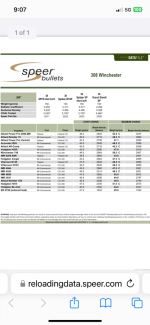
I found this I retesting the other day looking for some 308 data… you can see that Speer in there data shows some powders with magnum primers and some with regular primers… IMG_1353.png
 
"I think the gentlemen that had weighed in already on this matter and suggested dropping the powder charge by 1-1/2 to 2g and working up a load have got it all figured out and have nothing to worry about. Cheers !!"

there is that :)
 
Thats another contentious point
ball/spherical are said to be harder to ignite but that just doesn't compute
the kernels have much more surface area so burn unlike an extruded stick powder
so they are built with inhibitors in the recipe to retard the burn rate to where it fits what is target rate

I don't see reloading recipes from any powder manufacturer stating a change of primers is needed for any specific powder
as they burn as designed at the desired rate

Mag primers are suggested for load volumes at a certain point, but because of volume not burn rate

All my loading manuals specify what primer they used for each load. They typically specify the magnum primer for ball powders. On some occasions when I used ball powder with standard primers, I discovered (the hard way) why they used magnum.

The worst combination would be a mild load of ball powder under a light bullet. Can be a click-bank or just a click.

When I switch from stnd to magnum in a 308, I see a velocity increase of 40 fps. This suggests that I should reduce the charge by about 0.2 gr to stay the same velocity.

BTW, the stnd Winchester primer is very hot because Winchester used to load Olin (ball) powders, so their standard primer was good for ball powders.
 
Maybe Ganderite can show his in the dark photographs of different primers. Besides being impressive photography it sure answers the question of whether some primers have more fire than others.


I read an article years ago where the author had rigged up a miniture “gun” that fired BBs and was only powered by the primer and chronographed them. 215s and WLRMs were the hot ones, which I suppose doesn’t surprise that many. Something similar could be done with wax bullets and a revolver, using the Garmin to keep score. If I get bored enough I might even do it myself.
 
Back
Top Bottom