Hi everyone,
I've been thinking of doing this post for a while, and a few members have sugested it, so I thought I'd take the time to do it tonight.
I don't have pictures of everything, but at least it's a start; I may try to update it as I take pics of the steps that don't have any at this moment.
Recently, I refurbed a CGN member's Lee Enfield No1 Mk3*, chambered in .410. This good man was kind enough to trust his rifle to my somewhat beginner's hands, and I thank him again for this.
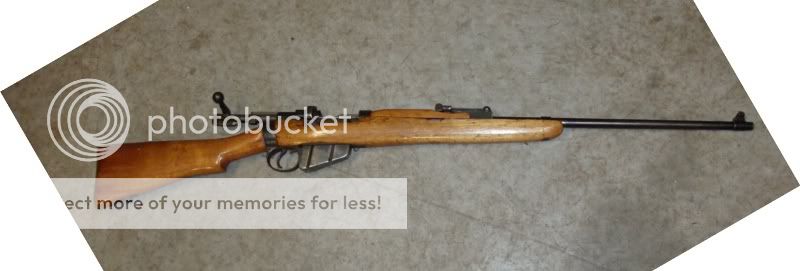
Here's the rifle as received. Typical Bubba'ed rifle, except it had a rear handguard, and the grain matched the butt stock - both nice looking but varnished.
First, I completely disassembled it.
http://i272.photobucket.com/albums/jj180/louthepou/Lee Enfield Refurb/explodedview.jpg
Then, I knew what parts I needed; some I already had, some I needed to order.
The butt and rear hadguard were keepers, so I stripped them with paint stripper (don't use sand paper to remove earlier finish), here's what the butt looked like.
http://i272.photobucket.com/albums/jj180/louthepou/Lee Enfield Refurb/stripped.jpg
The part that can take time and patience is the proper fitting of the wood parts to the action and barrel. In this case, the barrel channel of the forarm did come in contact with the barrel in some places where it shouldn't have; so I had to sand off some wood from these spots.
http://i272.photobucket.com/albums/jj180/louthepou/Lee Enfield Refurb/barrelchannel.jpg
Often, you also have to adjust the fit between the sear lugs and the part of the forarm that come in contact with the rear portion of the sera lugs. In this case, I found a forarm that fit almost perfectly. Sometimes, you need to remove some wood from the forarm, or the oposite, use shims to fill in some extra space. I'll try to take some pics next time that happens.
Also, the butt, when the big butt screw was removed, showed some free play in the socket. So, I fixed this, by:
First, cut a band of brown paper (grocery paper bag) that'll wrap around the butt socket portion:
http://i272.photobucket.com/albums/jj180/louthepou/Lee Enfield Refurb/HPIM1514.jpg
Then, in theory (according to a 1931 armorer's instruction booklet), I should have used varnish to glue the paper band. I used Epoxy glue, because that's what I had around (West Epoxy System, I use it to repair the wood stocks, so I though it'd be ok for this task). Here, rubber bands are holding the paper in place while the glue cures.
http://i272.photobucket.com/albums/jj180/louthepou/Lee Enfield Refurb/HPIM1517.jpg
Here's the result, after the glue is cured:
http://i272.photobucket.com/albums/jj180/louthepou/Lee Enfield Refurb/HPIM1515.jpg
Here's the adjustment so it'll go in the action socket with light force, and fit quite snuggly:
http://i272.photobucket.com/albums/jj180/louthepou/Lee Enfield Refurb/HPIM1519.jpg
Here's how deep it did go in before I used a rubber mallet:
http://i272.photobucket.com/albums/jj180/louthepou/Lee Enfield Refurb/HPIM1521.jpg
Next came the adjustment of the handguards. Both needed some fine tuning, but here's a picture of the removal of a little bit of wood from the front handguard's base. After this adjustment, the handguard did fit on the forarm without a gap between the two.
http://i272.photobucket.com/albums/jj180/louthepou/Lee Enfield Refurb/HPIM1524.jpg
Ok, then I moved on to the finishing with boiled linseed oil. Colour matching was a bit of a challenge with this project, since the grain and initial colour of the used parts I provided and the two parts that I kept from the rifle were quite different. I use some pure BLO, and also some BLO that has walnut colour mixed in with it. Sometimes I also use other stains, but in this case I don't think I needed them. Here's the rear handguard with a fresh coat of BLO (it's shiny because the oil just got rubbed on it).
http://i272.photobucket.com/albums/jj180/louthepou/Lee Enfield Refurb/colourmatching.jpg
It got cold, so I moved the finishing job inside; I don't have a basement, so here's the wood curing in the laundry room. I probably used about 20 coats.
http://i272.photobucket.com/albums/jj180/louthepou/Lee Enfield Refurb/itsgettingcold.jpg
After that, I moved to the cleaning of the metal parts. Some of them needed some reblueing, which I did (cold reblueing job), but I don't have pics of that. The butt plate got cleaned with a metal polish (stuff for mag wheels) and got quite nice.
The big bolt that holds the butt in place had to get its tip ground off (the surplus forarm I got wasn't made to receive the butt bolt tip):
http://i272.photobucket.com/albums/jj180/louthepou/Lee Enfield Refurb/HPIM1525.jpg
http://i272.photobucket.com/albums/jj180/louthepou/Lee Enfield Refurb/HPIM1526-1.jpg
Once all the metal parts were ready, I made sure all the parts were clean, I oiled all the metal parts, and assembled the rifle. Some more tweaking here and there, during the final assembly, should be expected, but eventually, you get the job done.
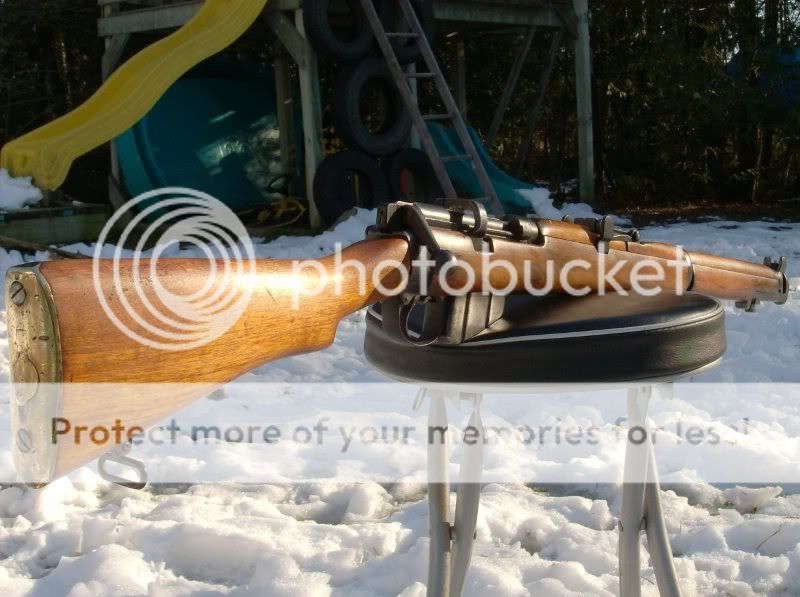
Here's a picture of the finished, reassembled rifle:
And here are a couple more.
http://i272.photobucket.com/albums/jj180/louthepou/Lee Enfield Refurb/HPIM1529.jpg
http://i272.photobucket.com/albums/jj180/louthepou/Lee Enfield Refurb/HPIM1530.jpg
It's not perfect, far from it; for one, I would have liked to achieve a lighter colour. In total, I probably put in about 15 to 20 hours of work. The rifle, his owner, and the owner's uncle's memory were worth it, I sincerely believe.
Cheers!
Lou
-----------
Edit on December 20 2008:
Here are a few pics that I thought I'd add to this post, pics of steps that I didn't describe above.
Fitting the butt in the socket requires that there's a small gap between the socket "edge" and the wood; here, the before and after pictures:
http://i272.photobucket.com/albums/jj180/louthepou/Lee Enfield Refurb/HPIM1611.jpg
http://i272.photobucket.com/albums/jj180/louthepou/Lee Enfield Refurb/HPIM1612.jpg
NOTE: Thanks to Claven who offers some appreciated clarification about when this is needed and when this isn't needed! See post #30 lower down this thread.
Buying "Drill Purpose" wood sometimes provides surprises. Here, a butt I recently worked on. It came... unfinished; the butt plate could not sit on properly on this flat surface! I used a rasp and other handtools to carve the required curved shape.
http://i272.photobucket.com/albums/jj180/louthepou/Lee Enfield Refurb/HPIM1594.jpg
Stripping old wood before refinishing it is not as hard as many would think. It's messy though. Here I am stripping a No1 MK3 forend, simple and effective technique to prep the wood without sandpaper!
http://i272.photobucket.com/albums/jj180/louthepou/Lee Enfield Refurb/HPIM1593.jpg
The nose cap of a No1 Mk3 shouldn't interfere with the muzzle. It's hard to see on these pictures, but in the first one, there's solid contact between the muzzle and the hole in the nose cap; second picture, some grinding and reblueing later, there's no solid contact.
http://i272.photobucket.com/albums/jj180/louthepou/Lee Enfield Refurb/HPIM1582.jpg
http://i272.photobucket.com/albums/jj180/louthepou/Lee Enfield Refurb/HPIM1587.jpg
I've been thinking of doing this post for a while, and a few members have sugested it, so I thought I'd take the time to do it tonight.
I don't have pictures of everything, but at least it's a start; I may try to update it as I take pics of the steps that don't have any at this moment.
Recently, I refurbed a CGN member's Lee Enfield No1 Mk3*, chambered in .410. This good man was kind enough to trust his rifle to my somewhat beginner's hands, and I thank him again for this.
Here's the rifle as received. Typical Bubba'ed rifle, except it had a rear handguard, and the grain matched the butt stock - both nice looking but varnished.
First, I completely disassembled it.
http://i272.photobucket.com/albums/jj180/louthepou/Lee Enfield Refurb/explodedview.jpg
Then, I knew what parts I needed; some I already had, some I needed to order.
The butt and rear hadguard were keepers, so I stripped them with paint stripper (don't use sand paper to remove earlier finish), here's what the butt looked like.
http://i272.photobucket.com/albums/jj180/louthepou/Lee Enfield Refurb/stripped.jpg
The part that can take time and patience is the proper fitting of the wood parts to the action and barrel. In this case, the barrel channel of the forarm did come in contact with the barrel in some places where it shouldn't have; so I had to sand off some wood from these spots.
http://i272.photobucket.com/albums/jj180/louthepou/Lee Enfield Refurb/barrelchannel.jpg
Often, you also have to adjust the fit between the sear lugs and the part of the forarm that come in contact with the rear portion of the sera lugs. In this case, I found a forarm that fit almost perfectly. Sometimes, you need to remove some wood from the forarm, or the oposite, use shims to fill in some extra space. I'll try to take some pics next time that happens.
Also, the butt, when the big butt screw was removed, showed some free play in the socket. So, I fixed this, by:
First, cut a band of brown paper (grocery paper bag) that'll wrap around the butt socket portion:
http://i272.photobucket.com/albums/jj180/louthepou/Lee Enfield Refurb/HPIM1514.jpg
Then, in theory (according to a 1931 armorer's instruction booklet), I should have used varnish to glue the paper band. I used Epoxy glue, because that's what I had around (West Epoxy System, I use it to repair the wood stocks, so I though it'd be ok for this task). Here, rubber bands are holding the paper in place while the glue cures.
http://i272.photobucket.com/albums/jj180/louthepou/Lee Enfield Refurb/HPIM1517.jpg
Here's the result, after the glue is cured:
http://i272.photobucket.com/albums/jj180/louthepou/Lee Enfield Refurb/HPIM1515.jpg
Here's the adjustment so it'll go in the action socket with light force, and fit quite snuggly:
http://i272.photobucket.com/albums/jj180/louthepou/Lee Enfield Refurb/HPIM1519.jpg
Here's how deep it did go in before I used a rubber mallet:
http://i272.photobucket.com/albums/jj180/louthepou/Lee Enfield Refurb/HPIM1521.jpg
Next came the adjustment of the handguards. Both needed some fine tuning, but here's a picture of the removal of a little bit of wood from the front handguard's base. After this adjustment, the handguard did fit on the forarm without a gap between the two.
http://i272.photobucket.com/albums/jj180/louthepou/Lee Enfield Refurb/HPIM1524.jpg
Ok, then I moved on to the finishing with boiled linseed oil. Colour matching was a bit of a challenge with this project, since the grain and initial colour of the used parts I provided and the two parts that I kept from the rifle were quite different. I use some pure BLO, and also some BLO that has walnut colour mixed in with it. Sometimes I also use other stains, but in this case I don't think I needed them. Here's the rear handguard with a fresh coat of BLO (it's shiny because the oil just got rubbed on it).
http://i272.photobucket.com/albums/jj180/louthepou/Lee Enfield Refurb/colourmatching.jpg
It got cold, so I moved the finishing job inside; I don't have a basement, so here's the wood curing in the laundry room. I probably used about 20 coats.
http://i272.photobucket.com/albums/jj180/louthepou/Lee Enfield Refurb/itsgettingcold.jpg
After that, I moved to the cleaning of the metal parts. Some of them needed some reblueing, which I did (cold reblueing job), but I don't have pics of that. The butt plate got cleaned with a metal polish (stuff for mag wheels) and got quite nice.
The big bolt that holds the butt in place had to get its tip ground off (the surplus forarm I got wasn't made to receive the butt bolt tip):
http://i272.photobucket.com/albums/jj180/louthepou/Lee Enfield Refurb/HPIM1525.jpg
http://i272.photobucket.com/albums/jj180/louthepou/Lee Enfield Refurb/HPIM1526-1.jpg
Once all the metal parts were ready, I made sure all the parts were clean, I oiled all the metal parts, and assembled the rifle. Some more tweaking here and there, during the final assembly, should be expected, but eventually, you get the job done.
Here's a picture of the finished, reassembled rifle:
And here are a couple more.
http://i272.photobucket.com/albums/jj180/louthepou/Lee Enfield Refurb/HPIM1529.jpg
http://i272.photobucket.com/albums/jj180/louthepou/Lee Enfield Refurb/HPIM1530.jpg
It's not perfect, far from it; for one, I would have liked to achieve a lighter colour. In total, I probably put in about 15 to 20 hours of work. The rifle, his owner, and the owner's uncle's memory were worth it, I sincerely believe.
Cheers!
Lou
-----------
Edit on December 20 2008:
Here are a few pics that I thought I'd add to this post, pics of steps that I didn't describe above.
Fitting the butt in the socket requires that there's a small gap between the socket "edge" and the wood; here, the before and after pictures:
http://i272.photobucket.com/albums/jj180/louthepou/Lee Enfield Refurb/HPIM1611.jpg
http://i272.photobucket.com/albums/jj180/louthepou/Lee Enfield Refurb/HPIM1612.jpg
NOTE: Thanks to Claven who offers some appreciated clarification about when this is needed and when this isn't needed! See post #30 lower down this thread.
Buying "Drill Purpose" wood sometimes provides surprises. Here, a butt I recently worked on. It came... unfinished; the butt plate could not sit on properly on this flat surface! I used a rasp and other handtools to carve the required curved shape.
http://i272.photobucket.com/albums/jj180/louthepou/Lee Enfield Refurb/HPIM1594.jpg
Stripping old wood before refinishing it is not as hard as many would think. It's messy though. Here I am stripping a No1 MK3 forend, simple and effective technique to prep the wood without sandpaper!
http://i272.photobucket.com/albums/jj180/louthepou/Lee Enfield Refurb/HPIM1593.jpg
The nose cap of a No1 Mk3 shouldn't interfere with the muzzle. It's hard to see on these pictures, but in the first one, there's solid contact between the muzzle and the hole in the nose cap; second picture, some grinding and reblueing later, there's no solid contact.
http://i272.photobucket.com/albums/jj180/louthepou/Lee Enfield Refurb/HPIM1582.jpg
http://i272.photobucket.com/albums/jj180/louthepou/Lee Enfield Refurb/HPIM1587.jpg
Last edited: