












































You are using an out of date browser. It may not display this or other websites correctly.
You should upgrade or use an alternative browser.
You should upgrade or use an alternative browser.
The big bad wolf!
- Thread starter Duffy
- Start date


This might explain it as well....
James Swan | August 14, 2013
All across North America, efforts are underway to restore wolf populations. Much of the press has painted a rosy picture of co-existing with wolves. For another opinion, I talked with ethologist Dr. Valerius Geist. Val has published 17 books on wildlife and large mammals (humans included) and served 27 years as a professor at the University of Calgary.
During some 50 years in the field, he had observed wolves on many occasions. “My early experiences with mainland wolves indicated that they were inquisitive, intelligent, but shy and cautious. During my academic career and four years into retirement I thought of wolves as harmless, echoing the words of many North American colleagues. I was wrong!”
He changed his mind when he retired to Vancouver Island in 1995, where he and his wife found themselves living with wolves as neighbors. He relayed some of his first-hand experience with them to me:
"The meadows and forests near our home contained about 120 blacktail deer and half a dozen large male black bears. In winter came some 60 to 80 trumpeter swans, large flocks of Canada geese, widgeons, mallards, and green-winged teal. Pheasants and ruffed grouse were not uncommon. In the fall of 1995 I saw one track of a lone wolf. Then in January 1999 my son and I tracked a pair of wolves in the snow. A pack arrived that summer. Within three months not a deer was to be seen, or tracked, in these meadows–even during the rut. We saw deer at night huddling against barns and houses, where deer had not been seen previously. For the first time deer moved into our garden and around our house. The damage to our fruit trees and roses skyrocketed. The trumpeter swans left. The tame geese and ducks avoided the outer meadows and lived only close to the barns. Pheasants and ruffed grouse vanished. The landscape looked empty, as if vacuumed of wildlife."
Eventually the wolves became even more of a problem. Geist explains: “These wolves progressively became bolder, seeking out human habitation, killing and maiming pets and livestock, and inspecting and confronting humans. No attacks on humans materialized by ‘our’ wolves after they began approaching us, for they were shot. A predator control officer trapped others.”
After the first “misbehavin’ pack” was eliminated, a second one moved into the area a couple years later, and a similar pattern unfolded. Geist found the behavior of both packs followed a similar seven-stage habituation pattern when wild food runs out and they are close to people.
1. Within the pack’s territory prey becomes scarce not only due to increased predation on native prey animals, but also by the prey evacuating home ranges en masse. Wolves increasingly visit garbage dumps at night.
2. Wolves in search of food begin to approach human habitations at night. Their presence is announced by frequent and loud barking of farm dogs.
3. The wolves appear in daylight and at some distance observe people doing their daily chores.
4. Small-bodied livestock and pets are attacked close to buildings, even during the day. The wolves preferentially pick on dogs and follow them right up to the verandas of homes. People out with dogs find themselves defending their dogs against wolves.
5. The wolves explore large livestock, leading to docked tails, slit ears, and hocks. Livestock may bolt through fences running for safety. Wolves become more brazen and cattle or horses may be killed close to houses and barns. Wolves may follow riders and surround them. They may mount verandas and look into windows.
6. Wolves turn their attention to people and approach, initially merely examining them closely. They may make hesitant, almost playful attacks, biting and tearing clothing, nipping at limbs and torso. They withdraw when confronted. They defend kills by moving towards people and growling and barking at them from 10 to 20 paces away.
7. Wolves attack people. These initial attacks are clumsy, as the wolves have not yet learned how to take down the new prey efficiently. Persons attacked can often escape because of the clumsiness of the attacks. A mature, courageous man may beat off or strangle an attacking wolf. However, against a wolf pack there is no defense.
Val met Dr. Robert Timm at the University of California at Davis, who has been studying coyotes targeting children in urban parks that act in virtually the same manner.
Geist’s habituation model has been translated into Swedish, Finnish, and German. It has become known in Finland as “Seven Steps to Heaven.”
“A century ago North America’s wildlife was largely decimated and that it took a lot of effort to bring wildlife back. When predators are scarce, and herbivores are abundant, wolves are well-fed. Consequently they are very large in body size, but also very shy of people. Wolves are seen rarely under such conditions, fostering the romantic image of wolves prevalent in North America today. However, when herbivore numbers decline while wolf numbers rise, we expect wolves to disperse and begin exploring for new prey. That’s when trouble begins,” Geist says.
Former Alaska wildlife biologist Mark McNay and others have established that there have been wolf attacks on people in Canada, historical and recent. On November 8, 2005, a 22-year-old geological engineering student at the University of Waterloo, Kenton Joel Carnegie, was killed by four wolves at Points North Landing in northern Saskatchewan. This was the first direct human fatality from a healthy wolf attack in North America in recent times to receive an investigation. Geist was an expert witness in the inquisition. Val says that the four wolves that attacked Carnegie had long been observed by others, were garbage-fed, and four days earlier attacked two employees of the camp who beat back the wolves.
Candice Berner, a 32-year-old school teacher, was killed on March 8, 2010 by wolves in the village of Chignik Lake on the Alaska Peninsula. These wolves were also habituated to garbage.
Val says that wolves learn differently than dogs:
"They learn by observing, and they also are insight learners. They can solve problems by observing, such as how to unlock a gate. In some studies of captive wolves researchers have found that wolves and coyotes not only learn to open their own cages, but those of others. With these intelligence traits wolves also develop an ability to assess the vulnerability of prey. For example, the sight of a human, walking boldly and carrying a firearm, will give them enough information to know that the potential prey is not vulnerable."
How did North American scientists ever conclude that wolves were no threat to people? Geist responds:
"They were unaware that starting in the 1800s, tens of thousands of trappers in Canada and Alaska were killing every wolf they could, legally and illegally, while predator control officers also removed wolves. Aerial poisoning and shooting campaigns were carried out and wolves were free to be killed by anybody. Little wonder wolves were scarce, very shy, attacks on people unheard of, livestock losses minimal, and wolf-borne diseases virtually escaped notice. In the absence of personal experience, they chose to disregard the accumulated experience of others from Asia and Europe."
I asked Val to look into his crystal ball and predict what he saw as the future fate of wolves for North America.
He said that wolves throughout North America will come into contact with millions of coyotes and feral dogs–the numbers of which are much higher than any previous time in history. The wolves will kill some of the dogs and coyotes, but others will breed resulting in hybrids. In short, pure-bred wolves in the wild will become a thing of the past.
His second prediction was on hydatid disease:
"The most important thing about the fate of wolves is hydatid disease. The threat scenario involves ranch dogs feasting on gut piles left by hunters or winter-killed elk and deer whose lungs and liver are infected with hydatid cysts. Deer and elk infected with cysts try to crowd in on private ranches trying to get away from wolves. A ranch dog gulping down the cysts will have mature tape worms in his gut within seven weeks or so and will then pass the deadly eggs in the ranch yard, kennel, veranda, and so on. People will bring infective eggs on their shoes into the house. Carpets and furniture will soon be hosting live, infective hydatid eggs. Children will be specially affected. Cysts take about a decade to mature. I will take at least another decade for cysts to grow to orange or grapefruit size in people. Nobody is facing up to the disease threat."
He added, “I do not think wolves have a happy future in the Lower 48.”
James Swan | August 14, 2013
All across North America, efforts are underway to restore wolf populations. Much of the press has painted a rosy picture of co-existing with wolves. For another opinion, I talked with ethologist Dr. Valerius Geist. Val has published 17 books on wildlife and large mammals (humans included) and served 27 years as a professor at the University of Calgary.
During some 50 years in the field, he had observed wolves on many occasions. “My early experiences with mainland wolves indicated that they were inquisitive, intelligent, but shy and cautious. During my academic career and four years into retirement I thought of wolves as harmless, echoing the words of many North American colleagues. I was wrong!”
He changed his mind when he retired to Vancouver Island in 1995, where he and his wife found themselves living with wolves as neighbors. He relayed some of his first-hand experience with them to me:
"The meadows and forests near our home contained about 120 blacktail deer and half a dozen large male black bears. In winter came some 60 to 80 trumpeter swans, large flocks of Canada geese, widgeons, mallards, and green-winged teal. Pheasants and ruffed grouse were not uncommon. In the fall of 1995 I saw one track of a lone wolf. Then in January 1999 my son and I tracked a pair of wolves in the snow. A pack arrived that summer. Within three months not a deer was to be seen, or tracked, in these meadows–even during the rut. We saw deer at night huddling against barns and houses, where deer had not been seen previously. For the first time deer moved into our garden and around our house. The damage to our fruit trees and roses skyrocketed. The trumpeter swans left. The tame geese and ducks avoided the outer meadows and lived only close to the barns. Pheasants and ruffed grouse vanished. The landscape looked empty, as if vacuumed of wildlife."
Eventually the wolves became even more of a problem. Geist explains: “These wolves progressively became bolder, seeking out human habitation, killing and maiming pets and livestock, and inspecting and confronting humans. No attacks on humans materialized by ‘our’ wolves after they began approaching us, for they were shot. A predator control officer trapped others.”
After the first “misbehavin’ pack” was eliminated, a second one moved into the area a couple years later, and a similar pattern unfolded. Geist found the behavior of both packs followed a similar seven-stage habituation pattern when wild food runs out and they are close to people.
1. Within the pack’s territory prey becomes scarce not only due to increased predation on native prey animals, but also by the prey evacuating home ranges en masse. Wolves increasingly visit garbage dumps at night.
2. Wolves in search of food begin to approach human habitations at night. Their presence is announced by frequent and loud barking of farm dogs.
3. The wolves appear in daylight and at some distance observe people doing their daily chores.
4. Small-bodied livestock and pets are attacked close to buildings, even during the day. The wolves preferentially pick on dogs and follow them right up to the verandas of homes. People out with dogs find themselves defending their dogs against wolves.
5. The wolves explore large livestock, leading to docked tails, slit ears, and hocks. Livestock may bolt through fences running for safety. Wolves become more brazen and cattle or horses may be killed close to houses and barns. Wolves may follow riders and surround them. They may mount verandas and look into windows.
6. Wolves turn their attention to people and approach, initially merely examining them closely. They may make hesitant, almost playful attacks, biting and tearing clothing, nipping at limbs and torso. They withdraw when confronted. They defend kills by moving towards people and growling and barking at them from 10 to 20 paces away.
7. Wolves attack people. These initial attacks are clumsy, as the wolves have not yet learned how to take down the new prey efficiently. Persons attacked can often escape because of the clumsiness of the attacks. A mature, courageous man may beat off or strangle an attacking wolf. However, against a wolf pack there is no defense.
Val met Dr. Robert Timm at the University of California at Davis, who has been studying coyotes targeting children in urban parks that act in virtually the same manner.
Geist’s habituation model has been translated into Swedish, Finnish, and German. It has become known in Finland as “Seven Steps to Heaven.”
“A century ago North America’s wildlife was largely decimated and that it took a lot of effort to bring wildlife back. When predators are scarce, and herbivores are abundant, wolves are well-fed. Consequently they are very large in body size, but also very shy of people. Wolves are seen rarely under such conditions, fostering the romantic image of wolves prevalent in North America today. However, when herbivore numbers decline while wolf numbers rise, we expect wolves to disperse and begin exploring for new prey. That’s when trouble begins,” Geist says.
Former Alaska wildlife biologist Mark McNay and others have established that there have been wolf attacks on people in Canada, historical and recent. On November 8, 2005, a 22-year-old geological engineering student at the University of Waterloo, Kenton Joel Carnegie, was killed by four wolves at Points North Landing in northern Saskatchewan. This was the first direct human fatality from a healthy wolf attack in North America in recent times to receive an investigation. Geist was an expert witness in the inquisition. Val says that the four wolves that attacked Carnegie had long been observed by others, were garbage-fed, and four days earlier attacked two employees of the camp who beat back the wolves.
Candice Berner, a 32-year-old school teacher, was killed on March 8, 2010 by wolves in the village of Chignik Lake on the Alaska Peninsula. These wolves were also habituated to garbage.
Val says that wolves learn differently than dogs:
"They learn by observing, and they also are insight learners. They can solve problems by observing, such as how to unlock a gate. In some studies of captive wolves researchers have found that wolves and coyotes not only learn to open their own cages, but those of others. With these intelligence traits wolves also develop an ability to assess the vulnerability of prey. For example, the sight of a human, walking boldly and carrying a firearm, will give them enough information to know that the potential prey is not vulnerable."
How did North American scientists ever conclude that wolves were no threat to people? Geist responds:
"They were unaware that starting in the 1800s, tens of thousands of trappers in Canada and Alaska were killing every wolf they could, legally and illegally, while predator control officers also removed wolves. Aerial poisoning and shooting campaigns were carried out and wolves were free to be killed by anybody. Little wonder wolves were scarce, very shy, attacks on people unheard of, livestock losses minimal, and wolf-borne diseases virtually escaped notice. In the absence of personal experience, they chose to disregard the accumulated experience of others from Asia and Europe."
I asked Val to look into his crystal ball and predict what he saw as the future fate of wolves for North America.
He said that wolves throughout North America will come into contact with millions of coyotes and feral dogs–the numbers of which are much higher than any previous time in history. The wolves will kill some of the dogs and coyotes, but others will breed resulting in hybrids. In short, pure-bred wolves in the wild will become a thing of the past.
His second prediction was on hydatid disease:
"The most important thing about the fate of wolves is hydatid disease. The threat scenario involves ranch dogs feasting on gut piles left by hunters or winter-killed elk and deer whose lungs and liver are infected with hydatid cysts. Deer and elk infected with cysts try to crowd in on private ranches trying to get away from wolves. A ranch dog gulping down the cysts will have mature tape worms in his gut within seven weeks or so and will then pass the deadly eggs in the ranch yard, kennel, veranda, and so on. People will bring infective eggs on their shoes into the house. Carpets and furniture will soon be hosting live, infective hydatid eggs. Children will be specially affected. Cysts take about a decade to mature. I will take at least another decade for cysts to grow to orange or grapefruit size in people. Nobody is facing up to the disease threat."
He added, “I do not think wolves have a happy future in the Lower 48.”
There was no big game season on at the time so I could not have legally shot it. I doubt tourists were feeding it. It just seemed confused and disoriented yet I could see no injuries and it seemed to move ok.Dammit Robin, where was the Savage?I wouldn't doubt he gets fed by tourists along that highway and is just conditioned to people.
Grizz

The wife and I were driving west on #11 and saw this wolf in the ditch. He crossed in front of us but seemed to have no fear. I think he must have been sick.
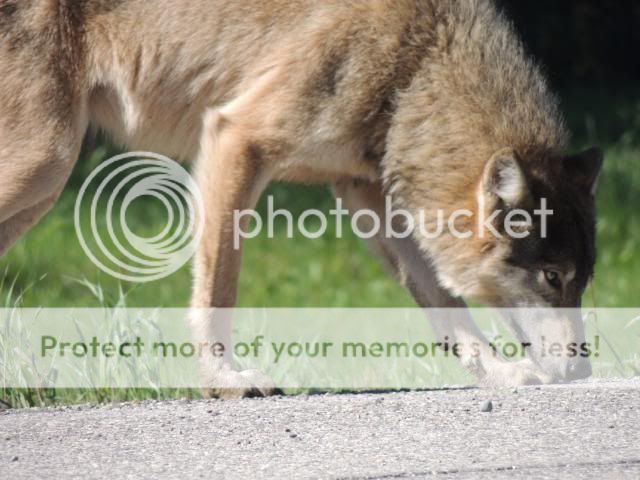
Looks like he / she is tracking a meal with its sniffer! Probably very focused on getting food into its stomach so it can see another sunrise


Brutus
CGN Ultra frequent flyer
Up here three years ago in the fall, I was heading back to my truck when I almost bumped into a wolf following me as I was hunting upland game. And the wind was in my favor.
He could of cared less, and if I did not have only 7.5 birdshot in both chambers, I would have let him have it at 35 yards. He literally walked away from me with hardly a glance backwards.
He could of cared less, and if I did not have only 7.5 birdshot in both chambers, I would have let him have it at 35 yards. He literally walked away from me with hardly a glance backwards.

The wolves in Russia are looking pretty healthy too.
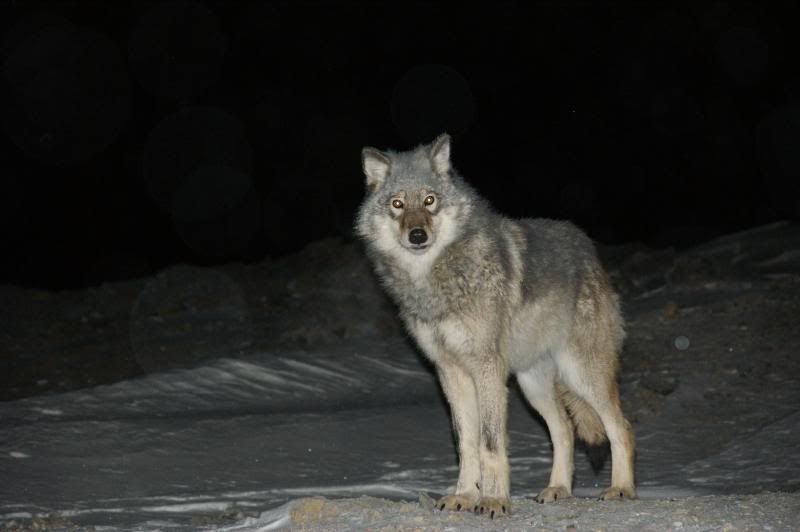
Asked a Rumanian once and he told me, all their wolves are gray. Apparently No Black or other color phases there.
Grizz
I drove by one on the ATV at sunset the other night. It was a skinny one, had his ears back and didn't look happy. I stopped look at him and then went up the trail and stopped and he came out and went the other way. I went back and paced out where he was standing from where I was, and it was only 20 yards. We've had them stock us out hunting acouple of times. Once the dog and I went down a trail turned around at the end came back 100yds to a wolf following us. That one got 2 blast's of a shotgun about 5 feet over his head. He left us alone after that. There's a good population of them around here.

I lived in Ontario into my 30's, shot lots of yotes but would always let any wolf I seen go by. They were sort of a novilty, didn't see that many, maybe 4 or 5 a season. Then I moved to Vancouver Island and started moose hunting on the mainland. I'll just say my oppinion has changed totally. Now it's shoot on site...all year long. When we are moose hunting, wolf packs move into the valley we hunt and the moose move out. I've seen packs of over 40 wolves. We've shot them right under the meat poles, trying to pull down hanging quarters while we are in camp at mid. day.

There is a healthy population of deer in the Kenora area to the point where they are wandering around town.
The wolves have followed and also been spotted in town as well.
And for the first time since a teenager I have a pack of what I think are coyotes on my island.
They were even howling in the daytime during this past full moon.
The wolves have followed and also been spotted in town as well.
And for the first time since a teenager I have a pack of what I think are coyotes on my island.
They were even howling in the daytime during this past full moon.























