The Dreaded Low Left Flinch

Recoil happens AFTER the shot.

Yup and thats why I said anticipation. You know that you are going to get a slap from that hand cannon and you tighten things up a bit to hold on. Thats when you start to flinch.

Lots of practice helps but even shooting .45lc that can get expensive hence the suggestion of .22. Jason's S&W 460SV is a lovely pistol but not what I would call mild when it comes to recoil.
 
Tenexx

Ya that 460 has given my the flinch so it will be staying home the next few times out! even that i do not mind recoil.

Yes i have a few 22 target pistols and my 38 i should be shooting more.

Where i see the flinch is in my 40 cz destinct low left groups.
 
I am also loking to join an indoor club so i can shoot more often in my spare time in the evenings.

Once a week outing are not helping.

A few years back i was about to join the marksman club, however I tok a job away from home, I think I even payed my initiation fee and did my shoots, but worked away for a year and never did join up.

I should look into this again.
 
If you reload, I'd suggest using minimum loads for a while, and light bullets. The flinch being most notable with the autoloader is something that happened to an old girlfriend of mine - she loved heavy loads in my 686, but hated my CZ because she said she didn't like "that thing" flying back at her face. She wasn't flinching from the recoil - she was flinching from watching the slide recoil towards her! Could this be part of the problem?
 
I'm just wondering if you have a flinch or a problem with grip? I have large hands with fat stubby fingers,and the only way I could find to fix the problem you are describing if by gripping the revolver as high and close to the hammer as possible(it feels very weird the first few times not comfortabat all) and getting as much finger through the trigger gaurd as possible.If you have a single action do not load it point it at the target and slowly squeeze the trigger with someone watching, for myself it was so noticable I could actually see the barrel move when I squeezed the trigger. Let us know how you make out.
 
hmm... Jason, your problem is summed up like this i think: shooting low and left consistently when shooting semi-auto handgun.

here's what i think is happening when you shoot that is causing you to shoot low and left.

as you are pressing the trigger rearward, your mind and body are unconsciously anticipating the resulting recoil that will happen when the hammer falls. what the body usually does is try and control the recoil that will be going up by either pulling down and trying to control the recoil or squeeze the gun REALLY hard to keep the gun from recoiling upward.

it seems that you are not that recoil sensitive as you seem to be shooting some large caliber handguns, so to me, that would eliminate pulling down on the handgun to control the recoil. i think that you are squeezing the handgun you are shooting too hard... in what is sometimes called a 'death grip'. have someone watch your strong hand as it grips and shoots your handguns. if your knuckles turn 'white' then you are gripping the gun to hard resulting in the low and left shot placement. you can even tell that this will happen by taking a shooting grip and squeezing the strong hand hard. you will notice your hand will naturally point low and left from where you were initially pointing when gripping hard.

to correct the low and left problem, you have to relax your strong (gun) hand and squeeze more with your support hand. this will not cause 'limp wrist' malfunctions as you really do have enough grip on the gun to have the recoil impulse work it's magic on the gun. the previous post of relaxing your pinky finger is excellent advice too. i would go one more finger and say to relax your ring finger too. remember, the only thing that should be moving in the shooting hand is the trigger finger. you must relax the rest of your grip, which includes your forearms. if your forearm is tight and hard, then you are not relaxing enough. squeeze more with your support hand, and relax your gun hand.

whether you shoot both thumbs high and pointing forward or thumbs locked crossed, it won't matter much. i will say it is easier for most people to shoot thumbs locked crossed as they can feel the support hand squeezing more and it is easier for the mind to relax the gun hand as it knows there is sufficient grip on the gun.

once you understand the mechanics of why you are shooting low and left, it then becomes a mind game. you have to tell yourself that to focus on something else other than the recoil... the mind does one thing superbly, but two things horribly. we do not multi task well at all, so if we say in our head or out loud, 'front sight, front sight, front sight...' as we use steady pressure on the trigger, the mind tends to be distracted from concentrating on the upcoming recoil and the body doesn't tense up and 'death grip' the gun just before the gun goes off. you replace 'front sight' with 'relax, relax, relax', or whatever mantra you want... just keep it simple.

the dummy round drill is a good one too. in a semi-auto, it will be a tap and rack drill. load 3-4 dummy rounds out of 10 rounds loaded into the magazine. if you don't concentrate on the recoil, you will have a steady gun that remains on point of aim.

having too much trigger finger on the trigger usually results in POI that is left of the POA, but not down. i don't think you have this problem.

another thing to do is not look at your target after you have shot. focus on your front sight for 3-5 shots and then look where you are impacting. this keeps you from chasing your rounds and keeps your eyes from getting tired.

anyhoo, i think i wrote too much... hope you were able to find something in my monologue to help you shoot straight.


:cool:
 
This might sound a little silly... but are you using good ear protection? I've seen quite a few shooters jerk the trigger because of the noise (or anticipated noise)

Other then that, there's no real secret in shooting pistol... just look at the front sight, gently squeeze the trigger, did I say look at the front sight? and repeat.

22lr pistols/revolver are nice because they will allow you to practice to your hearth's content without breaking the bank, they are not that noisy, and have minimal recoil... and you are using a Glock with conversion kit, you'll see that they actually have quite a bit of muzzle flip.

You need to build muscle memory... so practice the right technics, and practice them a lot.
 
JasonYuke, I am quite sure you are not flinch, because flinch is shoot all over the place, you are getting good group at 25 yards but just low and to the left. I suggest you can do some popcan plinking first instead of paper shoot. Most of the time shooting a paper you can hardly see where the bullet land and cannot adjust your pointing. on the other hand plinking something on the ground is more easy to adjust the pointing until you hit the target.

Trigun
 
I have trouble shooting low and left shooting rapid fire targets with my 625. I think what causes this in my case is when I squeeze the trigger fast shooting double action I have a tendency to squeeze with all my fingers and this pulls the front sight down to the left. I find if I grip the gun tighter this seems to help a lot. :eek:
 
How you hold the gun has no effect on accuracy.

Which part of your finger is on the trigger has no effect on accuracy.

You are not pressing the trigger straight back, you are pushing the trigger sideways.

Stop doing that.
 
Have not seen anyone mention "follow through". JasonYuke, may I suggest that you do the following:
1. Shoot one round, lower your gun, relax a bit, then raise gun and shoot another single round, etc.
2. Regarding "follow through" - as already recommended above, squeeze until the shot fires , but then you must follow through, that is, hold the gun in position with the trigger held back for a second or two after the shot has fired. The purpose of follow through is to convince your brain that it's NOT all over when the gun goes bang and by so doing you will be far less likely to flinch.
Once you have beaten the flinch, you can speed up the whole process and shoot multiple rounds without lowering the gun.
PM me if you want further explanation.
Try it. Follow through is being forgotten as a necessary practice in both handgun and rifle shooting.
 
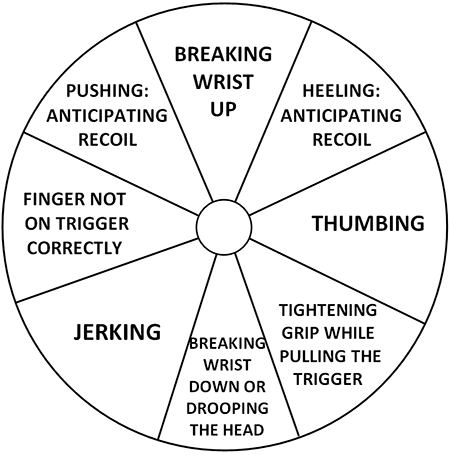
You could read this page

http://www.targetshooting.ca/docs/grp-analysis.pdf

or keep this chart handy (it has helped me)

wheel.gif


it came off this page
http://www.bullseyepistol.com/training.htm
 
I always have to work through my anticapation, never happens dryfiring, but I know i do it, I either have to be really fast or really slow to avoid it. Locking my right wrist seems to help.
 
Back
Top Bottom