That particular ammunition should have been condemned for ANY use. Instead, it was issued to he "Colonials".
At the St. Julien fight during the Second battle of Ypres (April 23/4, 1915), the 8th Battalion alone, with a single reserve Company, plugged the Line between the broken French North Africans and the Canadian Corps. I knew and interviewed TWO men who were in that fight. BOTH fired their Ross Rifles until they were too hot to reload, then continued the rifle engagement using a pickup rifle from a casualty. When their original rifles had cooled, they were picked up and the pickup rifles allowed to cool. Rifles were being fired until they were TOO HOT TO BE RELOADED; ammunition was being scavenged from Canadian casualties, of which there were a hideous number. The single Company of Canadians (about 140 men when they went in) were facing a couple of Divisions of German troops which had been massed behind the gas-canisters for a breakthrough attack. The men I interviewed were L/Cpl Robert Courtice and Pte Alex McBain. Both men were in good mental condition and fair physical health when I knew and interviewed them. They were part of that same reserve Company, A Company. Come to remember, they also both still were upset that they had seen the Brass running from Battalion Headquarters and abandoning the Field Hospital to the German advance; this is something which generally is glossed-over or avoided in the history books. L/Cpl Courtice told me, upon being questioned, that the ranges involved in this incredible rifle-to-rifle engagement were "too close to miss". Both men denied vehemently that there had been ANYTHING faulty with their rifles, or with the rifles of the men they were with. Pte McBain became so angry when I mentioned this question that he began swearing about it being "all lies". To be quite honest, I was afraid that he was going to take a poke at me for even suggesting this, despite the 50-year difference in our ages!
Both men remembered that engagement very clearly, partly because their personal combat experience was not a great deal more than that single history-changing battle. Pte McBain was wounded that day (bullet through the hand) and then treated and sent home, it being the idea at that time (before the casualty lists became so horridly long) that a man who had taken a bullet from the enemy had offered enough. L/Cpl Courtice was blown up by a 90-pounder the night before the big attack at Givenchy, only a few weeks later. Out of 12 men in the bay at the time (6 going in, 6 coming out) he was the only survivor. When it was discovered that he still was alive, Colonel Lipsett gave him a drink (Brandy from the Colonel's own canteen) and personally helped to carry him out of the Line, talking to him the whole way to keep him conscious. Cpl Courtice still had chunks of steel coming out of his head when I met him, 56 years later; he had a matchbox full of steel fragments which his body (mostly his head) had expressed over the years: much of what he had taken was far beyond the surgical techniques of 1915 to be removed.
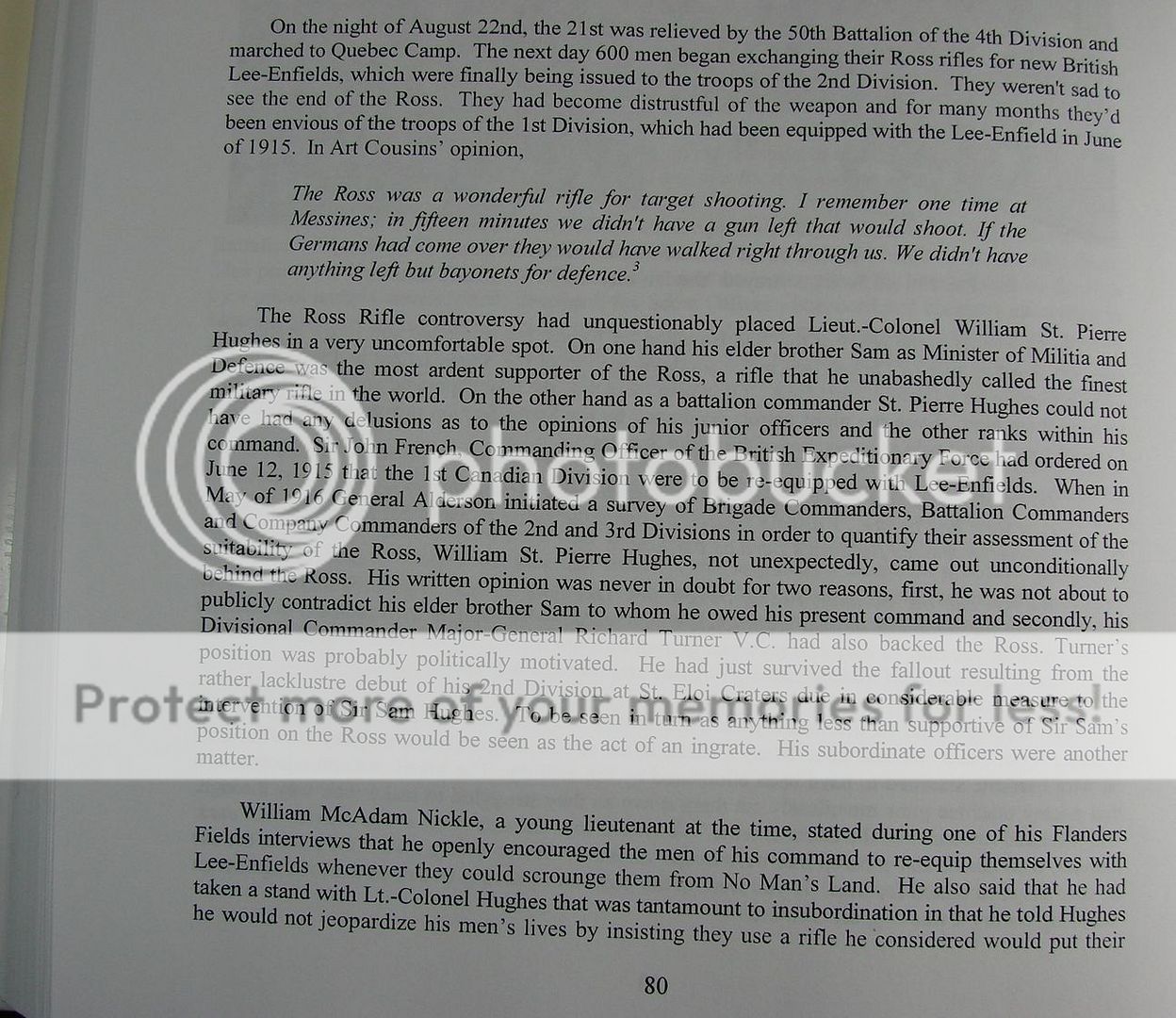
I never met a Great War veteran who had anything BAD to say about the Ross Rifle, apart from the fact that they didn't really LIKE it.
This was put in perspective for me by another old friend, Captain George Dibblee, DCM. Capt. Dibblee had been a cowboy before becoming a Guide to the NWMP in 1907. He joined the Amy in 1914 as a Private soldier and worked his way up to Captain. He was the SECOND man into Cambrai in 1918 because the plank over the Canal broke as he was crossing it; his Sergeant fished him out of the water. In October of 1916, he was with A Company, 5th Battalion, Canadian Mounted Rifles at the suicidal First Assault at Regina Trench (the operational orders were typed on the backs of superfluous Forms of Will!) and took command of the Company when both their own officers and a visiting officer were carried out. As a Sergeant, he held the position for 14 hours against a Brigade of Imperial German Marines before pulling out the remaining (all wounded) 15 to 20 living men. They had gone in as a full Company (140 men) and had got 120 into Regina Trench; only 20 got out. His souvenirs of that one were a piece of shell fragment in one arm, a bullet in the other and a DCM. He knew and served with Capt. George Pearkes VC who said, in a personal letter to me, that Dibblee's heroism was never properly rewarded: THAT coming from a man who HELD the VC! I queried Captain Dibblee regarding the Ross Rifle and he told me that, "The Ross Rifle was UNPOPULAR because of its length and weight; you couldn't get into a dugout with your rifle slung." When I persisted with my question, he said, "We had NO trouble with the Ross Rifle in our outfit (5th Batt, CMR) but we kept our rifles CLEAN, unlike some outfits that never cleaned their equipment."
For me, coming from men with THOSE personal tales to tell, this is enough.
I did, however, personally query the late Ellwood Epps regarding the Ross Rifle and was amazed when this quiet and friendly old man exploded into cursing and swearing: "It's all lies! It's G*d-damned LIES! There's nothing wrong with a G*d-damned Ross Rifle! I've worked on HUNDREDS of them!" Once it was determined that we were on the same side in this debate, things quieted down..... and Ellwood told me that he would be happy to rebarrel a 1910 Ross for me...... in .280 calibre. Alas! I never had the money..... and now Ellwood is gone.
But that "conversation" with Ellwood was the icing on the cake for me. I own nearly a dozen Rosses and I shoot them without fear and with wonderful results.
But I ALSO check the Bolt on a 1910 before I shoot it.
The Ross's main problems BOTH were made by Humans. The RIFLE itself is without peer from its own time.... and it has VERY few peers today, a CENTURY after the first 1910 was built.
That is a record which is awfully hard to beat.