









































Tips for cleaning black powder residue from breechloader shotgun barrels

ParksPipes

CGN Regular
Rating - 100%
2   0   0
Location
Ontario
Hi folks,
Have just read the “Steel shot in a Damascus cartridge gun” thread to much amusement.
What I have learned is that there are a whole lot of you out there with more experience shooting BP outta shotgun barrels than I.
Recently I did a duck hunt with a friend and we shot black powder loaded brass hulls with bismuth in our sxs’s (his an 1880’s damascus gun and mine an 1890’s steel gun).
Having never seen it before I was blown away by the amount of residue build up after some shooting.
.....I imagine that a round of skeet would be a mess.
It gave me an appreciation for what ‘pit-free’ and ‘in-proof’ barrels on guns of this vintage really means, and the effort required to keep them that way.

How are you guys cleaning your barrels, what are the recommended techniques?
I did get mine clean, but it took more work than I expected.
Wondering what the most common methods are ??

Any advice/tips are welcome, thanks!
 
Put some warm (not hot) water in a bucket. You could add a bit of dish detergent - I like Dawn - but it is not necessary. Stick the muzzle or breech in the water and pump water through it with your mop or substitute. When the barrel looks clean, dry it with clean patches. Next, run a WD40 saturated patch through it, followed by a clean dry patch. The WD is just to catch any remaining moisture. As a final step, lube it with your oil or grease of choice. I use RIG. It's WD and RIG for the exterior.
That is my routine with muzzle loaders and I have not had a spec of rust in almost 50 years of shooting.
 
^^^^^ Good advice, except repeat the same steps in two weeks. Steel sweats, and Damascus is porous. There will be fouling deeper in the pores than you think.
 
Yup..hot soapy water through bores..dry...oil...done
And checking periodocially never hurts for rust
Forming.. Wd40 is great to displace moisture. I use 3in 1 oil to coat bores in storeage
 
Hot soapy water with Dawn. Going to disagree with a couple Nova Scotians above because I hate WD 40. Fluid Film is my choice. I use a poly brush to clean any crude around nipples or flash holes. Fluid film displaces water and leaves a coating.
Wd40 just to displace excess moisture, i use 3 in 1 oil
To coat bores.
 
Put some warm (not hot) water in a bucket. You could add a bit of dish detergent - I like Dawn - but it is not necessary. Stick the muzzle or breech in the water and pump water through it with your mop or substitute. When the barrel looks clean, dry it with clean patches. Next, run a WD40 saturated patch through it, followed by a clean dry patch. The WD is just to catch any remaining moisture. As a final step, lube it with your oil or grease of choice. I use RIG. It's WD and RIG for the exterior.
That is my routine with muzzle loaders and I have not had a spec of rust in almost 50 years of shooting.

Bingo. I use this method for my .50 caplock and 10 gauge hammer gun. Zero issues.
Although I revisit the bore inspection, post cleaning about three times.
 
I run the electric kettle till it gets pretty hot then flush both barrels out to start. Then put the muzzles in a bucket of hot water and pump water through both barrels. Run a couple wet patches then a couple dry wipe the outside down then oil and spray oil in the ribs(a lot of shotguns have a small hole for this) something like wd40 first followed by normal oil.
 
Last edited:
I STRONGLY disagree with the suggestion to use HOT water. Hot water can cause flash (instant) rust.
As others have clarified, WD40 is used to displace moisture - not as a preservative. It was developed for that purpose and, from what I have read, it was the 40th formulation of a Water Displacing product developed for NASA. Fluid Film is an excellent preservative and I would not hesitate to use it on a BP firearm.
 
Put some warm (not hot) water in a bucket. You could add a bit of dish detergent - I like Dawn - but it is not necessary. Stick the muzzle or breech in the water and pump water through it with your mop or substitute. When the barrel looks clean, dry it with clean patches. Next, run a WD40 saturated patch through it, followed by a clean dry patch. The WD is just to catch any remaining moisture. As a final step, lube it with your oil or grease of choice. I use RIG. It's WD and RIG for the exterior.
That is my routine with muzzle loaders and I have not had a spec of rust in almost 50 years of shooting.

Thanks for the tips guys, and this one ^^^^^ seems to be the general basis for all.
So I've printed it out and will add some notes.......maybe the mess ain't so bad, and besides I've got some more shells to fire off!
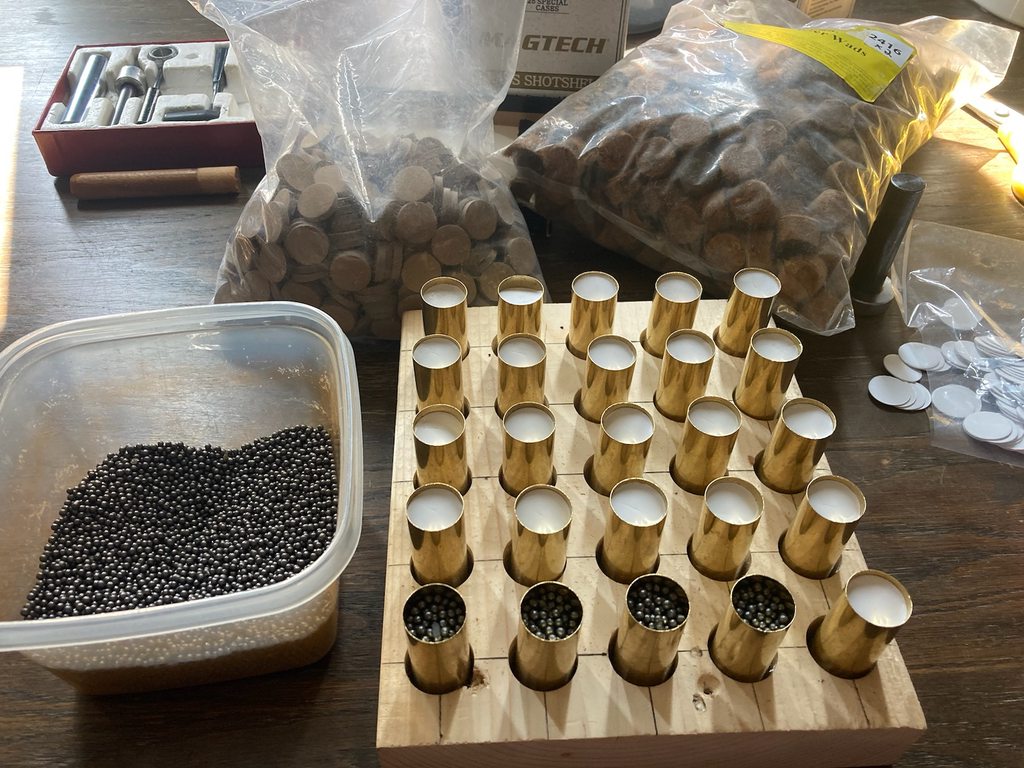
I've got some more of these bp loaded brass hulls plus a couple boxes of Gamebore 2 1/2" lead upland loads.
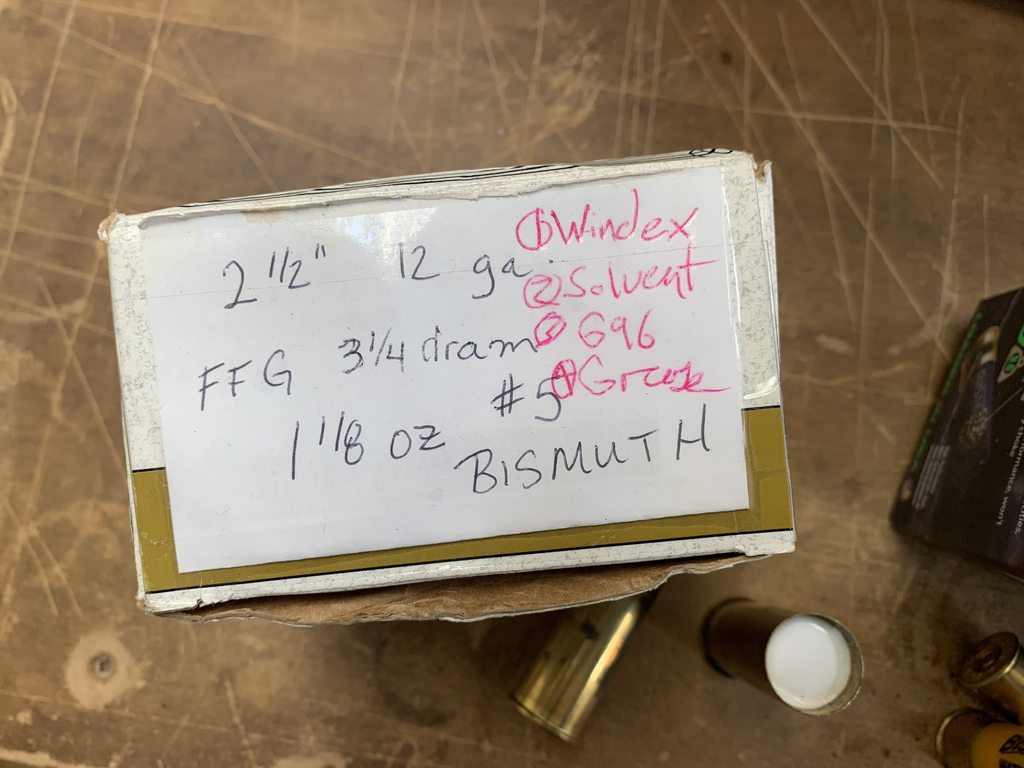
Basically I used Windex first followed by the standard Hoppes Solvent and then some light G96 lubricant spray (my note 4.Grease was for the receiver itself, knuckles, etc).
My pal Londonshooter has his methods having shot black powder before, but I wasn't prepared or set up at my place.
The Windex thing we'd heard of and actually it worked quite well to first loosen up the soot.
However next time I'll defer to the plain and simple time-tested method as stated by you guys, which it seems like the standard.
I just need to get out the bucket and long cleaning rod.
6HOEiwph.jpg


A thing about the load, we didn't find them overly effective...
Of course it can always be the shooting, but still they seemed not to connect....
And they haven't been patterned, probably should start there.
They certainly were well constructed and went off with a bang and a big cloud of smoke....maybe a larger sized bismuth pellet would have made an improvement?
Or maybe there is a finesse to the loading?
fAREKKah.jpg

--
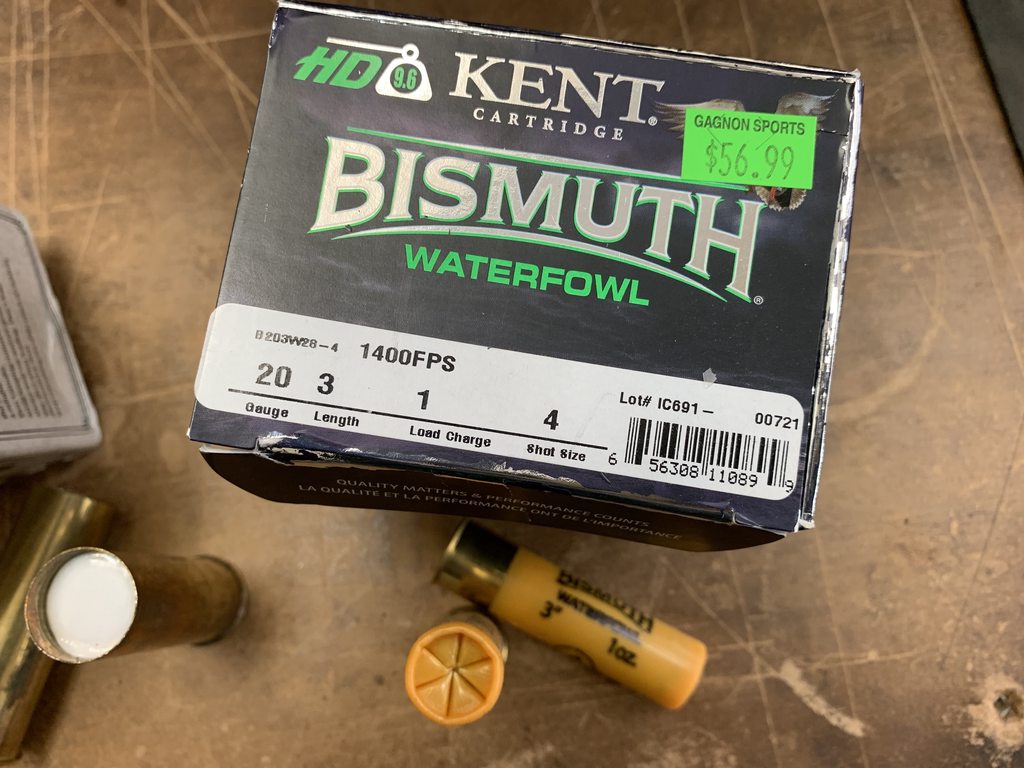
Although now I'm wondering if it's just the difference between the 1100-1200 fps, whatever they actually are, vs the 1400fps of the factory 20gauge loads I have regularly used, which really knock birds down?
Trying to picture a few hundred fps is mind-bending, that's a big distance over a short amount of time.
--
wCaRa6kh.jpg

--
Not all is lost though, and I should try and pattern a few of these first.

Here's a good shot of Londonshooter in the front of the canoe while the moon was still up, what it's all about...
aaJizrih.jpg
 
I STRONGLY disagree with the suggestion to use HOT water. Hot water can cause flash (instant) rust.
As others have clarified, WD40 is used to displace moisture - not as a preservative. It was developed for that purpose and, from what I have read, it was the 40th formulation of a Water Displacing product developed for NASA. Fluid Film is an excellent preservative and I would not hesitate to use it on a BP firearm.

Hmmm, never heard of the “flash (instant) rust” thing before but won’t dispute it couldn’t happen. I’ve always used the hottest water possible through the bore and then placed the muzzle into a sink of very hot water and used a rod with patches to suck up hot water on the upstroke and push it back down. The hot barrel dries almost instantly afterwards and a few patches with G96 seals the deal. Works for me.
 
Dont forget to clean your brass with water I usually have a jug with me when out shooting just pop them in and shake. Once home bottle brush and hot water.
 
Last edited:
Hmmm, never heard of the “flash (instant) rust” thing before but won’t dispute it couldn’t happen. I’ve always used the hottest water possible through the bore and then placed the muzzle into a sink of very hot water and used a rod with patches to suck up hot water on the upstroke and push it back down. The hot barrel dries almost instantly afterwards and a few patches with G96 seals the deal. Works for me.

Yeah I've always used hot water. Like you, I also use boiling water the hottest I can get and that's how I was taught. Been doing that since the late 80s and can't say I've experienced the "flash rust" phenomenon either. I'm not disputing some folks have but I'm guessing it's related to their local humidity and possibly other stuff in their water system.
 
Hmmm, never heard of the “flash (instant) rust” thing before but won’t dispute it couldn’t happen. I’ve always used the hottest water possible through the bore and then placed the muzzle into a sink of very hot water and used a rod with patches to suck up hot water on the upstroke and push it back down. The hot barrel dries almost instantly afterwards and a few patches with G96 seals the deal. Works for me.

I have always done this with BP and corrosive ammo.
 
Hmmm, never heard of the “flash (instant) rust” thing before but won’t dispute it couldn’t happen. I’ve always used the hottest water possible through the bore and then placed the muzzle into a sink of very hot water and used a rod with patches to suck up hot water on the upstroke and push it back down. The hot barrel dries almost instantly afterwards and a few patches with G96 seals the deal. Works for me.

I have experienced flash rust to varying degrees: modern replica caplock rifle, yes indeed.
Seems I vaguely remember, the hotter the water, the less its apt to flash rust(?)
120 years old Damascus sxs shotgun, not so much.
Virtually non existant.
 
I have experienced flash rust to varying degrees: modern replica caplock rifle, yes indeed.
Seems I vaguely remember, the hotter the water, the less its apt to flash rust(?)
120 years old Damascus sxs shotgun, not so much.
Virtually non existant.

I'm leaning toward local conditions as I've not seen it on anything up here, replica or original antiques. A variety of rifles, revolvers and single shot pistols over the years - I clean em all the same. The one constant is I'm usually cleanin' em all in the same geographic region all this time. Different water sources over the years ranging from municipal water supply to my current well and other peoples' wells but ultimately should be similar overall. But never witnessed it myself, so local conditions are the likely variable. I'd never heard of such a thing until I got on this forum.
 
Id be happy to help with the black powder/bismuth loads..ive found a way to improve patterns
With lead and I'm sure would work with bismuth.
Also you will find Pyrodex RS select a stouter load in a 12 or 16 with fiber wads..perfectly safe to use in old guns... I have an army & navy sxs here once owned by London Shooter...i do find my loadings improved with it after i re thought the loads out...one thing... Velocity... If your 1100fps and under...you'll be limited to 25/30 yards now....if you reduce to 1oz..but keep powder charge same...more speed....however...chokes matter. Most my Damascus guns are 1 bore not choked..one mod...with respect to pressures these guns can be useful with bismuth but range is not like a modern loaded 12g waterfowl load.. Fiber wads tend to bliw patterns but.....i have a little trick...
 
Id be happy to help with the black powder/bismuth loads..ive found a way to improve patterns
With lead and im sure would work with bismuth.
Also you will find Pyrodex RS select a stouter load in a 12 or 16 with fiber wads..perfecrly safe to use in old guns... I have an army & navy sxs here once owned by Londonshooter...i do find my loadings improved with it after i re thought the loads out...one thing... Velocity... If your 1100fps and under...youll be limited to 25yards and lead the birds alot......if you reduce to 1oz..but keep powder charge same...more speed....however...chokes matter. Most my Damascus guns are 1 bore not choked..one mod...with respect to pressures these guns can be useful with bismuth but range is not like a modern loaded 12g waterfowl load.. Fiber wads tend to bliw patterns but.....i have a little trick...
 
Back
Top Bottom