













































It turns out my ramblings are too much for CGN, so here are my musings on physics, in two parts:
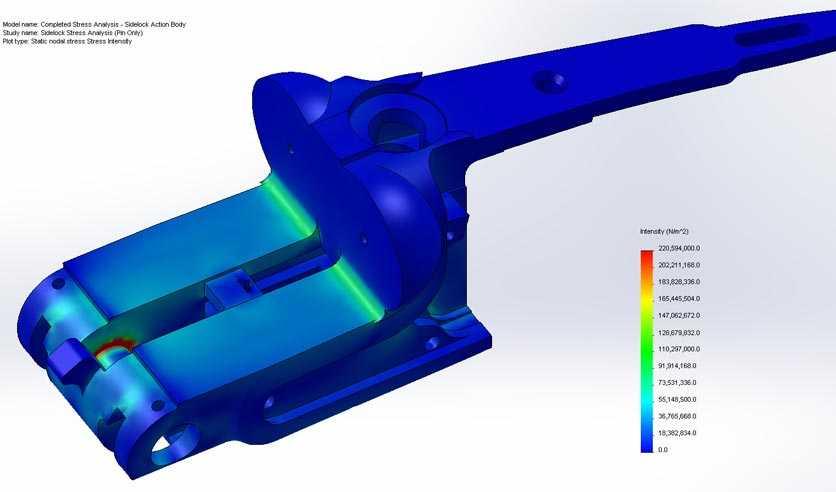
Stress. Something best avoided, to be sure. It’s the main reason I retired; it’s a bit of a long story there. But in the world of gunmaking, stress has always been a concern. When fired, a gun rings like a bell, sending vibrations travelling at the speed of sound. What does that mean? It means that vibrations course through the gun and the length of the barrel, back and forth several times, before the charge ever leaves the gun. Barrel flip is something rifle shooters are often aware of, but it affects shotguns, too. In the case of a hinge-action gun, the downward travel of the barrel acts like a first-class lever rotating on the hinge, pressing down on the action bar with considerable force. While pressing downwards, the barrel is also trying to leave the gun with the shot, pushing the barrel lump forward against the cross pin (the hinge). This latter exertion and friction is the reason hinge actions’ shoot loose’ over time, as the metal is battered and wears away, especially in guns where the tolerances between surfaces weren’t very good to start with. Repeated bending of the action bar (the action ‘flats’) can also leave a gap between the barrels and the standing breech, worsening over time. The current bespoke gunmaker Boxall and Edmiston posted a helpful image on their website, shown here, showing the areas of pressure acting on a boxlock action, with the highest pressure areas in light green, yellow, and red, where the barrel lump presses against the cross pin, and at the root (the juncture of the action flats and the standing breech).
British gunmakers of the Victorian Era were aware of these weak points and the weaknesses of breech-loaders early on, despite lacking the advanced metallurgical knowledge of steels we have today. The projected wear of the cross pin/hinge was a loudly voiced concern from the moment breech-loaders first appeared in Britain around 1853-1854, heard mainly from those who had never seen or held one but who felt the supremacy of their treasured muzzle-loaders was threatened. How could you trust a gun that came apart for loading? Makers of breech-loading actions acknowledged the issue of wear on the hinge and made actions whereby the cross pin could easily be replaced, if need be, with a slightly wider one (and not the bubba fix of peening the barrel lump). Victorians shot their guns quite a lot, much like competitive skeet and trap shooters today, and replacing a few essential parts every few years was not overly burdensome or expensive.
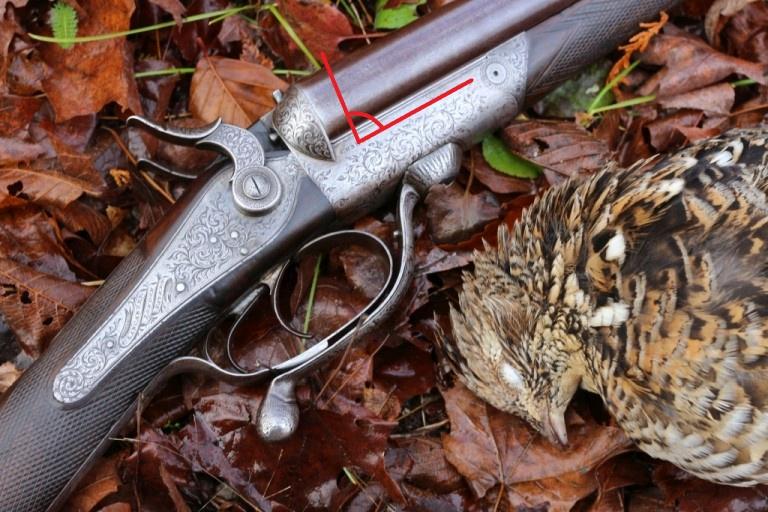
The gap at the breech was also a subject of discussion in the 1850s and a trickier issue to deal with. That it occurred was proven by the simple experiment of glueing a strip of paper across the top of the breech; the momentary separation of the barrels and the breech face would tear the paper. The first British gun to address the problem was Charles Lancaster’s slide-and-drop action. This design was originally the idea of Albert Henri Marie Renette of Paris, who patented the idea in 1835 (!) for a capping-breech-loader. In 1853, Renette’s son-in-law and partner, Louis Julien Gastinne, received a patent for this breech action on a hammergun, intended to use the then-new internally-primed Pottet/Schneider central-fire cartridges. The prolific patent agent Auguste Edouard Loradoux Bellford patented the design in Great Britain in the same year, and this patent was assigned to Lancaster and used for his proprietary base-fire cartridge and the new central-fire cartridges which had just started to appear. The way Lancaster addressed the breech movement issue was by making the angle between the action flats and the standing breech less than 90 degrees; once the barrels were slid back in place, the entire standing breech acted as a third bite, keeping the breeches from moving upwards upon firing. The action required very close filing work, and not surprisingly, Lancaster’s gun was the most expensive sporting gun on the London market.
Lancaster action, showing the acute angle between the breech face and the action bar.
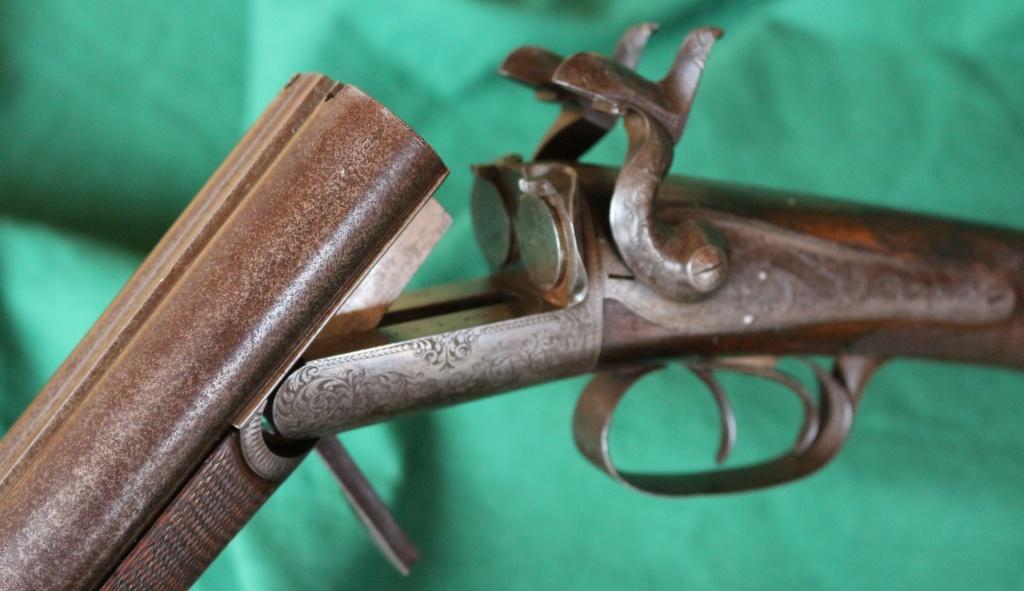
The second gunmaker to come up with a solution was James Dalziel Dougall, a Scot, who is said to have been one of the first British gunmakers to recognize the potential of breech-loading shotguns. Still, he had severe reservations about the system. Writing in the weekly newspaper The Field in 1857 and 1858 under the pseudonym “A Glasgow Gunmaker,” he was highly critical of the new breech-loader. In his 1857 book, Shooting Simplified: A Concise Treatise On Guns And Shooting, he questioned their strength and durability, and as far as quickness of loading, he decried the loss of “those little rests, while loading, to men and dogs, which preserve their strength throughout the day, and add a zest from the incidental conversation during these pauses.” He changed his tune rather quickly, perhaps prodded by the business opportunity the breech-loader presented, as by the end of 1857, he published in The Field an advertisement which declared he was taking orders for ‘breech-loading fowling pieces.’ Dougall did make the important step of addressing the ‘gaping breech’ issue by designing an action that addressed this specifically. In 1860, Dougall registered his patent for his famous “Lockfast” action, where the barrels, rotating on an eccentric hinge pin, slid forward before dropping down and, after loading, slid back and fit snugly into raised bosses on the action face. The closely-fitted raised bosses prevented the barrels from moving in any direction upon firing. The Lockfast action was very strong, suitable for both game guns and rifles. Dougall was a tireless promoter of his invention (to the point of being annoying), and it was built by him and under licence for many decades.
Dougall Lockfast, showing the raised bosses on the standing breech.
To be continued...
Stress. Something best avoided, to be sure. It’s the main reason I retired; it’s a bit of a long story there. But in the world of gunmaking, stress has always been a concern. When fired, a gun rings like a bell, sending vibrations travelling at the speed of sound. What does that mean? It means that vibrations course through the gun and the length of the barrel, back and forth several times, before the charge ever leaves the gun. Barrel flip is something rifle shooters are often aware of, but it affects shotguns, too. In the case of a hinge-action gun, the downward travel of the barrel acts like a first-class lever rotating on the hinge, pressing down on the action bar with considerable force. While pressing downwards, the barrel is also trying to leave the gun with the shot, pushing the barrel lump forward against the cross pin (the hinge). This latter exertion and friction is the reason hinge actions’ shoot loose’ over time, as the metal is battered and wears away, especially in guns where the tolerances between surfaces weren’t very good to start with. Repeated bending of the action bar (the action ‘flats’) can also leave a gap between the barrels and the standing breech, worsening over time. The current bespoke gunmaker Boxall and Edmiston posted a helpful image on their website, shown here, showing the areas of pressure acting on a boxlock action, with the highest pressure areas in light green, yellow, and red, where the barrel lump presses against the cross pin, and at the root (the juncture of the action flats and the standing breech).
British gunmakers of the Victorian Era were aware of these weak points and the weaknesses of breech-loaders early on, despite lacking the advanced metallurgical knowledge of steels we have today. The projected wear of the cross pin/hinge was a loudly voiced concern from the moment breech-loaders first appeared in Britain around 1853-1854, heard mainly from those who had never seen or held one but who felt the supremacy of their treasured muzzle-loaders was threatened. How could you trust a gun that came apart for loading? Makers of breech-loading actions acknowledged the issue of wear on the hinge and made actions whereby the cross pin could easily be replaced, if need be, with a slightly wider one (and not the bubba fix of peening the barrel lump). Victorians shot their guns quite a lot, much like competitive skeet and trap shooters today, and replacing a few essential parts every few years was not overly burdensome or expensive.
The gap at the breech was also a subject of discussion in the 1850s and a trickier issue to deal with. That it occurred was proven by the simple experiment of glueing a strip of paper across the top of the breech; the momentary separation of the barrels and the breech face would tear the paper. The first British gun to address the problem was Charles Lancaster’s slide-and-drop action. This design was originally the idea of Albert Henri Marie Renette of Paris, who patented the idea in 1835 (!) for a capping-breech-loader. In 1853, Renette’s son-in-law and partner, Louis Julien Gastinne, received a patent for this breech action on a hammergun, intended to use the then-new internally-primed Pottet/Schneider central-fire cartridges. The prolific patent agent Auguste Edouard Loradoux Bellford patented the design in Great Britain in the same year, and this patent was assigned to Lancaster and used for his proprietary base-fire cartridge and the new central-fire cartridges which had just started to appear. The way Lancaster addressed the breech movement issue was by making the angle between the action flats and the standing breech less than 90 degrees; once the barrels were slid back in place, the entire standing breech acted as a third bite, keeping the breeches from moving upwards upon firing. The action required very close filing work, and not surprisingly, Lancaster’s gun was the most expensive sporting gun on the London market.
Lancaster action, showing the acute angle between the breech face and the action bar.
The second gunmaker to come up with a solution was James Dalziel Dougall, a Scot, who is said to have been one of the first British gunmakers to recognize the potential of breech-loading shotguns. Still, he had severe reservations about the system. Writing in the weekly newspaper The Field in 1857 and 1858 under the pseudonym “A Glasgow Gunmaker,” he was highly critical of the new breech-loader. In his 1857 book, Shooting Simplified: A Concise Treatise On Guns And Shooting, he questioned their strength and durability, and as far as quickness of loading, he decried the loss of “those little rests, while loading, to men and dogs, which preserve their strength throughout the day, and add a zest from the incidental conversation during these pauses.” He changed his tune rather quickly, perhaps prodded by the business opportunity the breech-loader presented, as by the end of 1857, he published in The Field an advertisement which declared he was taking orders for ‘breech-loading fowling pieces.’ Dougall did make the important step of addressing the ‘gaping breech’ issue by designing an action that addressed this specifically. In 1860, Dougall registered his patent for his famous “Lockfast” action, where the barrels, rotating on an eccentric hinge pin, slid forward before dropping down and, after loading, slid back and fit snugly into raised bosses on the action face. The closely-fitted raised bosses prevented the barrels from moving in any direction upon firing. The Lockfast action was very strong, suitable for both game guns and rifles. Dougall was a tireless promoter of his invention (to the point of being annoying), and it was built by him and under licence for many decades.
Dougall Lockfast, showing the raised bosses on the standing breech.
To be continued...






















