Value of a fine London Double

Noobie81

Member
Rating - 100%
21   0   0
Location
Ontario
An acquaintance has inherited a Stephen Grant and Son Damascus barreled sidelock black powder proofed 12 gauge with the serial number putting it at about 1892 manufacture.
It has top lever, carved fences and fine engraving but is not a "best" gun by the looks of it. (I have only seen photos.)
The checkering is well worn and the browning on the barrels is well faded but overall the gun appears to be well taken care of and not butchered in any way. Assuming there are no nasty surprises could someone in the know give me a rough idea of it's value? This person does not know anything about these guns so the info i have obtained is only through me asking questions and looking at photos.

Thanks for any assistance. I will attempt to post photos when I have more time.
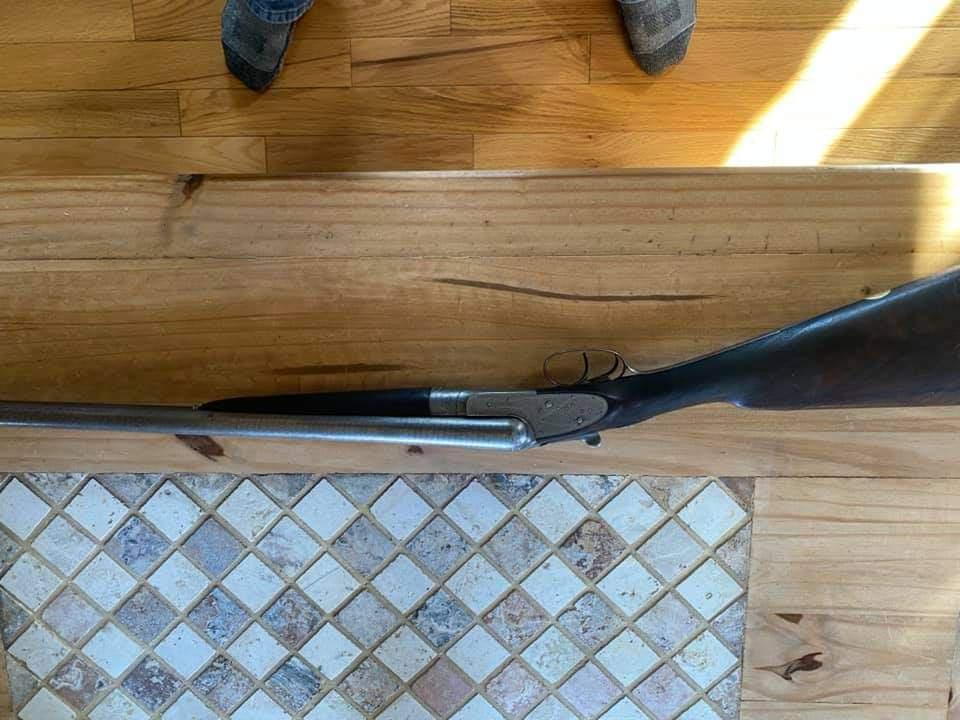
 
No idea of the value, but it would be great to see some pictures of the shotgun in question. It will also help others determine a price value of it.
 
akjErqH.jpg

wIv29V0.jpg

Hna69RY.jpg
 
There are too many variables that affect the value of a gun like this for anyone to make an estimate of value based on the rather vague description. The main factors affecting value.......
Brand value.... Stephen Grant is one of the finest London makers, top marks here.
Original quality...perhaps a second quality gun, lowers value
Current condition....superficially the external condition as described would be classified as 'Good', not Very Good, certainly not Excellent.
Current market... very poor for guns of this type in Canada right now, there are many fine doubles on the market and prices are going down.
There are also a number of lesser factors that affect value such as configuration, provenance, chamber length, modifications, etc.
The barrels are the heart of the gun and not economically replaceable for all but the most expensive desirable guns. A loose gun can be rejoined for hundreds of dollars. A faulty ejector can be repaired usually for many hundreds of dollars. Checkering can be recut, wood can be refinished, metal finishes can be renewed, more hundreds to fix. But if the barrels are severely pitted, severely dented or bulged, lapped dangerously thin they are not safely repairable and the gun becomes a wall hanger. It takes years of experience using special tools to accurately assess the barrels and this information is vital to any meaningful valuation. IF the barrels are sound ( many are not on these old guns) I would suggest a range of $1000 to $2500 in the condition described in today's market. If the barrels are not sound the value becomes what someone would pay for it as a curiosity - likely $300-$500. Anyone that was blinded by the name and elegance of this gun and paid big money for a gun with bad barrels would find themselves in a bad position if they try to sell.
Professionally restored, the value of this gun could be worth up to three times it's present value but it could well cost thousands to get it there.
 
Last edited:
Looks to be a sidelock ejector gun of high quality.
Is the action tight, barrels on face (look to be), and how are the bores?
Downside is that it has seen a lot of use.
 
Every time I go to add my sage advice to some thread, I see that Ashcroft has already said everything I was going to say, added a little more and said it all more eloquently than I would have.
 
Thanks for the pictures Noobie81, now I can add the following....
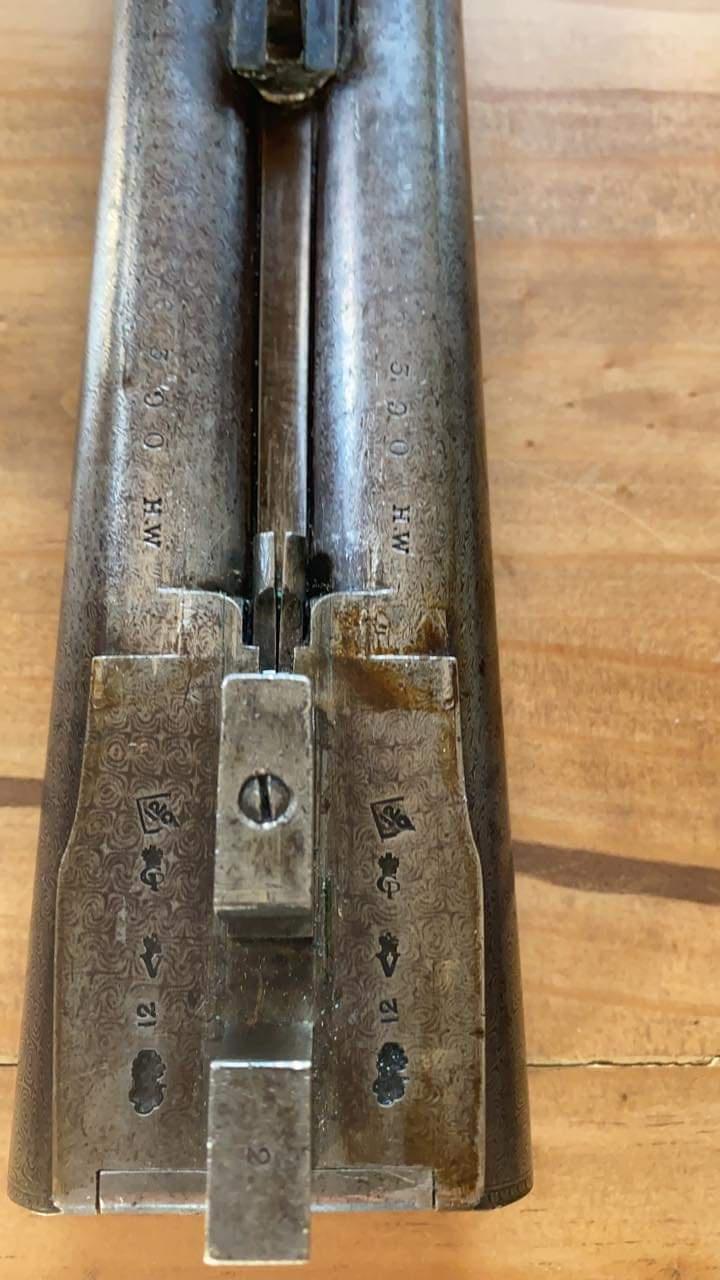
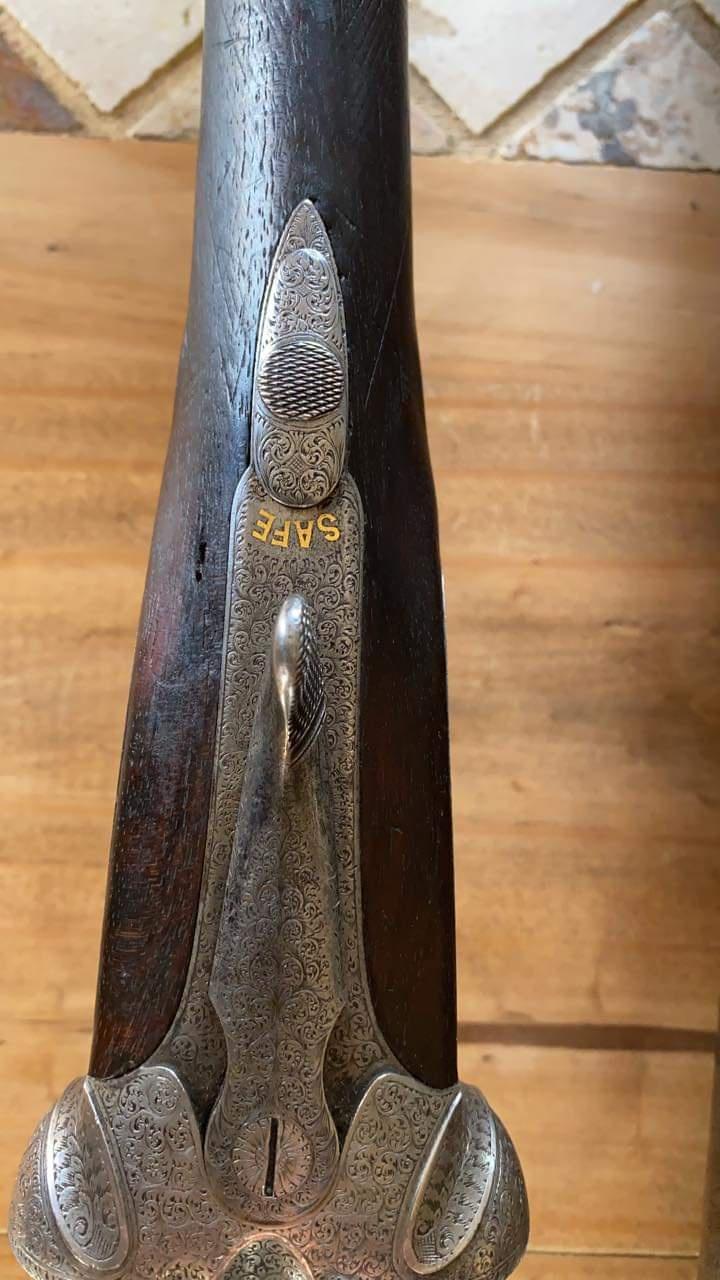
The engraving pattern conforms to a Grant best side lock.
This gun carries black powder proofs only. It was not made to use modern smokeless ammunition.
The chambers as made were for 2 1/2" cartridges, the British standard for the time it was made. It has not been reproofed, if the chambers have been lengthened to 2 3/4" it may be unsafe to fire, particularly with modern smokeless 2 3/4" ammunition.
The checkering isn't just worn, it's nearly gone! It could be honest wear but quite likely sandpaper was a factor at sometime.
The engraving is heavily worn, this usually means that the gun was too aggressively polished or buffed at some time. The action and lockplates would have been case hardened originally, the engraving is usually little affected in these areas by handling or cleaning, only the finish case hardening colours are affected. Metal and wood finishes can be renewed, worn engraving not so much.
The gun may still be a fine shooter ( with proper ammo) as it is but the value is low at best. The condition suggests that this would be a money pit to have restored, the realized value would be trumped by the cost of the work. Too bad, this was once a very fine gun but probably deserves an honest retirement now.
 
Great response Ashcroft, what a shame! I am told it was purchased by the current owners great uncle in Ireland before being brought over here
 
Wow, Ken, that's a beauty. Original quality was very high but the assisted openers 10 years later than this sidelock are more desirable and rightly so. The stocks as pointed out are pretty tired. The drop at comb would make this one, even if in shooting condition, a non-starter for me because I know I couldn't shoot it well at all. Still, this is/was an exceptional gun and your acquaintance is fortunate to have it. I dream of maybe one day shooting a Stephen Grant side lever actioned by Edwin Hodges. External hammers or not.
 
A JABC is appropriate for the wall at a hunt camp. A high grade British double, even one in tired condition, deserves better.
 
Agreed Tiriaq, I would probably take it out for an occasional partridge hunt with BP shells and then hang it over my fireplace but I don't have the extra funds to take it off his hands so he'll do with it what he pleases.
 
Thanks for the pictures Noobie81, now I can add the following....
................
This gun carries black powder proofs only. It was not made to use modern smokeless ammunition.
The chambers as made were for 2 1/2" cartridges, the British standard for the time it was made. It has not been reproofed, if the chambers have been lengthened to 2 3/4" it may be unsafe to fire, particularly with modern smokeless 2 3/4" ammunition.
..............

Ashcroft this gun is a great example for a question I have, and I'm hoping maybe you or someone else can answer. In that it is a pre 1897 gun how can you tell from the stamping that it is originally 2 1/2" chambered? Is there something that's present, or missing, that tells you this? I understand that 2 1/2" chambers were standard at the time, but that 2 3/4" chambers were also possible, although less common.
Is it the little 'C' under the '12' in a diamond that indicates regular chamber length? I read somewhere that if this were an 'LC' instead that it would indicate a 'Long Chamber', so 2 3/4".
But I only read that in one place whereas everywhere else on the great internet seems to state that a '12' over a 'C' in a diamond just means it's a 12 bore.
Any clarification would be appreciated!
 
My understanding is that when a gun is nitro proofed for 1 1/8 ounce that means it has 2 1/2" chambers and when it is nitro proofed for 1 1/4 ounce that means 2 3/4" chambers. I am thinking that when a Damascus/twist barrel gun has only BP proofs then it automatically means that it is 2 1/2" chambers? Were black powder Damascus guns produced that had 2 3/4" chambers? I am interested to know this as well especially since Ashcroft mentioned that a Damascus gun reamed out to 2 3/4_ is not safe to shoot at all.
 
Prior to 1887 the barrel was stamped with the nominal gauge ie 10, 12, 14, 16, etc. And this referred to the actual finished bore size. There was no standardized chamber lengths nor ammunition, they were reamed at whatever length the maker decided on and he generally supplied ammunition to fit. This unsatisfactory situation which resulted in some owners using longer shells with heavier shot charges than the gun was intended for was rectified in 1887 when the chamber length code in a diamond was brought into service. ParksPipes you are correct, the number over C in the diamond is the gauge, with the now standardized 2 1/2" length and LC refers to a longer chamber which could be 2 3/4", 3" or even longer! So this was now clear ( if you understood it ) if your gun had a 2 1/2" chambers but if it had the longer LC chambers you had no way of knowing how long they were. These marks were used until 1954. They also added the actual chamber length in inches (eg 2 3/4")in 1925, changing over to metric (eg70mm) optionally from 1955 and completely from 1989.
So chamber length marks varied over time, very confusing. And to add to the confusion, in 1896 they changed the marks again, marking guns Nitro Proof if applicable and adding the shot load, eg 1 1/8 oz Max, then in 1904 it became 1 1/8 oz Shot, then in the 1925 Rules it became just 1 1/8 oz. and yes, under these rules 1 1/8 oz was 2 1/2", 1 1/4 oz was 2 3/4", 1 3/8 oz had a 3" chamber.
These numbers referred to the load the gun was proofed at, the service load was generally 1/8 oz less and with much lower pressure. Confusing? You bet! You really need the code tables to puzzle these marks out.
Noobie81 my reference to lengthened chambers being possibly unsafe refers to all barrels, not just Damascus, I only mentioned Damascus because this Grant had Damascus ( and as a Grant it would have the very finest Damascus barrels available). In England and Europe if the chambers are lengthened the gun must be reproofed for this new load before the gun can be legally sold. This area immediately ahead of the chamber is subject to the highest pressures and you are thinning the barrel at this vulnerable point. Coupled with the fact that this area has frequently been already thinned by reboring to remove pitting and refinishing on the exterior which may involve drawfiling to remove corrosion and pitting, you can see that this area could have been thinned by .010-.020" which is approximately 1/4 of the generally accepted minimum of .080" in this area. In general, proof is a very large and confusing subject and the end goal is always safety. J.
 
I hope he doesn't hang in a hunt camp or several years from now there will be a thread "I found this old rusty English sxs" . I'd have it checked out and buy or load appropriate shells for it and knock off a bird or two every year if it was determined to be safe to fire.
 
When this gun was made it was one of the finest guns in the world, you could not buy better. It's now worn nearly to the point of junk but it still functions like it is supposed to. Look at it. How much use, how much handling, how much shooting does it take to wear a gun so severely? I've seen many 10-20-30 year old trap guns which have digested hundreds of thousands of rounds that showed some wear but nowhere near as much as this old Grant. If it was mine ( unfortunately it isn't) I would carefully examine and measure up the bores and if I thought there was even a glimmer of hope I would pack it off to my gunsmith for his assessment and possible bore polishing. Then, if it locked up securely, functioned properly, had no stock cracks and the barrels were safe I would load up some black powder ammo ( easy) and honour it by hunting with it a few times a year as Hunter 5425 suggests. Personally I think it is beyond economical restoration but if it is still safe to use occasionally it should be. On the other hand it costs just as much to restore a basic gun from a lesser maker as it does to restore a best gun by one of Britain's finest makers, so for someone with deep pockets this might be worth it. On the other hand don't ever expect to get more than a fraction of the money spent back out of it. It would not be a wall hanger in my house if it could be used.
 
Awesome, Thanks Ashcroft that clears it up!

I wonder did the standardized length in the UK ever change from 2 1/2 to 2 3/4, so what a c under a 12 meant changed?

Also looking at the flats on this Grant I don’t see it stamped ‘choke’ on either barrel.
Wouldn’t a factory cyl/cyl bore gun be unusual for this time?
Maybe I just can’t see the stamping or it’s worn off with a damascus refinish at some point....

I’d hate to see this a wallhanger, the possibility of a real find is too exciting.
I suppose that’s the catch....
Although yes if the outside is in this condition what’s it like on the inside....
 
Back
Top Bottom