






























Value of WW2 303 and .380 ammo

DarExc

CGN Regular
Rating - 100%
26   0   0
Hi all,

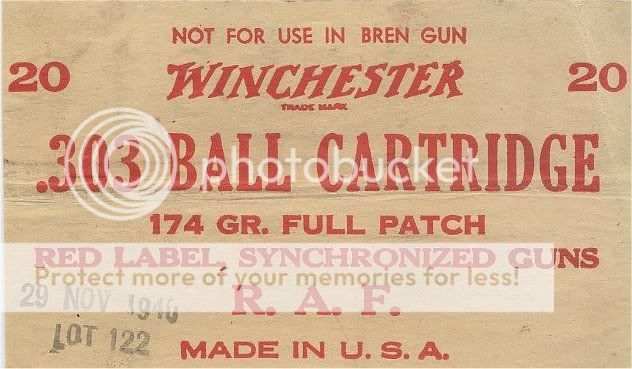
I was asking to take some ammo out of my wifes Grandmothers garage so I made my way out there today to clean it up. Her father was a reloader so I was told it was all his stuff he has reloaded. When I got there I saw the stuff on the top marked as reloaded in 1981 and it was all 30-06. I took it home and grabbed a box that said 303, I opened it and noticed the headstamp said 1941...anyways, I stopped, read the labels and realized I broke a seal to open it and other than the 3 plastic boxes of reloaded 30-06 this is all unfired and unopened WW2 ammo. The 303, of which there are 20 boxes is labeled in red 20 Winchester 303 Ball Cartridge 174 GR. Full Patch Red Label, Syncronized Guns R.A.F. Made in USA There are also a couple boxes of rounds with a head stamp of DA Mk.7 45 and some loose stripper clips with 1944 marked ammo labelled D/ Z 1944 or Dl Z

There is also a bunch of loose rounds stamped DC 42 380 for .380 handguns

If they're not worth much I'll shoot them, otherwise I'll have to give her some money for them or let her sell them to a collector, I know nothing about WW2 allied stuff and values though.
WinBren.jpg


Thanks!
 
Last edited:

Yup the 303 is worth money. Someone would probably pay $30.00 a box to fill out their collection and probably maybe $15.00 for a charger filled with matching rounds.The loose .380 is not worth to much to a collector but .50 cents a round would be a fair price.If you would like to sell a box of the winchester PM me.
 
All of it is pretty common ammo for cartridge collectors, but as Mr.Moose says, it is probably worth about that for someone to put with their rifle.

"DA" is Dominion Arsenal, the government plant and will be Berdan primed with corrosive primers. "DI" is Defence Industries, a private contractor and is non corrosive and Boxer primed. It is some of the best brass around for reloading.

The Winchester ammo was part of a large contract placed by the British before Lend Lease came into effect in mid 1941. It was supposed to have been made to a higher standard than normal ball for use in aircraft synchronised guns (not that there were a great number of such Vickers guns left in 1940) but was not well liked by the RAF and most was condemned to ground use.

Regards
TonyE
 
The .380 ammo will not be regular .380ACP; we didn't use any of that. The Germans and Italians marked their .380 ACP s 9mmK or 9x17.

It will be the .380 Revolver Mark II cartridge, which is a .38 S&W Short casing loaded with a 178- or 200-grain round-nosed slug. It is the correct ammunition for all those Webley, Enfield and Smith & Wesson revolvers.

That is a NICE haul!!!
 
German and Italian 9mm Short (.380 ACP) military ammunition was not marked with the calibre, only civilian ammo. Italian was 9mmC for Corto.

.380 Mark II would only have a 178 grain jacketed bullet. The 200 grain lead bullet was the Mark I and none was produced after 1936.

I cannot speak for Canada, but Britain issued .380ACP to air crew for personal protection. Early issues were commercial Kynoch loads but in 1944 military headstamped rounds were produced marked "K 44 .380" with the "ICI" monogram on the cap.

Regards
TonyE
 
why wouldnt the synchro ammo be used in bren guns? isnt it just really high quality mk7 ball? i thought it was just issued for regular guns/rifles after it "expired"
 
In the RCAF doing coastal patrols, the aircraft ammunition was loaded into the 12 Brownings on the Hurricanes when it was fresh.

Once it had passed its 'expiry date' it was made available for coast watch, target practice and so forth.

The Brownings were firing outside the propellor arc, of course, but it is really hard to climb out on the wing and clear a jam when the bird is at 15000 and doing 320 kts.

Makes sense for the fresh stuff to go for the critical guns.
 
In the RCAF doing coastal patrols, the aircraft ammunition was loaded into the 12 Brownings on the Hurricanes when it was fresh.

Once it had passed its 'expiry date' it was made available for coast watch, target practice and so forth.

The Brownings were firing outside the propellor arc, of course, but it is really hard to climb out on the wing and clear a jam when the bird is at 15000 and doing 320 kts.

Makes sense for the fresh stuff to go for the critical guns.

true, but it says specifically "not for use in bren guns" on the wrap, nothing about rifles or anything else
 
I believe the case hardness gradient was unsuitable for Bren guns and separated cases resulted.

A similar problem occurred when the first Brens were converted to 7.62mm and the L2A2 round was introduced with a thicker case web.

Regards
TonyE
 
^ I believe TonyE has the answer, when I first got my Bren many moons ago I tried firing commercial ammo and had a number of seperated casings before I wised up.
 
Hi all.
I just recently came into some WWI and WWII .303 Br ammo that I have no use for and was wondering if there is any value in it.
The WWI ammo consists of 2 rounds of what appears to be .303 Br AP (armour-piercing) marked with the Cdn broad arrow, DA , 1917 VII, and 2 rounds with the same markings, other than they are marked 1918 (both unfired).
The WWII stuff is:
2 rds, AP, with black-paint bands, marked DA, Cdn arrow, 1942 GI (one fired, one un-fired). The fired case has a cracked neck, but the bullet is still in the case.
13 rds, Ball, marked DA, Cdn arrow, 45, Mk7 (all unfired)
1 rd, Ball, marked DA, Cdn arrow, 41, WI
1 rd, Ball, marked DA, Cdn arrow, 43, VII
2 rds, Ball, marked DI, Z, 1943
1 rd, SP, marked V P T 41
I also have a single 5-rd stripper clip marked II with the Cdn arrow, and 2 rds of unfired Dominion .303 Br SP and two empty, fired cases of Dominion .303 Br, along with a box of 50 Dominion .22 LR cartridges. The 22 box is marked: This is the property of DND, 50 Ctgs .22 Ball Long Rifle.
Cheers.
Islandguy
 
Back
Top Bottom