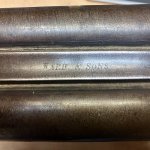
Thanks for posting, it is always interesting to look at old guns. The following information, which you may already have, is adapted from the Internet Gun Club database: "The partners in J Ward & Sons were J B Ward and A B Ward. They were first recorded in 1859 at 24-27 Bath Street, Snow Hill. In about 1870, the firm acquired additional premises at 2 St Mary's Row, which they later named the Central Gun Works. In 1876, H Ward, certainly related in some way to the Ward family of J Ward & Sons of Birmingham, established the firm of H Ward & Sons at 55 Rupert Street in London. This firm became known as Ward & Sons, and in 1879, it gave its Birmingham address as 2 St Mary's Row, Birmingham, with additional premises in Bath Street. It would appear that the two firms amalgamated. Although the London shop was not recorded after 1880, it may well have existed for longer. J Ward & Sons described themselves as gun, rifle and pistol makers, but from about 1883 if not earlier, they made gun implements, also letter punches, stamps, stencil plates, door plates and rubber stamps. The firm was a contractor to the War Department. In about 1910 and 1912, the firm may have had additional premises at 131 Steelhouse Lane, but this has not been confirmed. By this time, the firm was owned by A B Ward. From 1933, the firm no longer occupied the Bath Street premises; they operated only from 2 St Mary's Row. In 1938 the firm was bought by Warwickshire Gun & Manufacturing Co Ltd of 255 Hospital Street, Birmingham, but continued to trade as Ward & Sons. In about 1942, the firm acquired the business of Arthur Ilsley & Co (he had worked for Ward & Sons before starting his own business in about 1909). The firm ceased trading in 1964."
A bit of digging in UK census records provides some additional information. Unfortunately, looking up the name "Ward" in Birmingham in the period 1870-1900 turned up over 100 persons of that name involved in the gunmaking business! However, it appears that 'J Ward' is James W Ward, born in Birmingham in 1837. His sons, James B, was born in 1860, and Arthur B, was born in 1875. Apprenticeships were usually started at age 14, for a 7-year period. The 1881 census listed James B as a 'gun maker', so he had completed his apprenticeship by this time. In 1881, James W Ward was employing 85 men, which is quite a significant operation for the Birmingham Gun Quarter, as most gunmakers employed fewer than 10 workers, and often only had an apprentice and a journeyman (daily paid) worker on hand.
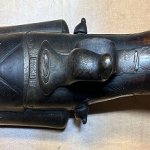
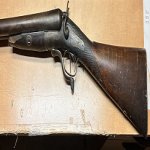
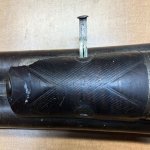
From the differing serial numbers on the barrels, one might be for the workshop that first put together the barrels or barrelled action, and the other from Ward & Sons as an inventory/production number; I have no way of knowing which is which, without comparing to other Ward & Sons guns, and any records for the firm have not survived. The Gun Quarter was a rabbit warren of several hundred tiny establishments and workshops, all producing guns and gun parts. A maker could produce guns in-house, or contract out much of the work, which is why guns can have multiple serial numbers. Your gun is a fairly basic one, with (possibly machine-made) damascus barrels and the generic engraving style of the day. The under-lever action is a post-patent copy of Henry Jones’s sturdy design. Jones patented his double-bite screw grip action in 1859, and the patent lapsed in late 1862. As it is easy to build and is very solid, just about every gunmaker started using the 'Jones double screw grip' after that, so the action itself is usually not enough to date a gun. It looks like the barrel loop was re-soldered at some time. Your gun almost surely has 2 1/2" chambers, and someone firing inappropriate cartridges could very well have caused the barrel loop to come off in the first place. As it is, the gun is a nice wall-hanger, I would not consider putting it in use without it being properly inspected. Proof marks on the barrel flats (hidden in your photos) would help date the gun more precisely.