Washing brass with warm/hot water?? I have reasons to ask...

.22LRGUY

CGN Ultra frequent flyer
Rating - 100%
177   0   1
Location
Ontario
Hey guys~I'm very new to reloading 17 Hornet, but have been reloading for years. (.223, .204R, .243 Win) I use RCBS case lube when re-sizing brass, and in an effort to avoid stuck cases...I usually have a Q-tip with a VERY small amount of case lube on it, which gets applied to the inside of the case neck on about every 3rd case. Since I've mostly used extruded powders like Varget, I've never had an instance where this approach created a problem. Either so little lube was used that powder didn't stick to it..powder was more coarse...or...the larger necks maybe helped it dry...?

Flash ahead to my first 17H loading session a week or so back. I decided to give CFE BLK a try, and it genuinely IS a powder (spherical?)...and SUPER fine consistency. After pouring powder, I noticed some sticking to the inside of the neck. Thought it was static at first, as there was just a little sticking in the funnel too. After remedying the funnel with a few swipes of a dryer sheet, it seemed fine. Got me wondering if the fine powder+thin layer of case lube was actually the problem with the case necks. Being such a fine diameter ID, the options on what to do are limited, got me thinking about warm...or possibly hot water, then thoroughly air drying. I own a Lyman tumbler, and use walnut media...but the powder/dust from the media (I'm thinking) would stick to the lube too.

Is there any reason NOT to use hot water to rid cases of case lube, aside from moisture being left on them/in them if you're not careful drying?

Thanks for taking a moment to reply.
 
The manual for my ultrasonic says to use warm, not hot water as hot water can tarnish the brass more. YMMV, I've never noticed a difference. I use a dollar store flour sifter to hold my wet brass over a heating vent. Leave overnight, nice and dry.
 
I own a Lyman tumbler, and use walnut media...but the powder/dust from the media (I'm thinking) would stick to the lube too.

Most of my rifle reloading is in 30 cal. I see some pieces of walnut shell stuck inside the case from time to time after tumbling (I use a spray lube) but a quick pass with a dry RCBS case neck brush solves the problem.
 
Lots of people clean brass with soap and water; usually in an ultrasonic tank or a stainless steel pin tumbler. Making sure it's dry is the only concern.

I tumble all my lubed and sized brass in my Lyman dry media tumbler to clean off the lube. It's gets absorbed into the tumbling media and the cases come out clean and oil free. I keep either old media or some cheap ground walnut lizard bedding just for this; don't want to contaminate my polishing media (don't even know if that's a thing though).
 
I don't tumble brass - just soak it in warm soapy water and vinegar or citric acid, as available. I then dry the brass on a cookie sheet in the oven @ 215 F for 15 minutes....
 
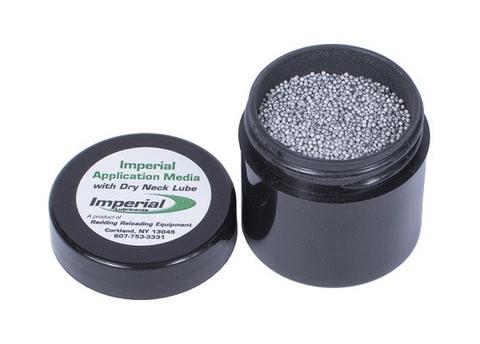
Below is the secret to lubing the inside of the case and keeping it "dry". The lube below is powdered graphite that is nothing more than fine powdered carbon.

Plus when you use Imperial Dry Neck lube you can tell your friends you have a lot of balls. :evil:

CH3epH9.jpg
 
I stopped using a vibrating tumbler years ago and now just use VERY HOT water+ salt+ vinegar+ a very small amount of dish soap. I rinse at least 5X to be sure to get rid of any residual junk in the water. I've tried a number of methods for drying but the best I've found ( from a guy on CGN forum ) is to use my food dehydrator. I've never loaded for a 17 but have for 223, several 30's and a 450". Another method of lubing case neck/shoulder is to use a "dry lube" (Imperial) dip, available from a number of sponsors on CGN. I only just started with this but a friend that is an F-class shooter (300-1000 yards) says it's what he uses.
 
I'll track down some some of that Imperial~makes allot of sense.

I don't tumble brass - just soak it in warm soapy water and vinegar or citric acid, as available. I then dry the brass on a cookie sheet in the oven @ 215 F for 15 minutes....

^any ratio/recipe...or just a splash?

Thanks for the input guys.
 
I lube my rifle cases with Imperial sizing wax and tumble them in walnut media for 20 min after resizing. They come out with no media stuck in the case mouth but some stuck in the flashhole. It's all gone after brushing the case necks and cleaning the primer pockets.

Hope this helps.
 
I'll track down some some of that Imperial~makes allot of sense.


^any ratio/recipe...or just a splash?

Thanks for the input guys.

You can make your own lube of this type. Being dry, it does not attract any powder types.
You just need an old pill container [plastic] with a lid, some # 9 lead shot and some powdered
graphite. Put 3 or 4 tablespoons of shot in the container, add some graphite, shake it around,
and to use it, simply dip your case neck into the shot, give it a twirl, and voila! Your necks
are lubed inside. I have been using this system for half of forever, and it works great! EE.
 
You can make your own lube of this type. Being dry, it does not attract any powder types.
You just need an old pill container [plastic] with a lid, some # 9 lead shot and some powdered
graphite. Put 3 or 4 tablespoons of shot in the container, add some graphite, shake it around,
and to use it, simply dip your case neck into the shot, give it a twirl, and voila! Your necks
are lubed inside. I have been using this system for half of forever, and it works great! EE.

But do you tell your friends you have heavy lead balls. :stirthepot2:

I'm beginning to think most of the people in this forum are half nuts.:evil:
 
I had the same problem with .243 cases, after sizing them fine grain powder (H414 in my case) would stick to the inside of the case necks. I use RCBS case lube on the necks. A small cleaning brush wrapped in a single layer of patch material cleans it up in a couple of seconds.
 
I am going to let you guys in on a proprietary piece of information here... so shhh... don't spread it around. I specifically heat the fluid in my deburring machine to 31 degrees centigrade. I found at that temperature mixed with Black Sheep Brass' proprietary cleaning solution (burnishing fluid and dawn dish soap) that it cleans the brass really well, and the heat that you put into the brass during the cleaning process helps dry it (a bit) out and the warm brass takes on lube for processing well as it is warm enough to keep the lube soft and transferable so when it goes into collators it will spread amongst the other pieces. That being said I polish for lube removal prior to loading.
 
I am going to let you guys in on a proprietary piece of information here... so shhh... don't spread it around. I specifically heat the fluid in my deburring machine to 31 degrees centigrade. I found at that temperature mixed with Black Sheep Brass' proprietary cleaning solution (burnishing fluid and dawn dish soap) that it cleans the brass really well, and the heat that you put into the brass during the cleaning process helps dry it (a bit) out and the warm brass takes on lube for processing well as it is warm enough to keep the lube soft and transferable so when it goes into collators it will spread amongst the other pieces. That being said I polish for lube removal prior to loading.

Switch to Sunlight and you'll only need half as much soap and won't leave as much residue. Dawn is junk.
 
Well, I don't get so anal with my brass that it just has to look new every time I reload or shoot it. Unless you have lots to spare IMHO it's a waste of time.

I do however like it to be CLEAN.

If I only have a couple of hundred rounds of rifle brass it goes into a SS Pin Tumble with Lemshine from Canadian Tire. It has a mild acid in it that gets rid of the grease. The soap and pins get rid of the carbon, inside and out. Stains stat in place but seeing as they are purely cosmetic, I don't bother with them.

If I have a large batch of rifle/pistol brass, it goes into an old pillow case and into the clothes washing machine with Lemshine. I knot the bags very tightly so they usually need to be cut open when I dump the cases out to dry, into a couple of old cake pans. Then they go into the oven to be dried at 250F for about and hour. This works well for me.
 
When using black powder in the 45-70 I always used hot soapy water to get the crud off then let it dry and then tumble to make 'em shine.

I wouldn't hesitate to use hot soapy water to get rid of case lube.
 
Back
Top Bottom