What's that old bullet ?

olivierlamothe

CGN Regular
Rating - 100%
48   0   0
Hello antique lovers,

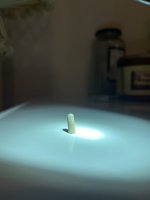
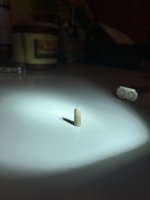
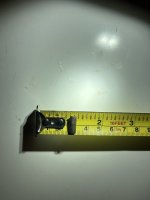
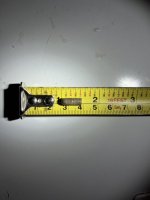
I'm referring to you to identify a bullet I dug up metal detecting in a old park near Ottawa.

It's smaller than .22lr :O

Se picture pictures for details

Thank

Olivier
 

Attachments

  • IMG_1846.jpeg
    IMG_1846.jpeg
    30.3 KB · Views: 84
  • IMG_1843.jpeg
    IMG_1843.jpeg
    31 KB · Views: 86
  • IMG_1839.jpeg
    IMG_1839.jpeg
    51.9 KB · Views: 78
  • IMG_1838.jpeg
    IMG_1838.jpeg
    54.2 KB · Views: 74
  • IMG_1847.jpeg
    IMG_1847.jpeg
    46.5 KB · Views: 79
You might need to be a bit more precise in your measurements - from your pictures, it appears to be circa 3/16" diameter - so that is 0.1875" - nominal bore size (top of rifling to top of rifling of .22 Long Rifle is 0.217" or so - groove to groove is often circa 0.222", but you would probably want to use a caliper or micrometer or similar to find a diameter? Go here for some SAAMI specs: https://saami.org/wp-content/uploads/2022/08/ANSI-SAAMI-Z299.1-Rimfire-2018-Approved-2018-06-13.pdf

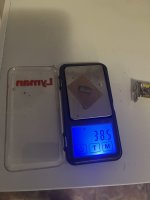
Same about weight - I have not used that brand of scale - so I have no clue if that is 38.5 grains or grams or if that counts the paper on the thing that is being weighed or not. Someone might be able to ID it from the information that you have given - I can not.
 
Thinking about it - that bullet could have hit the ground 250 years ago, or last week. Without knowing a bit more, not sure how to know. You said you dug it out of an "old park" - not sure what you mean by "old" - has considerable to do with what caliber firearms were common or were in use in what era. So far as I know, was quite common for there to be one bullet weight used for any particular caliber - had to do with rate of twist and what was possible to be made at various times. Old time might have been black powder propellant at specific velocity - later might be smokeless propellant at much higher velocity. Generally, black powder loads tended to go with larger diameter bores - not always, but generally lots of fouling with black powder - whereas small bores became more possible and common with smokeless powder - not much powder fouling. I think I read that 22 Long Rifle sort of "bridged" that - was originally a black powder round, I think - then, circa 1930's became mostly smokeless powder round.

 
Last edited:
One avenue to research, is the Zimmerstutzen guns. They often had smaller bores and were mainly intended for indoor, and very short range shooting, though it is my guess that there may have been more than one that ended up used in the garden for pest control...

Agree with the idea that you get a more accurate idea of the bore size, with something more accurate than a tape measure!
 
Back
Top Bottom