Who made this enfield?

bros

Regular
Super GunNutz
Rating - 100%
32   0   0
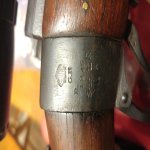
This one has me stumped. Trying to figure out who manufactured this No1 MK3* and if it is a dispersal rifle.

Wondering if it is a BSA made dispersal rifle? The prefix in the serial number has the letter "N".

No significant markings on the rear of the bolt raceway other than a broad arrow on the right and a "PH" on the left side.

The year of manufacture appears in the picture as 1945 but most definitely the 5 is a 3......so it's a 1943!


Thanks for looking.20201219_212429_resized.jpg
 

Attachments

  • 20201219_212429_resized.jpg
    20201219_212429_resized.jpg
    51.3 KB · Views: 612
There could be other indicator stamps on the butt stock. India produced the No1 until 1974??? and Australia produced them until 1945.

From what I can see of the wood, your rifle is possibly Australian.

You don't include pics of the whole rifle. If it's produced in India, the nosecap will have an RFI stamp on the front face, just over the bayonet lug.
 
There could be other indicator stamps on the butt stock. India produced the No1 until 1974??? and Australia produced them until 1945.

From what I can see of the wood, your rifle is possibly Australian.

You don't include pics of the whole rifle. If it's produced in India, the nosecap will have an RFI stamp on the front face, just over the bayonet lug.

bearhunter ......almost too embarrassed to show pictures of rifle in its entirety, it's a sporter but with a uncut barrel. ��
 
This one has me stumped. Trying to figure out who manufactured this No1 MK3* and if it is a dispersal rifle.

Wondering if it is a BSA made dispersal rifle? The prefix in the serial number has the letter "N".

No significant markings on the rear of the bolt raceway other than a broad arrow on the right and a "PH" on the left side.

The year of manufacture appears in the picture as 1945 but most definitely the 5 is a 3......so it's a 1943!


Thanks for looking.View attachment 445160

That is in fact a "dispersal" rifle

Check for a 4 groove barrel.
 
"Can one of you explain dispersal rifle?"

OK.
Roughly, after the 1940 bombing of the Small Heath BSA plant, SMLE production was "dispersed" to smaller facilities in the Birmingham area.
BSA was the only producer of rifles in the UKicon at the time, No4 production hadn't even started, so this was mildly important.

From personal observation, the rifles continued the BSA pre-war serial number letter prefixes through L,M and N from 1940-43. Receivers were MkIII (to 1941)and MkIII* from BSA stock, barrels were new made and carry Enfield inspection marks. Furniture can be Walnut or Beech, salvaged or new.
In 1944, salvaged receivers outside of the L-M-N series were built up into rifles with barrels that were also reused---in one case, a barrel from a 1941 Dispersal rifle was renumbered to match a '44 receiver.
The 1944 rifles also have an "FTR" mark at the bottom of the roll stamp marking on the buttsocket---I have not seen a '44 (8 examples) without this yet, but it is possible there are such rifles.

Dispersal rifles I have found in three states of preservation---
1.Matching numbered, well used to unused.
2.BSA 1953 FTR rebuilds.
3.Third World refugees with crudely remarked bolts and nosecaps.

krinko

This is from the Milsurps site
 
It is a dispersal rifle, but the PH stamp could indicate it was sporterized by Parker Hale. I have a PH sporterized MkIII* that was PH's lowest grade of sporter. The only thing done was to cut the wood back. The marking disc hole, and grooves for the upper handguard springs in the fore-stock were neatly plugged and a PH leather sling similar to a US 1907 but narrower added. The receiver is stamped NRF on the LR and PH on the RR. without looking I believe the woodwork is also stamped PH.
 
The NRF "receiver" (BODY in Enfieldese) is made by the National Rifle Factory some time in 1918. The NRF marking supercedes the SSA (Standard Small Arms) marking effective January 1, 1918, but there still existed a number of Bodies completed and in the system on that date.

The rifle under consideration is indeed a BSA "Dispersal" rifle with the Body itself made by BSA and subsidiary small parts sourced from the many small shops in the program.

My most recent acquisition sort-of completes this set: a fully-commercially-marked BSA 1940 SMLE Mark III complete with Magazine Cutoff (M prefix, s/n 66xx): one of the first British rifles built after the Dunkirk "miracle" (also spelled "disaster"). It, too, has seen the attentions of Bubba & Co, but there is enough there to begin a full restoration. I am a happy camper, thanks to the consideration of John at Wolverine.
 
That is in fact a "dispersal" rifle

Check for a 4 groove barrel.

Yes, correct a 4 groove barrel.

I made a mistake in my observation.....the "PH" stamp is on the right and the broad arrow on the left side of the bolt raceway.
Wonder why these receivers if they were all BSA..... why they were not stamped as such instead of just a "B."

Thank you all for your input.....you cleared up a few things for me.

Merry Christmas to all!
 
The NRF "receiver" (BODY in Enfieldese) is made by the National Rifle Factory some time in 1918. The NRF marking supercedes the SSA (Standard Small Arms) marking effective January 1, 1918, but there still existed a number of Bodies completed and in the system on that date.

The rifle under consideration is indeed a BSA "Dispersal" rifle with the Body itself made by BSA and subsidiary small parts sourced from the many small shops in the program.

My most recent acquisition sort-of completes this set: a fully-commercially-marked BSA 1940 SMLE Mark III complete with Magazine Cutoff (M prefix, s/n 66xx): one of the first British rifles built after the Dunkirk "miracle" (also spelled "disaster"). It, too, has seen the attentions of Bubba & Co, but there is enough there to begin a full restoration. I am a happy camper, thanks to the consideration of John at Wolverine.

I'm a bit confused, forgive me......so this dated 1945 receiver was made pre-WW2, in fact in 1918 by NRF and upon assembly in 1945 was stamped so? Did the BSA plant in Small Heath ever go back into production after the 1940 bombing?

Thanks
 
I think several people here have not read the posts carefully. The OP's rifle doesn't have any NRF markings. His does have a PH mark. I merely commented the I have a NRF rifle that was sporterized by PH and that his BSA dispersal rifle may also have been a post war sporter done by PH.
 
For clarification, that rifle body originally had the maker and date below the Crown and G.R. (eg. ENFIELD 1918, B.S.A. Co. 1917) but when rebuilt had that and the last two digits of the date the buffed off and replaced with that B and 45 (43?).
 
No. the dispersal rifles only had the B and the date. Yours is marked as it was built by BSA. also the butt is not fitted properly. There are cracks starting around the area where the butt meets the socket. There should be a slight gap between the wood and the outer edge of the socket with the recoil being taken on the end of the butt stock tenon on the inside of the socket.
 
No. the dispersal rifles only had the B and the date. Yours is marked as it was built by BSA. also the butt is not fitted properly. There are cracks starting around the area where the butt meets the socket. There should be a slight gap between the wood and the outer edge of the socket with the recoil being taken on the end of the butt stock tenon on the inside of the socket.

Are you saying the B marked dispersal rifles with the "19" then a clearly different '43' weren't originally WW1 receivers with part of the original markings scrubbed and then overstamped? I have seen many examples (and I would say this one) where that's clearly what happened.
 
My understanding is they were not WWI rifles that were scrubbed. BSA was making No.1 actions in the interwar years for commercial and foreign contracts. I'd have to get up and look through Skennerton's to find the quote, but many of the dispersal rifles were made on the commercial actions already on hand. That is not to say that they didn't rework some WWI rifles but the dispersal rifle I have is marked as is the OP's and shows no signs of any previous markings being removed. I believe the actions were marked with the B and 19 then the years digits and cypher were added when the action was brought out to be assembled. GR works for either war.
 
Skennerton is unclear about the markings except that all dispersal rifles were marked as this one, no factory, just cypher, B. date (often with individually stamped, poorly aligned year numbers) and the model information. BSA stopped production of No.1 rifles in 1943. While cannibalized furniture and other parts were used it would surprise me if they linished out markings on a rifle being reworked. It would be much simpler to simply mark FTR and a date. By 1944-45 the requirement for No.1 should have been pretty low with at least four other plants cranking out No.4s

What is the serial number of the OP's rifle?
 
My understanding is they were not WWI rifles that were scrubbed. BSA was making No.1 actions in the interwar years for commercial and foreign contracts. I'd have to get up and look through Skennerton's to find the quote, but many of the dispersal rifles were made on the commercial actions already on hand. That is not to say that they didn't rework some WWI rifles but the dispersal rifle I have is marked as is the OP's and shows no signs of any previous markings being removed. I believe the actions were marked with the B and 19 then the years digits and cypher were added when the action was brought out to be assembled. GR works for either war.

I have a 1940 dispersal that shows no signs of scrubbed previous markings. Also marked as the OP’s. Is there a way that ID it as a “commercial” action or were they the same as military actions?
 
No difference. they were making rifles for foreign military contracts, service rifle match shooters and yeomany/territorial units that would all conform to British military specs. Commercial, i.e. sporting rifles would differ in sights fitted, wood furniture etc.
 
Back
Top Bottom