wobble cartridges ?

WhelanLad

CGN Ultra frequent flyer
Rating - 0%
0   0   0
Location
Australia AU
sooooo, with some FC brass ive used several times, an mostly just neck size now days 3-4-5-6? times now, but what ive just found is when putting cases through the Lee Zip trimmer and giving a few pulls to trim the length, one in 40 cases is "Bent" to a fair degree, the CLG still goes in, the neck an firing pins line up but something seriously bent in between..... whats going on here?

rifle is a nice chambered kimber 84m 7mm08 factory............. brass is original once fired in this gun an FLS once an then Necked since...


is this the Case Base / Rim bent? would it help if i upload a video of the case spinning? or you get the gist?

i seperated them couple, an will see what happens after next firing... is this perhaps just a "time for new brass, Bloke"


Thanks
 
Try good brass and see if it repeats - Peterson is close to Lapua imho, and sold in 50 packs - good for a whirl!
But I would bet the issue you are seeing is the brass.
 
Try good brass and see if it repeats - Peterson is close to Lapua imho, and sold in 50 packs - good for a whirl!
But I would bet the issue you are seeing is the brass.

yeh i dont see any 'federal' brass for sale in Aus?? perhaps im lucky to get so many firings out of the stuff, i think i will purchase RP next for sure!


Do ya think just the case base is deforming with the use?
 
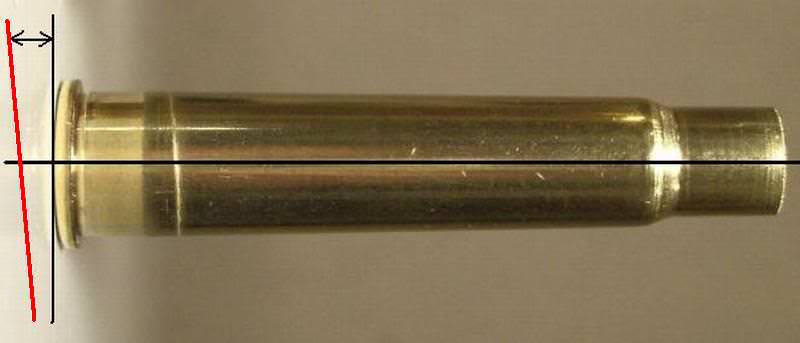
If the base of the case is not centered or has a ding on the rim the case will wobble. This happens to me with the simple Lee trimmer below and even my old grey Lyman trimmer.

Loosen the shell holder and spin the case a little and retighten and see if it wobbles. If the case is off center you should be able to center the case and it will spin without any wobble. If the rim has a ding it may still wobble and you may be forced to spin the cutter and not the case.

NOTE, sometimes the case holder causes the wobble, check the holder and make sure there are no manufacturing sprews or burrs causing the problem.

Below with this type Lee shell holder it easy to make the case wobble if its not centered. Any type of trimmer that grips the rim can wobble either being off center or having a bent dinged up rim. I went to the WFT that indexes off the case shoulder for my AR15s and M-1 Garand that can chew up the case rims

case_trimmer_7mm08.gif


Below the WFT and no wobble, you hold the case and press it into the trimmer. My old hands might shake from too much coffee but they don't have any high speed wobble. ;)

Worlds-Finest-Trimmer-.223-beside-.308-2000-768x396.jpg
 
Last edited:
There is one more thing that can cause the case to wobble and that is the case itself warps when fired. If the case wall thickness is not equal the thin side of the case will expand more when fired. This makes the case body egg shaped and when this case is full length resized it makes the base of the case tilt. And if the case is placed on its base it will lean to one side, because the case head is out of square with the case body.

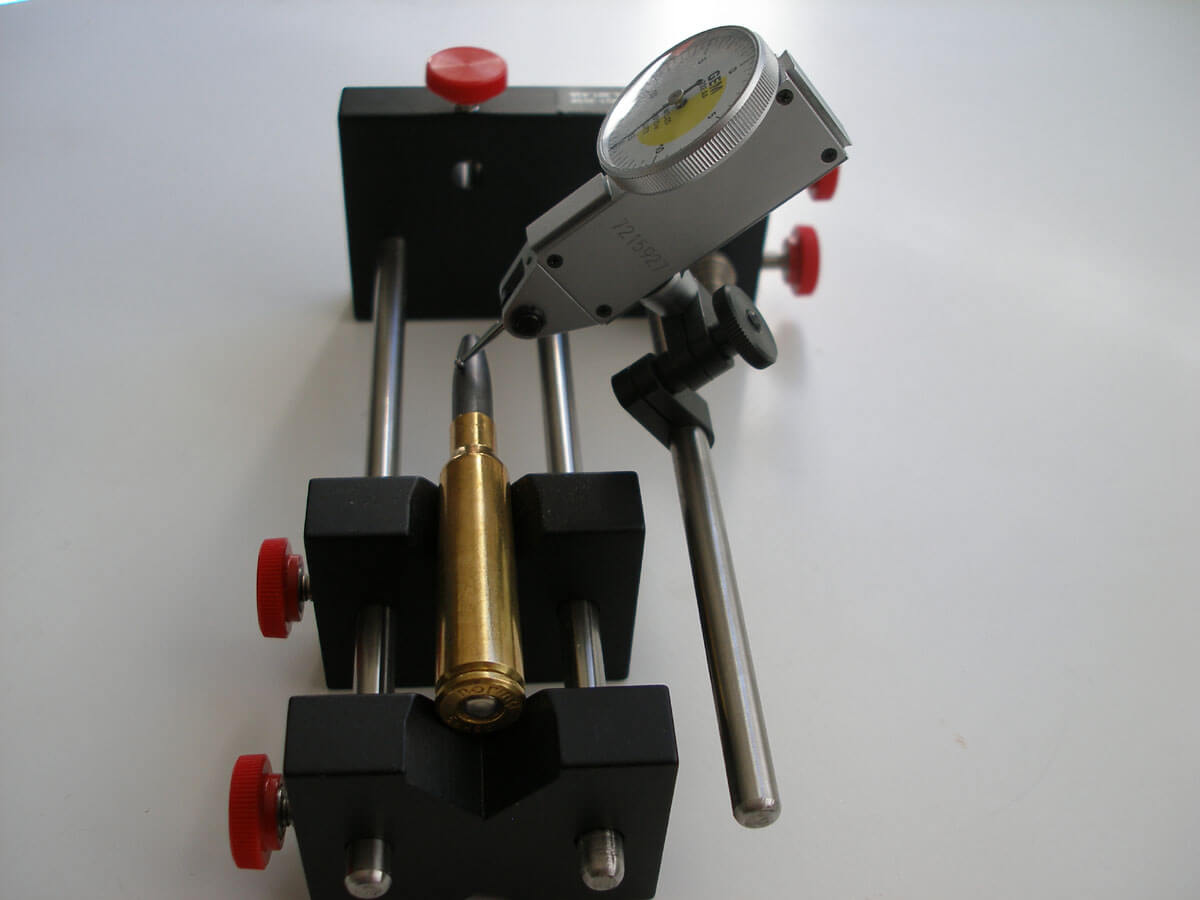
This effect becomes worse when you have a minimum diameter case and a maximum diameter chamber. Meaning a skinny case fired in a fat chamber will become more egg-shaped when fired and warped when resized. This can drive you nuts trying to find out why your group size increases to several inches in size from warped brass. This is explained below from the NECO case gauge web page. And this gauge will allow you to place the gauge on the base of the case and measure its tilt.

NECO CONCENTRICITY, WALL THICKNESS AND RUNOUT GAUGE

NEWDIAL2-1.jpg


This case gauge is designed to measure:

1) The curved “banana” shape of the cartridge case;
2) The relative wall thickness variation of a cartridge case;
3) The cartridge case head out-of-squareness;
4) Individual Bullets – out-of-round “egg shape” and/or
curved “banana” shape (excepting very small bullets);
5) The seated bullet and cartridge runout of loaded rounds. The accuracy of any firearm is determined — and limited — by the quality of the ammunition shot in it. The effect of imperfections in ammunition is cumulative; each flaw adds to the influence of all others. Precision shooters spend much time and effort “uniforming” cartridge cases, using advanced techniques to eliminate variation. Yet until recently, one of the most important of these variations has not been susceptible to detection by any device readily available to marksmen.

Normal manufacturing tolerances cause brass cartridge cases to vary in wall thickness around the circumference of their bodies. Under the stress of firing, a case with such variation stretches more readily along its thin side, transferring more pressure to the bolt face at that point and introducing an unbalanced force which contributes to bolt whip and vibration of the barreled action in its bedding. This whip and vibration varies from one shot to the next as cartridges are fired with their thin sides randomly oriented at different angles, causing reduced accuracy. The problem is made even worse if the brass is too hard or springy to completely fireform to the shape of the chamber, in which event the greater stretching of the case’s thin side will cause it to develop a curve along the length of its body. These “banana” cases cannot hold a bullet aligned with and centered in the bore, undercutting the effectiveness of the handloader’s careful case preparation.

Fortunately the accuracy problems caused by wall-thickness variation can be minimized, or perhaps eliminated, if all cases are “indexed” — fired with their thin sides always oriented the same direction in the chamber. This causes bolt whip to be minimized and consistent, and, while bullets will still be misaligned, they will all be misaligned the same way, which often produces accuracy like that of perfectly aligned and concentric ammunition.

Below a link showing how to use the NECO gauge and type measurements it can make. It shows measuring case wall thickness and case head squareness and checking for warped cases.

https://www.neconos.com/old/neco%20article0001.pdf
 
Last edited:
Neck sizing is a thing of the past, its better to full length size, adjust a full length sizer to just bump the neck enough to allow the bolt to close with the slightest amount of resistance.
 
Neck sizing is a thing of the past, its better to full length size, adjust a full length sizer to just bump the neck enough to allow the bolt to close with the slightest amount of resistance.

This is a new one to me.

If the condition, bigedP51 describes with the uneven case wall thickness, full length sizing won't fix it.

bigedp51, the uneven case wall thickness is seldom a problem these days, especially with good cases. Still, it does happen.

The last time it happened with me was when I reloaded a batch of once fired Federal, white box 223rem/5.56 nato. The cheap stuff from Walmart, because it was on sale. Actually cheaper than I could purchase the brass for.

The banana shape wasn't readily visible, nor was the egg shape, but it definitely showed up on my concentricity gauge.

I believe you've explained it very well.
 
The worst this ever happened to me was with a 1943 03-A3 30-06 and Remington cases. New cases shot very good groups but the fired and reloaded cases had 5 to 6 inch groups.

I didn't have any gauges in 1976 so I took the fired cases to work and had a machinist and bench rest shooter measure the cases. And the cases were badly warped and the base of the cases out of square. To keep the cases from getting warped I down loaded them to 30-30 velocities with 170 grain bullets. And this was good enough for deer hunting in the woods and only using the old rifle as my bad weather rain gun.

And you are correct bearhunter and modern cases are made better today than in the 1970s. BUT I have some newer Remington .223 cases with over .009 thickness variations so it still happens. And my main point in posting this info is a poorly made case can drive you nuts if you do not have a good case gauge. And if new brass shoots good groops and your reloads shoot shotgun patterns don't blame the rifle. And again a fat chamber and skinny cases makes the problem worse, like a skinny Winchester .303 British case fired in a WWI No.1 Enfield rifle.

The Winchester case below was only reloaded two times and started to seperate. But on the first firing the case warped and the base of the case became out of square. You can even see the case separation was at an angle and corresponding to the case wall thickness.

46QO4nj.jpg
 
Last edited:
Back
Top Bottom