WW1 Canadian Cap Badge

TheCroatian

Regular
Rating - 100%
140   0   0
Just got this. Im not big into WW1 items but I must say I like this alot. Im guessing its a cap badge? I know its the 48th and the major battles they took part in. What is the star for? It has hooks attached to the ribbon and a nice label from Phily and made in the USA?

Im keeping it but anyone know what this would be worth?

Thanx


48th.JPG
 
CEF 15th Battalion 48th Highlanders cap badge

Looks correct for the WW1 Cap badge, It has the belt on the bottom which on later WW 2 cap badges was omitted.

48 tartan behind the badge. I don't know what the star is for, it's not part of the cap badge. Same for the ribbon (trying to see if it was used as a backing under the cap badge)???

WWI value is around $50 - $60

WWII is $25
 
Ummkay, odd combo then, a Canadian cap badge with a USA made ribbon and a US award star stuck to it...if only this item could talk, how and why its assembled like this.

Looked the star up and it looks like a Bronze Star, these were commonly on the WW1 French Croix de Guerre medal for US troops.
 
CEF 15th Battalion 48th Highlanders cap badge

Looks correct for the WW1 Cap badge, It has the belt on the bottom which on later WW 2 cap badges was omitted.

48 tartan behind the badge. I don't know what the star is for, it's not part of the cap badge. Same for the ribbon (trying to see if it was used as a backing under the cap badge)???

WWI value is around $50 - $60

WWII is $25

Tartan is Davidson. After the 1st Col. in 1891, John I. Davidson. Ribbon and star are not associated with the regiment. The "buckle" badge (as it is referred to within the regiment) was re-instated in 1991 at the unit centennial. It is not uncommon to see any of the post WW1 badges still worn by members. CEF marked badges are not worn but I have seen the pre WW1 badge (quite rare) worn by individuals.
 
Tartan is Davidson. After the 1st Col. in 1891, John I. Davidson. Ribbon and star are not associated with the regiment. The "buckle" badge (as it is referred to within the regiment) was re-instated in 1991 at the unit centennial. It is not uncommon to see any of the post WW1 badges still worn by members. CEF marked badges are not worn but I have seen the pre WW1 badge (quite rare) worn by individuals.

I was there in 91 when the 48th got their new colours. Great Day on parade.
 
Hey, thanx for your post, you are correct, the US stars are 5 points!

So whats this old wolf cub hat award???

you have to go back, way back, to when scouts wore green and had the stetson, and no sash- the hat is similar to the one worn by one of the guitarists of ac/dc, if it isn't one of those- the "stars" " were awarded as you worked through your various programs - similar to what tenderfoot, second class, and first class were in scouts , except they were called tenderpad, first star and second star- the handbook was called "from tenderpad to second star"
 
I understand it to be black for mourning the killed in action.

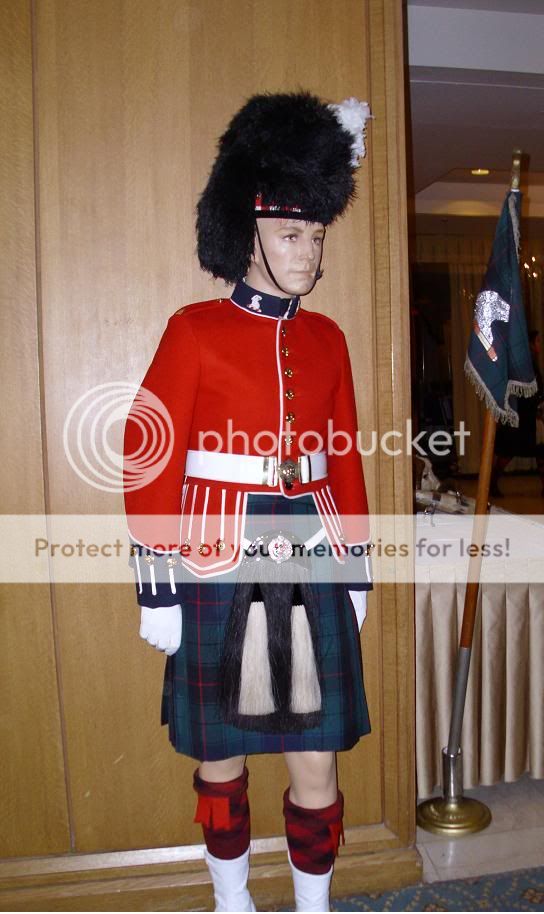
Highlanders wore 3 distinctive types of head dress over the years {with some exceptions} 1= Feather Bonnet: {Black Ostrich feathers w "tails" 5 older style, 4 later and "dice" which is the reference to the red and white checkering around the head band} This headdress rarely utilized a badge. Think "Thin Red Line"
2= Glengarry: Most commonly seen today, wedge type headdress w/ pom on top. Worn centered, leaning slightly to the right the badge is worn "on top" of the left side and is affixed to a black ribbon that is stitched to the hat. Black ribbon "tails" hang loosely from the back of the Glengarry and resemble a time when the headband was tied in place. The Glengarry when worn as Military dress will also be "diced". Civilian and personal ones are not.
3= Balmoral: A floppy kind of French Beret looking headdress only larger also with pom. Military is "diced". It also has Black ribbon to attach the badge to as well as "tails" at the rear. Worn centered and to the right as with the Glengarry. When part of a dress uniform in the 1950's and 60's the guys would insert a wire form to the inside of the Balmoral in order to get a uniform circular pattern to the top of the headdress.
Highland Regiments have of course also worn things like Pith Helmets,Fur headdresses,Military caps and the like depending on the Regiment or campain of the time period.
 
Some one correct me. The cap badge would not have a tartan backing or ribbon. I was in a civy pipe band for 10yrs. Black ribbon or cockade under a cap badge or both.


In the 48th the badge is customarily worn with a red serge backing behind the open "48" against a square of Davidson tartan centred on the red cross of the sett. The tartan is frayed along each edge. My avatar shows a typical setup. This is worn only with the "Balmoral". Highland regiments of the British Army refer to this headress as the Tam O' Shanter or TOS. The Balmoral is technically different but this term is what is commonly used in the Highland/Scottish regiments of the CF for the same thing.

With the feather bonnet, a black leather rosette is worn behind the badge which retains the red serge. The Glengarry is navy with navy blue/red/white dicing. Badge again retains the red serge.

Full dress for ORs:

48thfulldress.jpg
 
In the 48th the badge is customarily worn with a red serge backing behind the open "48" against a square of Davidson tartan centred on the red cross of the sett. The tartan is frayed along each edge. My avatar shows a typical setup. This is worn only with the "Balmoral". Highland regiments of the British Army refer to this headress as the Tam O' Shanter or TOS. The Balmoral is technically different but this term is what is commonly used in the Highland/Scottish regiments of the CF for the same thing.
QUOTE]

I've always heard the headdress that the ORs wear referred to as a tam o' shanter and the officers have the balmoral. At least, that's how it is in my unit and it makes sense when you look at the differences between what's currently issued. Having said that, the line becomes blurred for those fortunate enough to have come across the older, larger tam o' shanters that begin to resemble the balmoral. I was actually lucky enough to find a 1945 dated "battle bonnet" tam o' shanter that I won't wear as a) it is wartime vintage and b) its as big as a dinner plate.
 
In the 48th the badge is customarily worn with a red serge backing behind the open "48" against a square of Davidson tartan centred on the red cross of the sett. The tartan is frayed along each edge. My avatar shows a typical setup. This is worn only with the "Balmoral". Highland regiments of the British Army refer to this headress as the Tam O' Shanter or TOS. The Balmoral is technically different but this term is what is commonly used in the Highland/Scottish regiments of the CF for the same thing.
QUOTE]

I've always heard the headdress that the ORs wear referred to as a tam o' shanter and the officers have the balmoral. At least, that's how it is in my unit and it makes sense when you look at the differences between what's currently issued. Having said that, the line becomes blurred for those fortunate enough to have come across the older, larger tam o' shanters that begin to resemble the balmoral. I was actually lucky enough to find a 1945 dated "battle bonnet" tam o' shanter that I won't wear as a) it is wartime vintage and b) its as big as a dinner plate.

A Seaforth regimental tradition, I would think. Out east here the use of the term Balmoral is pretty much universal in highland/scottish reg'ts.

The khaki balmoral is worn by 48th ORs with a finer, soft material "fawn" colour worn by officers.

 
A Seaforth regimental tradition, I would think. Out east here the use of the term Balmoral is pretty much universal in highland/scottish reg'ts.

The khaki balmoral is worn by 48th ORs with a finer, soft material "fawn" colour worn by officers.


Thanks! Fawn was the term I was looking for. Khaki just didn't seem right seeing as the ORs wear the khaki.

Probably right about it being a Seaforth tradition as I believe the Can Scots use balmoral for both ORs and officers.

 
Back
Top Bottom