













































Well its not a firearm and its not as cool as a restoring a M38 or a M2A1 (or as expensive) but if you plan to do do a period display...
After quite a bit of online searching; and for the sake of 'knowing', I decided to sacrifice the cover on my newly purchased WW2 water bottle.
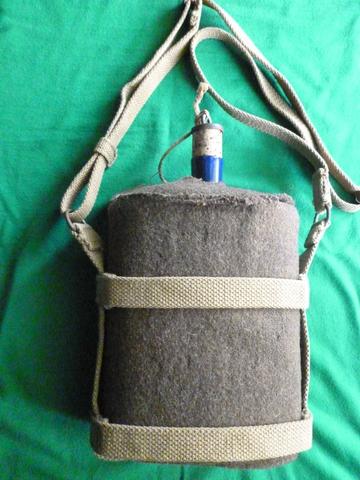
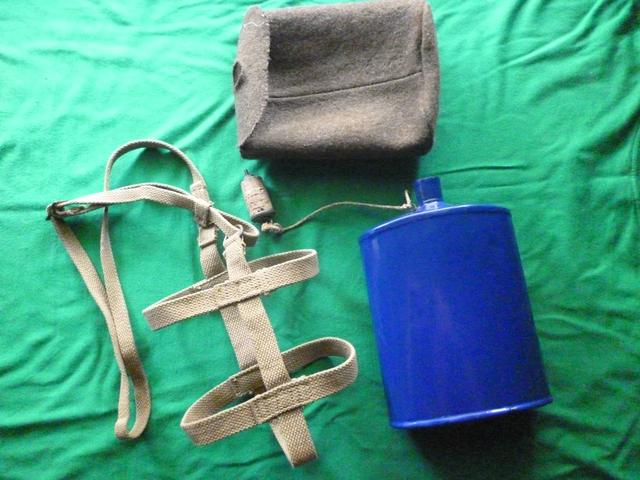
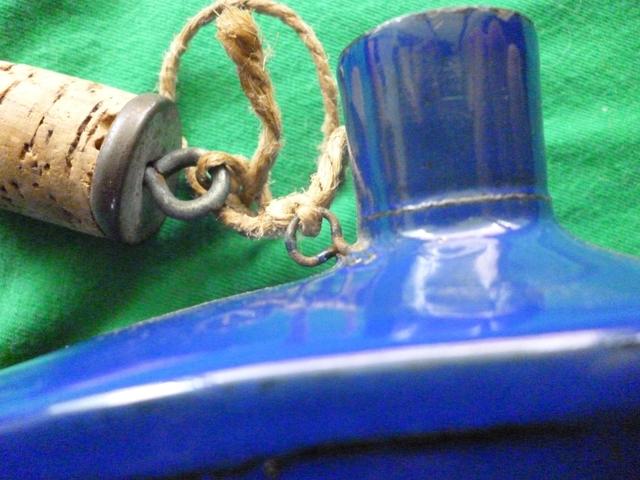
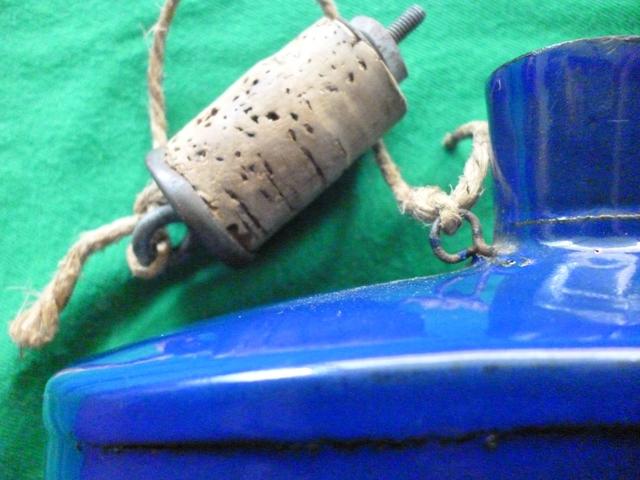
First off its not a WW2 water bottle. Not quite. It is a Mk VI water bottle which was introduced in 1903 as part of the Bandolier Equipment, Pattern 1903 but better associated with the Pattern 1908 Web Equipment. That said it could have been manufactured anywhere between 1903 and 1939 when the green enameled Mk VII water bottle was introduced. My Mk VI is blue enameled iron and the top and bottom are pressed (and welded?) onto the kidney shaped body, which is made like a tin can with a welded seam on one side. The spout is welded to the top plate and has parallel sides which was a return to the Mk IV bottle spout from the funnel shape of the Mk V spout. It has a eye hook welded next to the spout to fasten the cork string to the bottle in the fashion of the Mk VII water bottle, most likely this being a post 1939 modification. Previously the string was attached to the cover. The cover was originally thick lighter khaki felt but was changed to a thinner darker drab one. There are no stamps/marks and it is enameled inside and out.
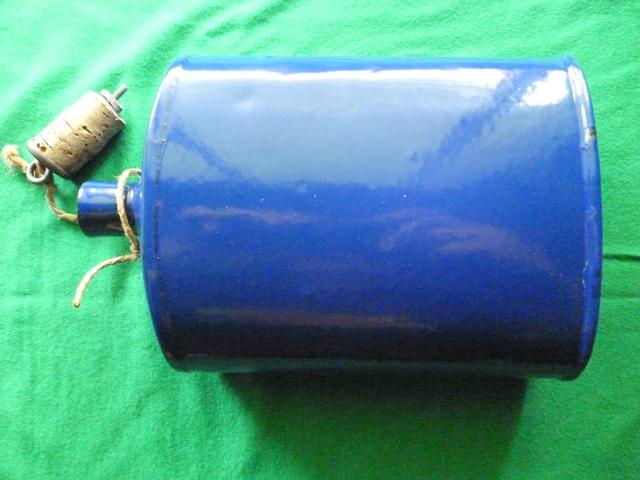
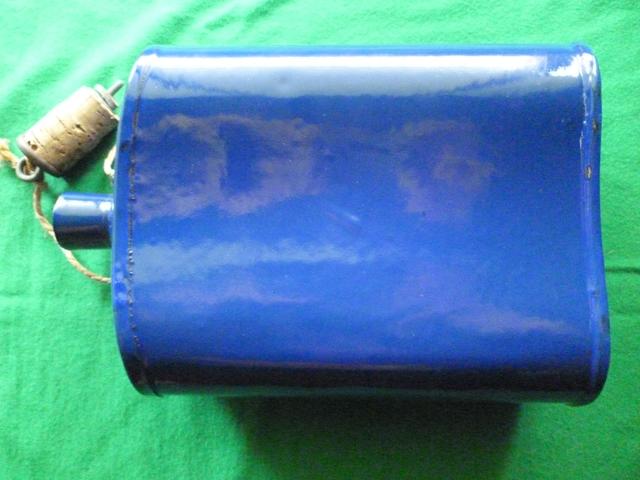
The stopper is a cork with a eye bolt through the center and a dished oval fastener with two washers at each end, the one on the inside of the bottle being galvanized. Its attached to the bottle by a short string.
The 'skeleton' carrier is interesting. It is a 'Water Bottle Carrier, Other Services' which was originally made in leather as part of the Pattern 1903 Bandolier Equipment. The web version is sometimes misidentified as the 'Water Bottle Carrier, Home Guard' which was the updated nomenclature for the leather carriers which were still available/being made and issued to the British Home Guard and others. The web version was first made by the British Mills Equipment Company in 1943. My carrier is marked M.E.Co 1943 ^ (arrow) on the inside of the bottom strap.
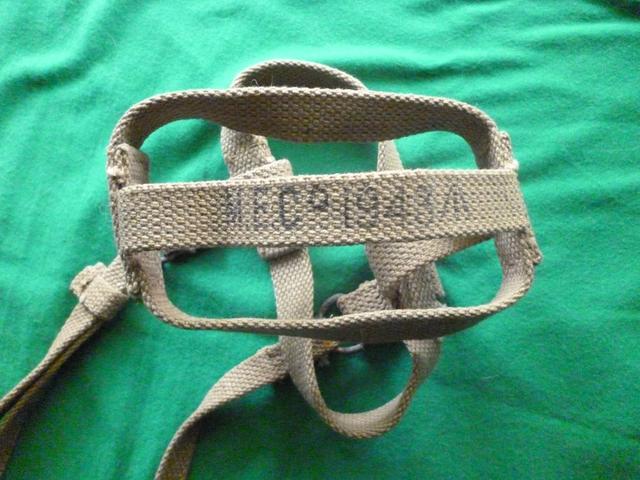
Apparently these carriers were issued to units in WW2 not requiring the Pattern 1937 webbing which has buckles to attach the carrier to the web belt. These carriers were used by drivers and other support troops as imho they were probably more comfortable and suitable; and kept Pattern 1937 webbing available for combat troops especially infantry.
Australian Pattern ('Pattern 15')
I found a reference to an Australian soldier using the Australian Pattern (sometimes known as 'Pattern 1915') leather carrier who was part of a transport company in WW2. The WW2 Australian troops went to war first equipped with old 'Pattern 15' equipment in leather until they started to receive/manufacture their own Pattern 1937 webbing.
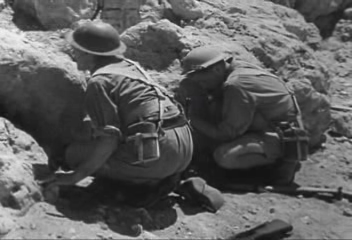
Here are Australian troops at Tobruk in 1941 with Australian Pattern carriers:
Never thought there would be so much to learn about a water bottle and its carrier. For all things 'British webbing' this is the site:
http://www.karkeeweb.com/
After quite a bit of online searching; and for the sake of 'knowing', I decided to sacrifice
the cover on my newly purchased WW2 water bottle.
First off its not a WW2 water bottle. Not quite. It is a Mk VI water bottle which was introduced in 1903 as part of the Bandolier Equipment, Pattern 1903 but better associated with the Pattern 1908 Web Equipment. That said it could have been manufactured anywhere between 1903 and 1939 when the green enameled Mk VII water bottle was introduced. My Mk VI is blue enameled iron and the top and bottom are pressed (and welded?) onto the kidney shaped body, which is made like a tin can with a welded seam on one side. The spout is welded to the top plate and has parallel sides which was a return to the Mk IV bottle spout from the funnel shape of the Mk V spout. It has a eye hook welded next to the spout to fasten the cork string to the bottle in the fashion of the Mk VII water bottle, most likely this being a post 1939 modification. Previously the string was attached to the cover. The cover was originally thick lighter khaki felt but was changed to a thinner darker drab one. There are no stamps/marks and it is enameled inside and out.
The stopper is a cork with a eye bolt through the center and a dished oval fastener with two washers at each end, the one on the inside of the bottle being galvanized. Its attached to the bottle by a short string.
The 'skeleton' carrier is interesting. It is a 'Water Bottle Carrier, Other Services' which was originally made in leather as part of the Pattern 1903 Bandolier Equipment. The web version is sometimes misidentified as the 'Water Bottle Carrier, Home Guard' which was the updated nomenclature for the leather carriers which were still available/being made and issued to the British Home Guard and others. The web version was first made by the British Mills Equipment Company in 1943. My carrier is marked M.E.Co 1943 ^ (arrow) on the inside of the bottom strap.
Apparently these carriers were issued to units in WW2 not requiring the Pattern 1937 webbing which has buckles to attach the carrier to the web belt. These carriers were used by drivers and other support troops as imho they were probably more comfortable and suitable; and kept Pattern 1937 webbing available for combat troops especially infantry.
Australian Pattern ('Pattern 15')
I found a reference to an Australian soldier using the Australian Pattern (sometimes known as 'Pattern 1915') leather carrier who was part of a transport company in WW2. The WW2 Australian troops went to war first equipped with old 'Pattern 15' equipment in leather until they started to receive/manufacture their own Pattern 1937 webbing.
Here are Australian troops at Tobruk in 1941 with Australian Pattern carriers:
Never thought there would be so much to learn about a water bottle and its carrier. For all things 'British webbing' this is the site:
http://www.karkeeweb.com/






















