












































Ran this test on new loads.

Longshot

CGN Ultra frequent flyer
Rating - 100%
55   0   0
Location
Complete Denial
I ran this test on some new loads/bullets I was trying. Not sure what this test is called but I saw it on accurate shooter and figured I'd give it a try.
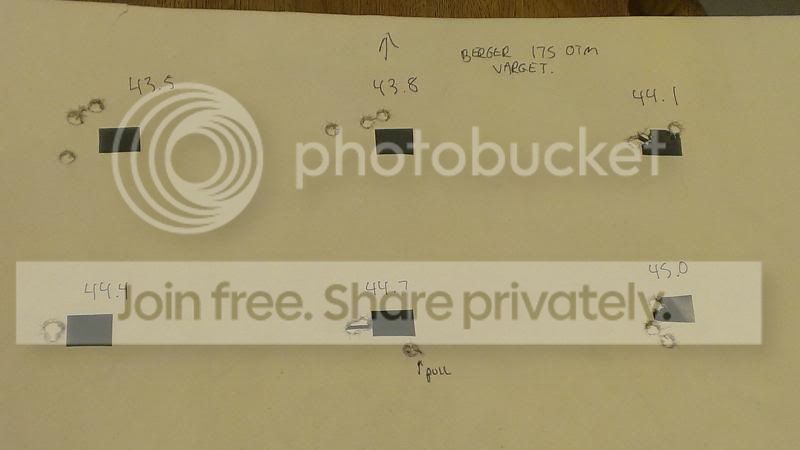
175otmloadtest.jpg

The theory is that the groups size matters little( although it's nice if they are small) but instead the position of the groups are all important.
As you can see the 44.1,44.4 and 44.7(other than the one I pulled) groups seem to clock in the same position in regards to the target dot. Apparently that indicates the node that you should be looking at. Once you see that node then you may either narrow down the powder charges OR change seating depth until you get a group that you like. All shots are 3 rd groups and they are all shot off the bench at 100m/y. Generally speaking 1/2 grain increments are used but I already knew basically where my node was so I elected to go with .3 grain increments.
Thought some of the new precision rifle reloaders might be interested. Very easy test to conduct and uses minimal resources.
As a side note my load for 175 matchkings was 44.8/varget so this is right in the ballpark.
 
Last edited:
You have a nice range between 44.1 and 44.7 gr. The Point of impact is very similar and you are getting nice groups, suggesting it is potentially pressure insensitive. I would try another series at 44.0 to test seating depth to tighten it up further.
 
I'm limited by mag length as this is out of a tactical rifle so I think im going to do a little more at 44.4 and see if its repeatable and if it does that same thing with more rds in the group I'll just leave it.
 
Don't get me wrong, your groups are very good.

I notice a bit of dispersion and vertical stringing. If that were my rifle and loads, I would use the 44.4 load but seat the bullets closer to the lands, if your magazine will accept the extra length.

The vertical is usually caused because not enough cooling time was allowed between groups. Or, your front receiver screw needs to be retorqued a bit tighter.

If that rifle and load are intended for hunting purposes, it is a really good idea to shoot all groups from a stone cold barrel. Takes a lot more time but it is well worth it in the field and can be the difference between a good shot and a wounding shot.

By shooting from a stone cold barrel, you will know where your first bullet will go on a hunt.

One of the biggest mistakes new shooters make is to go on a hunt with a freshly cleaned bore. That first shot can often be as far as 6 inches from point of aim. Some lucky shooters have rifles that will shoot to POA clean or fouled. Most don't.
 
interesting
I have been using a ladder test the last few time. find it great to a node and max load all in the same test
 
OCW Test (Optimal Charge Weight)

Gives you the window of charge weight that will group in the same place making for easy, sloppy loading if you so desire. LOL
 
Well I wasn't going for good groups but thanks! lol. This is a match rifle and although I do use it for hunting if I'm in the right terrain I have a completely different load. You are correct in that I fired all of these within 45 minutes without waiting for cooling etc. Long strings in the type of matches I shoot don't really allow for cooling anyways.
 
OCW Test (Optimal Charge Weight)

Gives you the window of charge weight that will group in the same place making for easy, sloppy loading if you so desire. LOL

Lol well the bulls I shoot at are much bigger than yours....however sometimes they are moving or only there for a few seconds. ;)

Why do you say sloppy?
 
Last edited:

Last edited:

With regards to your groups printing in the same location on the target...In short range BR, a proper seating depth is found when the groups form in the same location on the target regardless of powder weight (all other factors being equal). Powder charge is then tweaked to find where the groups are smallest looking for round groups; no horizontal or vertical stringing. When the groups are at their smallest and don't change in size whether you go up several tenths or down several tenths in powder charge (tune window), you know you've found the OCW or rifle's tune for the current conditions. Some guys will shoot at a higher tune node then others. Depends on the barrel IMO. The trick is maintaining that tune throughout the day as the temp and humidity changes. That's why rounds are loaded between each target (usually) and not preloaded for the entire match. The larger your tune window the better, for reasons stated above (sloppy loading) or ones inability to recognize when a rifle is losing its tune soon enough, like me. Once a seating depth is found, it is rarely changed unless powder type or bullet type is changed or a re-barrel. This is my understanding of the theory anyway and how I approach it. I've been much more successful since I've adopted this method.
 
I read that article too. He says to shoots the groups at 200 yards, but I don't see why 100 yds wouldn't work as well.

The tighter your rifle groups, the harder it is to interpret the results on paper. Shooting at 200 yards open things up a little allowing for clearer feedback from your groups. The further you shoot, the more obvious it is when there is a problem with the load. IMHO.
 
The tighter your rifle groups, the harder it is to interpret the results on paper. Shooting at 200 yards open things up a little allowing for clearer feedback from your groups. The further you shoot, the more obvious it is when there is a problem with the load. IMHO.

This is the reason I do my load development at 300m, not that my shooting or loads are BR quality, its just easier to see.
 
Lol! That's the webpage of the guy who created OCW. He has a forum too where you can post your results and he will help you interpret them:

http://practicalrifler.fr.yuku.com/forums/4

Here is the OCW test for the 6mm Crusader load I ran at NSCC PR this year:


There are usually many more groups when developping a brand new load. This was just fine tuning for a new lots of components.
 
Back
Top Bottom




















