












































Pressure Signs under max load

BeagleBoy360

CGN Regular
Rating - 100%
65   0   0
Location
London, ON
So I got a new rifle, and was doing some test loads with it.

I went to the Hodgon loading center, and looked at the 175 and the 180gr A-max, both had a max of 45gr (C) and the minimums were 42 and 41 respectively. So i figured the 178 would have the same max load.

I went with 44gr after reading tons of people going with 45 to 46.5 and having good results, I know Hodgon would probably set their max a bit low for legal reasons.

So I assumed 44gr would be fine, upon loading and shooting. I found the primers were getting pretty flat (Winchester Large Rifle), and the bolt lift on my rifle seemed to me a tinyyy bit stiff. Is it normal for pressure signs under the max load like this, as well is it fine to shoot until excessive signs.

I looked at the base of the rifle to see if it had any extractor marks, or any signs like that, and there was none of any cases. So the only signs were flat primers and stiff bolt.

Did some measurements, the brass at the
neck is 0.01inch larger
shoulder is 0.001 larger
Base us 0.003 larger
than fully resized brass.

What are your thoughts, it shot very well, but should I bring down the charge a bit.
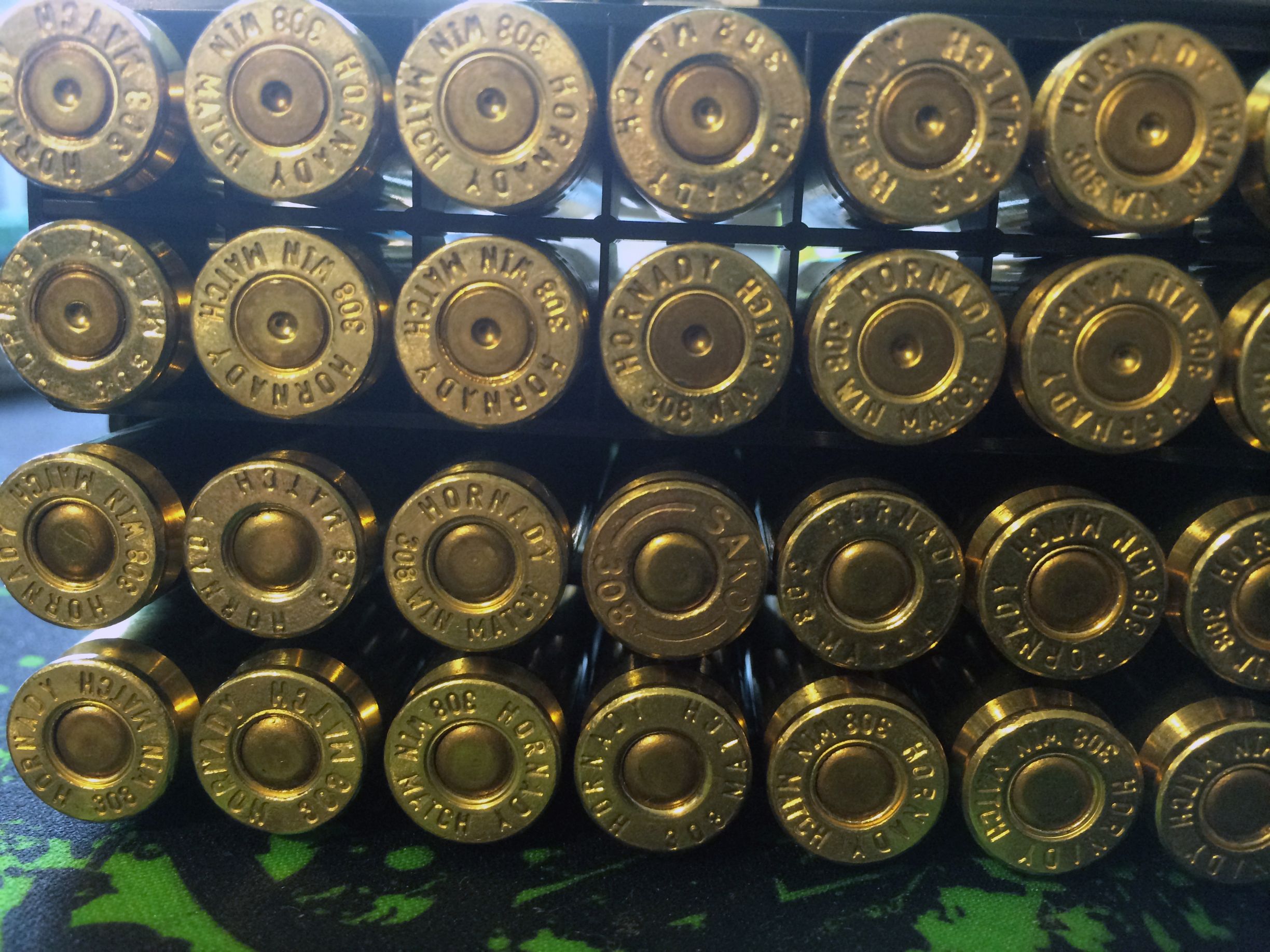
5OBcMD6.jpg
 
First thought is why the hell did you use a close to max load as a starter? The loads should be worked UP, not down.
Each rifle is different, so every new one is a work in progress when it comes to reloading.

The dimensions you give are insignificant as you don't post the chamber actual dimensions. The only not-so-accurate way to measure case head expansion id with a micrometer and measures in 0.000X". But today we know this is inacurate as the brass reacts differently with hardness and even with pressure level.

Anyhow, what I see seems to be primers hammered back by the case expansion. I guess your brass is new, never fire formed, right?
Even there, you need at least onced fired brass to be able to measure case head expansion. You can't do it with brand new brass.

Sorry if it sounds like I knock on you.
 
Like Baribal says, you need to work up the load, not just pick one. Every rifle is different and what shoots well out of mine won't necessarily out of yours. The 2 grains won't matter.
Hodgdon doesn't set anything low for legal reasons either. That's why there's a disclaimer.
 
The brass is 1F, but has been fully resized, as well as used a pocket swagger to get rid of the crimp.

I started off at 44 due to the fact I have friends shooting well above 44gr in their rifles, as well as the wealth of load data online and people saying they get the best results above 44gr, so i had planned to do a ladder test at 44 grs and going up in .1gr increments.

It may be due to the pocket swagger, and its not holding the primer tight enough.
 
Well, as I said, every rifle is different and if you follow what others do, one day you may face a pretty nasty situation.

Then, if your brass was once fired, it's either you resized too small or the primers were loose in the pocket. But you "should" have feel it when priming.
I'm personally always quite concerned about loose primers, as it's one of the first sign of overpressure, and I really doubt your swager can swage wide enough to get the primer loose.
When you resize, make sure you don't go over about 0.004" of the first round that fitted your rifle. I mean, when you resize, you screw the die 1/4 of a turn until the case freely chambers the rifle, then, you back 1/8 of a turn to make sure you did not reach too far. Then, with your comparator, you screw the die until you get a 0.004" clearance of the brass vs the chamber.
 
I had similar results (flattened primers, not sticky bolt) when I over-sized my brass in my .223. I backed off the sizing die ever so slightly, and now the brass has slight resistance when closing the bolt (ie: zero headspace), and no more flattened primers with the same load.

In my opinion, it might NOT be overpressure - just brass sized down too small, which can cause slightly flattened primers like you're seeing.
 
/\/\

Been meaning to ask about that as I've seen something similar happen with .223 brass I've reloaded for my AR. I noticed 1 or two primers out of 10 of the same charge had flattened primers where as the rest did not. Figured this was not due to excessive pressure but a loose primer pocket perhaps. I'll try backing off the resizing die a bit.
 
I don't know if anybody noticed but I think he is using Military once fired brass. He said he had to remove the crimp at the primer pocket.
 
^^True, I had some .223 that had crimped primers.

Anyhow, it was quite silly to just pick a load anywhere near max to start with. Too many variables at play. Start over, work up from a good starting load. If you have signs of "pressure" at a lower load, THEN it could be a brass or chamber issue..
 
You are being beaten up by the loading Nazis.

I don't see any pressure signs there at all. I see what is likely a batch of soft primers.

Winchester gets most of their stuff done by contractors now and IMHO, some of their stuff leaves a lot to be desired.

That is excellent brass by the way and the crimped primer pockets are intended for the high pressures encountered with some match loadings.

There should be a tinyyy bit of resistance on your bolt lift after a round is fired. It's the normal expansion of the case filling the chamber and coming up tight against the bolt face.

There are no bolt face marks on any of those cases.

The Amax bullets, like the SSTs have a lot of bearing surface in comparison to some other bullets. This will very slightly increase the length of the pressure curve as your powder burns.

Does the load shoot well???? If so, keep using it.

Next time you buy primers, look for CCI and if your rifle actually warrants match brass, it also warrants CCI Bench Rest primers.

You don't mention the powder you are using. It may be a bit fast for the relatively heavy bullet you are using as well. These days, with the unavailability of powder, beggars can't be choosers.

I also find Remington/Winchester primers to be inconsistent between lots.

By the way, if you are going to use brass of that quality, you should also learn how to re anneal it.

Lots of threads here that explain the procedure.
 
Well, maybe should you have carefuly read the whole posts before pressing the loading nazis button. Then who said there were pressure signs?
 
The brass is 1F, but has been fully resized, as well as used a pocket swagger to get rid of the crimp.

I started off at 44 due to the fact I have friends shooting well above 44gr in their rifles, as well as the wealth of load data online and people saying they get the best results above 44gr, so i had planned to do a ladder test at 44 grs and going up in .1gr increments.

It may be due to the pocket swagger, and its not holding the primer tight enough.

Once you have some more reloading experience under your belt you will find .1 increments for load development for rifle are indicative of pretty much nothing. Variances in everything from components to environment to the rifle/optics and the shooter make .1 increments in powder irrelevant to the average shooter shooting an average rifle. It will give you valuable trigger time though.:D .2 minimum will save you time for general load development.
 
So I got a new rifle, and was doing some test loads with it.

I went to the Hodgon loading center, and looked at the 175 and the 180gr A-max, both had a max of 45gr (C) and the minimums were 42 and 41 respectively. So i figured the 178 would have the same max load.

I went with 44gr after reading tons of people going with 45 to 46.5 and having good results, I know Hodgon would probably set their max a bit low for legal reasons.

So I assumed 44gr would be fine, upon loading and shooting. I found the primers were getting pretty flat (Winchester Large Rifle), and the bolt lift on my rifle seemed to me a tinyyy bit stiff. Is it normal for pressure signs under the max load like this, as well is it fine to shoot until excessive signs.

I looked at the base of the rifle to see if it had any extractor marks, or any signs like that, and there was none of any cases. So the only signs were flat primers and stiff bolt.

Did some measurements, the brass at the
neck is 0.01inch larger
shoulder is 0.001 larger
Base us 0.003 larger
than fully resized brass.

What are your thoughts, it shot very well, but should I bring down the charge a bit.

5OBcMD6.jpg

I have a question here. Is that random Sako 308 case there for a reason?

I have had some trouble with case capacity differences and some brands have a drastically different reaction to the same powder load and bullet. Ie federal and mil brass take almost a full grain less of powder to achieve the same velocity of hornady, norma, and remington brass in my rifle. It may be beneficial to do ladder tests with all components.

also on a side note all the hornady brass I have also had a crimp in it, but is still excellent brass otherwise. I have something like 300 pieces of federal brass now and I encountered 19 which have crimps for some reason unknown to me.

thankfully ammosmith.com was a huge help for me with straight answers to direct questions I had.
 
Because of variance in chambers and barrels (and brass , powder and primers) what is Max in the loading manual rifle might be medium or over max in your rifle.

This is where a chronograph comes in handy. If they got 2875 fps with Varget at Max, then start low, work up, and be prepared to stop at 2875 fps. This may take more or less powder than what they used. Velocity is a good indicator of pressure, if the correct powder is used.

The brass you show does not look like it was a hot load. Are your bolt locking lugs lubed? Lack of lube can cause harder bolt lift.
 
Last edited:
If you took the time to work up a load you would have felt the
harder bolt lift coming on before you felt the need to ask the question here.
Most loading manuals will give a warning about loading up to a rifles maximum and like
some others have already stated what is maximum in each rifle can be very different.
Consider yourself lucky that in this case a sticky bolt and flattened primers are
all you have to show for your efforts. You are not exersizing safe loading practices.
I have a friend that did exactly what you did, he broke his bolt handle trying to
open his bolt on the first shot, lesson learned.
BB
 
Hornady manual max load is 43.2.
Lyman manual max load is 44.0.

As far as I can tell, the Hodgdon reloading site does not have data for the Hornady 178gr BTHP/Amax.
 
Unfortunately, far too many people assume that any load, listed in any manual, will be safe in any firearm. These people seem to skip right over the disclaimers about working up loads while watching for pressure signs.
 
Back
Top Bottom





















