












































44 Magnum question? Update

Skinny 1950

CGN Ultra frequent flyer
EE Expired
Rating - 100%
42   0   0
Location
Vancouver
I took a single action six shooter chambered for 44 Magnum to the range on the weekend and fired 20 rounds. I loaded 5 rounds and rested the hammer on an empty chamber, after shooting the 5 rounds I noticed that one case had a flattened primer and an imprint of the firing pin retainer ring.
The picture shows live rounds on the left and empty cases on the right, it seems that one chamber is causing this flattening which can be seen on some of the cases.
I am wondering if this is a serious problem with the head-spacing on one of the chambers or is something else causing this?
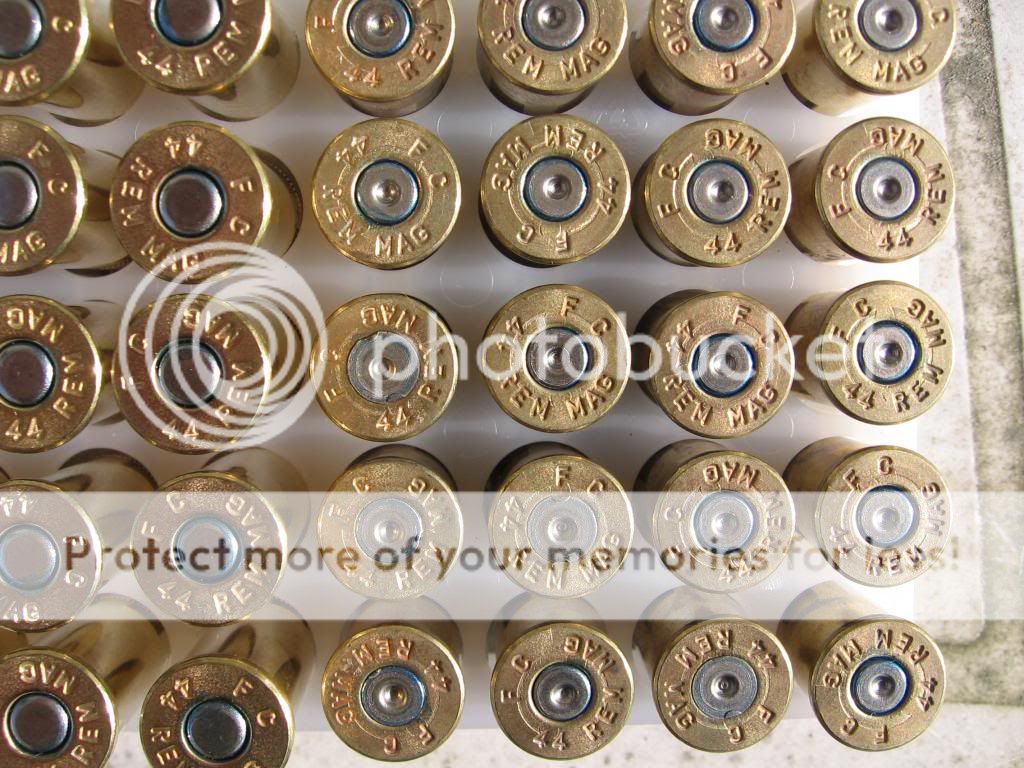
 
Last edited:
The headspacing if based on the rim sitting in the cylinder. But regardless of any issues head spacing won't mushroom the primers like that. Only ONE thing will do that. The rounds with the distorted primers were over charged. Pressure in the mushroomed primer casings was almost certainly much higher than SAMMI spec. Nothing else will make the primers flow and form like that.

I don't know where you get your loads but it's time to talk to the loader. Something very bad happened there and it happened far too often. It would likely not be an actual double charge. But depending on how you're measuring the powder and how close you were to the max load it might be a case of you jiggled the measure to settle the powder and put more in to top the measure off and that resulted on going a few grains over the max load data.

Or if those loads, and I'm assuming they are someone's reloads, came from someone other than you I would not be in a hurry to get them to make more for you.
 
I'm guessing those are factory rounds, judging by the blue (glue?) that Federal likes to use. Not that they couldn't be hand loads. If they are factory, set aside the box(s) and maybe try some other ammo. If it continues to happen, you could have a firearm problemand find a smith. If not, then there could have been a bad lot out of the factory. Contact Federal. This happened to me and some 130gr 270 Winchesters some years back. Blowing out primers, horrible accuracy. I was reimbursed for 2 boxes. Good luck, be safe.
 
These are factory "American Eagle" (Federal) 240 gr jacketed hollow point .44 Rem. Magnum, I didn't notice any difference in recoil or sound from round to round and the cases were easy to remove from the chambers.
This is my first experience with the .44 Mag revolver and was wondering if 44 Rem mag is any different than other .44 Mag rounds?
 
These are factory "American Eagle" (Federal) 240 gr jacketed hollow point .44 Rem. Magnum, I didn't notice any difference in recoil or sound from round to round and the cases were easy to remove from the chambers.
This is my first experience with the .44 Mag revolver and was wondering if 44 Rem mag is any different than other .44 Mag rounds?

I'm not going to paint the American Eagle brand with any kind of wide brush.
However, I had a bad box of .45 LC AE rounds. It happened to be my first rounds through my .460V. I didn't have any overpressure rounds but I had several stick in the barrel.
I was worried that there was something wrong with the gun. I took the box back as suggested by one of the RSO's at my club. Sure enough, no problems with the next box.
I would try another box. If you do isolate one chamber as the culprit, that's another matter and should be taken to a gunsmith. (or measured by you if you have tools)
I'm happy that mine were underpressure and not over. That's surprising.
 
If we were in the US more than one of us would be suggesting that the box with empties be returned to Federal for replacement. Clearly they screwed up.

I've reloaded heavy loads for my .44Mag and some for a .500S&W Encore. I expect the primers to "square up" from the pressure. But I have NEVER seen any signs of the sort of flow that you got on some of the worst cases. To pressure form the primer cups like you've got pretty much means that the pressure has passed through the normal ceiling for .44Mag and reached into the 50K to 60K rifle pressure range. And that isn't good for the gun.

I would not shoot the rest of the box if I were you. I'd return it to the store and see what they say. I don't know if they have any way of moving this stuff to Federal for inspection or not.

Or if you prefer I'd suggest you break down the remaining rounds and weigh the charge in each casing. I'm betting that you'll find a wide variation between them. You'll need a bullet puller for this of course.

But either way I would not shoot the rest of that box. Rugers are tough guns. But this ammo looks to be tougher. At least I HOPE it was a Ruger because otherwise you're straining the frame and cylinder on anything lesser.

It's interesting that it's AE ammo. I had much the same thing occur with some AE. But in my case it was a brick of .22LR. The powder charges were very inconsistent. It was so bad I could not shoot the stuff through a semi auto. I had to finish it off with my revolver. Even then some came out like WMR rounds while others forced me to check the bore because they were so weak I was sure that they'd stuck in the barrel. I have not bought any AE rimfire ammo since. And this thread is making me happy that I load all my own center fire since they obviously have managed the same thing in .44Mag.
 
Federal brass is known for being soft, but their QC is usually good. Even with their lower end AE brand name. However, I see 4 or 5 rounds that came back hard enough to be imprinted by the frame. I'd be inclined to contact Federal and ask 'em about it.
http://www.federalpremium.com/company/contact_us.aspx
What brand is the revolver? Isn't likely to be a headspace issue considering only 4 rounds have any issues.
 
As B.C.Rider says "don't shoot anymore from that box".
I don't buy much factory ammo as a rule but will if I'm taking a newby out for their first time.Only I shoot my reloads.
I bought a box of Federal 240 gr. jacketed soft-points last fall that jammed my S&W mod.29 twice on the first 12 shots.The reason was they weren't crimped enough and the recoil forced the bullet out the front of the cylinder.You can't pull the trigger and you can't open up the crane.Needless to say,it would be ####ty ammo to be betting your life on. A soft tap with a 1/2 a glue stick and my plastic hammer cleared the gun twice soI took the rest of that ammo home, popped out the bullets,dumped the powder and used my favorite powder formula and a crimp I would bet my life on.
 
.44 Rem Mag is the same as .44 Mag to answer your question OP. I'm also not convinced the ammo was hot. If you're used to shooting .44 Mag you would definitely notice a hot round vs a normal load.
I'll bet it's something with the machining on the cylinder. Load the cylinder full with the spent casings that look "normal" and eyeball whether one is hanging back farther than the rest. If it can't be seen with the eye, 2 cylinders worth of live ammo will tell you (shoot it at the range, yes!?).
On the first cylinder load, mark the chamber which leaves the primer looking like that. Shoot another cylinder load and verify if it happens again on the same chamber.
 
i would send that picture to federal and not shoot the rest of it even though nothing will likely happen.

get another box and remember which rounds come out of which cylinder after firing. if you still have 1 rounds that has a more flattened primer vs the others then you may have a tighter cylinder.
 
Even if there's a slight burr that is holding one cartridge proud of the back face it won't produce primers that look like this. Only serious over pressure can do that.

Checking the throats as tjsudbury suggests is very much worth doing. You can do this with one of the loaded cartridges. Remove the cylinder from the frame and using a loaded cartridge try to fit the bullet nose into the chamber throats from the front of the cylinder. The throats SHOULD be sized to around .430 to .432 so the bullet should fit all the way in and let the mouth of the casing rest against the face of the cylinder without any force being needed.

If you can't fit the bullet in like this on one or more chambers and depending on the size I can see where it would cause the pressure to spike up and the result could well be the primers showing the signs of serious pressure. But it would need to be seriously undersized for this to produce the sort of pressure signs we're seeing.

If it turns out that one or more of the throats is small then do not shoot the gun any more until you get it fixed. Or if you really MUST then at least stuff something into the chambers with the tight throats and don't use them. But that's purely a stop gap solution to let you show off the gun to someone or to finish up the ammo. But if the ammo shows primers like those again then stop right there. Because in that case you've got TWO issues.
 
I took the cylinder out and carefully checked it out. The live rounds all fit in the chambers very slightly proud of the rear of the cylinder, the chamber throats are all the same diameter which according to my calipers is .435, the bullet end of the live round will go all the way in the front of the chambers with room to spare.
I am really hoping the problem isn't oversize throats causing the casing to be blown back instead of swelling in the chambers.
 
Note to self: No Federal soft point .44 magnum ammo through my revolvers. Whether it was an anomaly or not, I don't care. Factory rounds are so bloody expensive why chance it?

As B.C.Rider says "don't shoot anymore from that box".
I don't buy much factory ammo as a rule but will if I'm taking a newby out for their first time.Only I shoot my reloads.
I bought a box of Federal 240 gr. jacketed soft-points last fall that jammed my S&W mod.29 twice on the first 12 shots.The reason was they weren't crimped enough and the recoil forced the bullet out the front of the cylinder.You can't pull the trigger and you can't open up the crane.Needless to say,it would be ####ty ammo to be betting your life on. A soft tap with a 1/2 a glue stick and my plastic hammer cleared the gun twice soI took the rest of that ammo home, popped out the bullets,dumped the powder and used my favorite powder formula and a crimp I would bet my life on.
 
Another thing to consider is 'are the cases oily?'
Cases reply on the friction generated by expansion on firing 'between the case and the chamber walls' to help grip it and hold it in place.
Even oily chamber walls might allow the case to exert much higher pressures on the face of the cartridge.
A pretty good article or two in 'Reloading' on this phenomenon
http://www.canadiangunnutz.com/forum/forumdisplay.php/79-Reloading/page2
Perhaps you oiled up your new acquisition before range time?
 
Identify which chamber is causing the flattened primer... if you can. If it is the same chamber each time, that chamber is the problem. If it appears to move around or be different chambers it is probably the ammo.

Primers can flatten out and appear to be high pressure if the pressures are normal and there is slight head clearance on the cartridge and/or slight head space in the firearm... this can occur if the primer pops back when ignited and the case pushes back when the pressure rises. This all happens in a millisecond. I have seen it fairly often with higher pressure center fire rifles cartridges.
 
Did you notice any unusual level of recoil or muzzle flash from shot to shot?

Have you tried running the cases through a de-capper/resizing die to see if the primer hole is larger or if the cases appeared unusual?
 
Back
Top Bottom






















